
Facing questions about a criminal record can feel overwhelming for many in Catawba, Burke, or Caldwell counties. Whether you need clear answers for your own legal defense or family law concerns, understanding what truly counts as a criminal record matters. Beyond serious convictions, these records can include arrests, charges, and even cases that were dismissed or acquitted. This guide breaks down common myths and highlights the facts, helping you see where you stand and what steps may be available.
Table of Contents
- Criminal Record Defined: Facts And Common Myths
- Types Of Records: Arrests, Convictions, And Outcomes
- Contents And Access: What’s In Your Record And Who Can View It
- North Carolina Laws And Expungement Eligibility
- Real-World Effects On Employment, Housing, And Rights
- Steps To Correct, Seal, Or Expunge Your Record
Key Takeaways
| Point | Details |
|---|---|
| Understanding Criminal Records | Criminal records encompass a variety of legal interactions, not just convictions, impacting personal and professional lives significantly. |
| Common Myths | Many believe only serious offenses result in a criminal record, but this is a misunderstanding; even minor infractions can lead to records affecting various opportunities. |
| Expungement Importance | Expungement can be crucial for those with criminal records, providing a path to potentially clear or seal records, but requires understanding specific eligibility criteria. |
| Consequences on Life | Criminal records can create substantial barriers in employment, housing, and civil rights, necessitating proactive measures from individuals to navigate these challenges. |
Criminal record defined: Facts and common myths
A criminal record is a comprehensive documentation of an individual’s interactions with the criminal justice system, extending far beyond common public perception. State legislatures are actively evaluating policies to understand and mitigate the long-term consequences of these records on personal and professional opportunities.
Contrary to popular belief, criminal records are not simply a list of convictions. They can include a wide range of legal interactions, such as:
- Arrest records
- Criminal charges
- Actual convictions
- Dismissed cases
- Acquittals
- Pending legal proceedings
Statistics reveal a startling reality about criminal records in the United States. Approximately 1 in 3 adults have some form of criminal record, which can create significant barriers in multiple life domains including employment, housing, education, and professional licensing.
Most people misunderstand the comprehensive nature of criminal records. While many assume a record only includes serious criminal convictions, the reality is more nuanced. Criminal records can encompass minor infractions, traffic violations, and even instances where charges were ultimately dropped. The impact of these records can persist long after the initial legal interaction, potentially affecting background checks, job applications, and personal opportunities.
Common Myths About Criminal Records:
- Myth: Only serious criminals have criminal records
- Myth: Criminal records automatically disappear after a certain time
- Myth: All criminal records are publicly accessible
- Myth: A single record means permanent disqualification from opportunities
The complexity of criminal records underscores the importance of understanding their scope, potential implications, and available legal remedies. Each record is unique, influenced by specific circumstances, jurisdictional variations, and individual legal history.
Pro tip: If you have a criminal record, consider consulting a local attorney who specializes in record expungement or sealing to understand your specific options and potential pathways for mitigation.
Types of records: Arrests, convictions, and outcomes
Criminal records are complex legal documents that capture an individual’s interactions with the justice system. Criminal records in the U.S. include various levels of documentation maintained by local, state, and federal law enforcement agencies, each with unique implications for an individual’s personal and professional life.
The primary types of criminal records can be categorized into several distinct classifications:
- Arrest Records: Documentation of initial law enforcement contact
- Charging Records: Formal accusations of criminal activity
- Conviction Records: Official legal findings of guilt
- Non-Conviction Records: Cases resulting in dismissal or acquittal
- Pending Case Records: Ongoing legal proceedings
An arrest record represents the initial point of legal interaction, documenting when law enforcement takes an individual into custody. This does not necessarily indicate guilt, but remains a permanent part of an individual’s legal documentation. These records can include details about the nature of the arrest, charges considered, and subsequent legal actions.

Conviction records represent the most serious category of criminal documentation. When a court finds an individual guilty of a specific offense, this determination becomes a permanent part of their legal history. Criminal records encompass a range of documents that can significantly impact future opportunities, including employment, housing, and professional licensing.
Nuanced Record Categories:
- Felony Convictions: Most serious criminal offenses
- Misdemeanor Convictions: Less serious criminal offenses
- Infractions: Minor legal violations
- Sealed or Expunged Records: Legally hidden from public view
Understanding the distinctions between these record types is crucial. Not all records carry equal weight, and some may be eligible for sealing or expungement depending on specific legal circumstances and jurisdictional regulations.
Here’s a quick comparison of criminal record types and their potential impact:
| Record Type | Typical Contents | Impact on Life | Eligibility for Expungement |
|---|---|---|---|
| Arrest Record | Police reports, charges filed | May affect background checks | Sometimes eligible, varies |
| Conviction Record | Court verdict, sentencing | Job and housing restrictions | Depends on seriousness |
| Non-Conviction | Dismissals, acquittals | Limited effect, persists | Often eligible |
| Pending Case | Ongoing legal proceedings | May delay opportunities | Not eligible until resolved |
| Infractions | Minor violations, fines | Minimal impact, can linger | Frequently eligible |
Pro tip: Consult with a local legal professional to understand the specific implications of your criminal record and potential strategies for mitigation or record sealing.
Contents and access: What’s in your record and who can view it
Criminal records contain a comprehensive compilation of an individual’s legal interactions with law enforcement and judicial systems. Criminal records consist of various official documents that capture critical details about an individual’s legal history and potential interactions with the justice system.
The typical contents of a criminal record may include:
- Arrest reports and documentation
- Formal criminal charges
- Court proceedings and case details
- Conviction information
- Sentencing records
- Probation and parole documentation
- Outstanding warrants
- Dismissals and acquittals
Access to criminal records is strictly regulated and varies depending on the type of record and the requesting party. Different entities have different levels of access, creating a complex landscape of information sharing and privacy protection.
Who Can Access Criminal Records:
- Law enforcement agencies
- Potential employers
- Government licensing boards
- Immigration authorities
- Background check services
- Certain educational institutions
International travel and employment often require criminal record verification, which means individuals might need to obtain official background checks or Identity History Summaries from local police departments or federal agencies like the FBI.
Not all criminal records are publicly accessible, and privacy laws protect individuals from unrestricted information sharing.
Individuals have specific rights regarding their criminal records, including the ability to request a copy, review its contents, and challenge any inaccurate information. Some records may be eligible for sealing or expungement, depending on the specific circumstances and jurisdictional regulations.
Pro tip: Request a copy of your criminal record periodically to ensure accuracy and understand exactly what information is being shared about your legal history.
North Carolina laws and expungement eligibility
Expungement represents a critical legal mechanism for individuals seeking to clear their criminal records in North Carolina. North Carolina General Statute provides specific guidelines for individuals hoping to remove certain criminal records from their permanent legal history.
Eligibility for expungement in North Carolina depends on several key factors:
- Age at the time of the offense
- Type of criminal charge
- Time elapsed since conviction
- Completion of sentencing requirements
- Absence of subsequent criminal convictions
North Carolina law distinguishes between different types of expungement, each with unique requirements. Misdemeanor convictions, felony charges, and juvenile records have distinct pathways for potential removal from an individual’s permanent record.
Key Expungement Categories:
- Dismissed charges
- Acquitted cases
- Non-violent misdemeanors
- First-time nonviolent felonies
- Juvenile record expungement
The expungement process requires meticulous documentation and typically involves filing a petition with the court, paying associated fees, and demonstrating compliance with specific legal criteria. Waiting periods can range from zero to ten years, depending on the nature of the original offense.
Expungement is not an automatic process and requires proactive legal intervention by the individual seeking record clearance.
Individuals must understand that expungement does not necessarily guarantee complete erasure of records from all systems. Some law enforcement and federal agencies may retain limited access to historical records even after successful expungement.
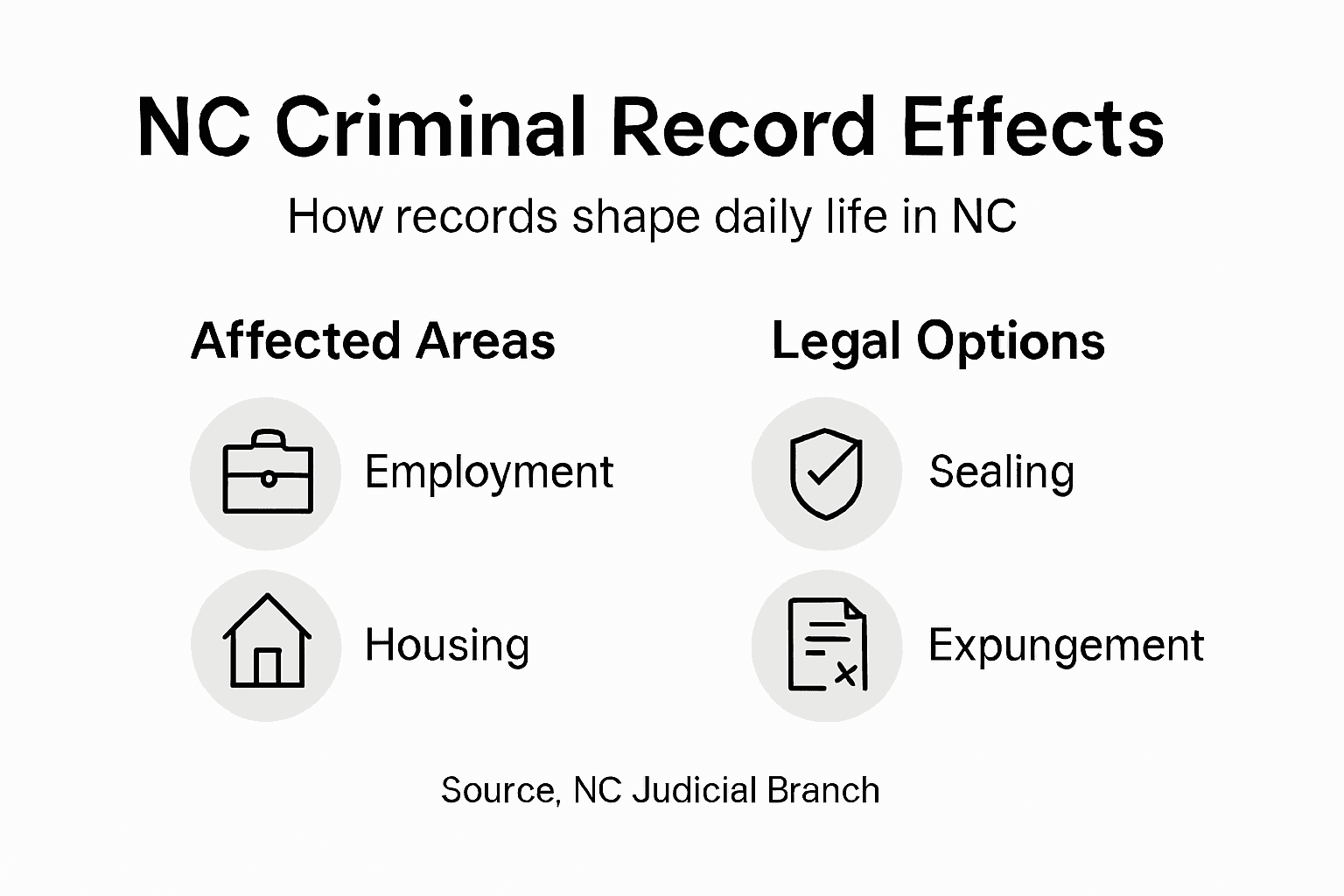
For North Carolina residents, here’s a summary of key expungement categories and main requirements:
| Expungement Category | Main Requirement | Typical Waiting Period | Who Can Apply |
|---|---|---|---|
| Dismissed Charges | Case dismissal | None or few months | Any defendant |
| Acquitted Cases | Not guilty verdict | None | Any defendant |
| Non-Violent Misdemeanors | No subsequent offenses | 1-2 years | First offenders |
| Nonviolent Felonies | No further convictions | 5-10 years | First-time offenders |
| Juvenile Records | Age under 18 at offense | 15-18 years old | Juveniles |
Pro tip: Consult with a local attorney specializing in criminal record expungement to navigate the complex legal requirements and improve your chances of successfully clearing your record.
Real-world effects on employment, housing, and rights
A criminal record can create profound and lasting challenges across multiple aspects of an individual’s life. Collateral consequences of criminal records extend far beyond the initial legal punishment, creating systemic barriers to personal and professional advancement.
Employment opportunities are significantly impacted by criminal records, with many challenges arising during background checks:
- Automatic disqualification from certain job positions
- Reduced hiring potential across multiple industries
- Limited access to professional licensing
- Increased difficulty obtaining professional certifications
- Potential wage discrimination
Housing Limitations present another critical challenge for individuals with criminal records. Many landlords and housing authorities conduct thorough background checks, which can result in:
- Automatic rejection of rental applications
- Higher security deposit requirements
- Restricted access to public housing
- Challenges in obtaining mortgage approvals
An estimated 70 to 100 million Americans face these systemic obstacles, creating a cycle of economic marginalization that extends beyond individual legal infractions.
Criminal records can create invisible barriers that persist long after formal legal consequences have been resolved.
Civil rights are also substantially affected, with potential restrictions on voting, jury service, firearm ownership, and professional memberships. These limitations can fundamentally alter an individual’s ability to fully participate in civic life and professional communities.
Pro tip: Document and prepare detailed explanations of your criminal history for potential employers and housing applications, focusing on personal growth and rehabilitation.
Steps to correct, seal, or expunge your record
Record correction is a complex legal process that requires careful navigation of North Carolina’s judicial system. North Carolina law provides specific procedures for individuals seeking to address and potentially remove criminal records that may be hindering their personal and professional opportunities.
The process of correcting or sealing a criminal record involves multiple critical steps:
- Obtaining a complete copy of your criminal record
- Identifying eligible charges for expungement
- Gathering necessary supporting documentation
- Preparing a comprehensive petition
- Filing the petition with the appropriate court
- Attending potential court hearings
Key Eligibility Criteria for record correction typically include:
- Time elapsed since the original offense
- Nature of the criminal charge
- Absence of subsequent criminal convictions
- Completion of all sentencing requirements
- Meeting specific statutory waiting periods
Expungement policies are expanding to improve second chances and reduce barriers in employment, housing, and social participation. This means more opportunities exist now than ever before for individuals to clear their records.
Not all criminal records are eligible for expungement, and the process requires meticulous attention to legal details.
The difference between sealing and expungement is crucial. Sealing restricts access to records but does not completely remove them, while expungement essentially erases the record as if the offense never occurred. Each approach has specific legal implications and requirements.
Pro tip: Consult with a local attorney specializing in criminal record expungement to ensure you follow the most up-to-date legal procedures and maximize your chances of success.
Take Control of Your Criminal Record with Expert North Carolina Legal Support
Facing the challenges of a criminal record in North Carolina can feel overwhelming. Whether you are concerned about expungement eligibility, sealing records, or the real impact on employment and housing opportunities King & Rowe is here to guide you through every step of the process. Our experienced team understands the complexities of North Carolina laws and is committed to helping you restore your future and protect your rights.

Do not let a criminal record limit your potential. Reach out today to consult with professionals who know the local courts and can tailor a strategy for your unique situation. Visit us at King & Rowe for personalized criminal defense assistance and learn how our legal services can help you move past your record. Your fresh start begins with informed action and trusted legal advocacy.
Frequently Asked Questions
What is a criminal record?
A criminal record is a comprehensive documentation of an individual’s interactions with the criminal justice system, including arrests, charges, convictions, and even instances where charges were dismissed or acquitted.
How can a criminal record affect employment opportunities?
A criminal record can lead to automatic disqualification from certain jobs, limit access to professional licenses, and reduce hiring potential across various industries, impacting long-term career prospects.
What steps can individuals take to expunge or seal their criminal records?
To expunge or seal a criminal record, individuals must obtain a copy of their record, identify eligible charges, gather supporting documentation, prepare a petition, and file it with the appropriate court. Legal assistance is advisable for best results.
Are all criminal records publicly accessible?
Not all criminal records are publicly accessible; access is regulated by law and may vary depending on the type of record and the requesting party, with specific privacy protections in place.
Contact King & Rowe Attorneys at Law
 Serving Hickory, NC and surrounding communities
 Phone: 828-466-3858
 Email: kingrowelaw@gmail.com
 Website: www.kingrowelaw.com
Recommended
- What Is a Felony? Impact on North Carolina Lives
- How Long Does a DUI Stay on Your Record in North Carolina? – Hickory Attorneys for Family Law, Criminal Defense, & Estate Planning | King & Rowe
- What Is the Difference Between a Dismissal and an Expungement in NC? – Hickory Attorneys for Family Law, Criminal Defense, & Estate Planning | King & Rowe
- Classes of Felonies in North Carolina: What Do They Mean for You? – Hickory Attorneys for Family Law, Criminal Defense, & Estate Planning | King & Rowe
- Anger Management Classes in North Carolina | Masteringanger.com®