Every criminal defense attorney has faced the challenge of preparing a case without fully grasping how the judge’s decisions may set the tone in a North Carolina courtroom. With judges serving as impartial arbiters and exercising significant judicial discretion that shapes rulings, evidence, and sentencing, their influence stretches far beyond calling balls and strikes. By understanding the role and philosophy of each judge, you can strengthen your advocacy and tailor strategies that better protect your client’s rights across Catawba, Burke, and Caldwell counties.
Table of Contents
- Defining The Judge’s Role In Criminal Cases
- Types Of Judicial Functions In North Carolina
- Judicial Discretion And Decision-Making Authority
- Ensuring Fairness And Due Process In Court
- Impact Of Judges On Defense Strategy And Outcomes
Key Takeaways
| Point | Details |
|---|---|
| Judicial Role | Judges in criminal cases act as active managers, ensuring legal integrity and fairness throughout the trial process. Understanding their discretion can shape a defense strategy effectively. |
| Court Divisions | North Carolina’s court system consists of three divisions, each with specific jurisdictions affecting the type of cases judges handle and the rules that apply. Knowing the correct division helps tailor defense strategies. |
| Judicial Discretion | Judges have significant but constrained discretion in decision-making, influencing outcomes in sentencing, evidence rulings, and motions. Recognizing where discretion plays a role can be crucial for managing a defense. |
| Impact on Strategy | A judge’s background significantly influences their decisions and methods. Understanding a specific judge’s philosophy allows attorneys to adapt their strategies accordingly. |
Defining the Judge’s Role in Criminal Cases
In North Carolina courtrooms, judges aren’t referees who simply call fouls. They’re gatekeepers of justice with significant power shaping how your case unfolds. Understanding this role is essential for effective advocacy.
A judge functions as an impartial arbiter who ensures legal procedures are followed and all parties receive fair treatment. This means presiding over hearings, ruling on evidence admissibility, and managing courtroom proceedings to maintain trial integrity.
Their responsibilities span well beyond simply applying existing law. Judges have obligations to apply and improve the law, protect the rule of law, and maintain institutional integrity. This judicial discretion extends into territory that directly affects your defense strategy.
Here’s what judges actually control:
- Pre-trial motion rulings: Whether evidence gets admitted or suppressed
- Evidentiary decisions: What witnesses can testify about and what documents matter
- Procedural guidance: How trials flow and which rules apply
- Discretionary sentencing: Within guidelines, judges have flexibility in sentencing outcomes
As a defense attorney in Catawba, Burke, or Caldwell counties, you’re working within each judge’s courtroom philosophy. Some judges run tight ships; others grant more latitude. Some prioritize procedure; others focus on outcomes.
This discretionary power means understanding how judges approach their role directly affects your case. A judge who values procedural rigor may be more receptive to Fourth Amendment arguments. One focused on fairness might be persuaded by mitigation evidence.
The judge’s role isn’t passive observation. It’s active management of a complex system with real consequences for your client.
Pro tip: Research how individual judges in your local courthouse have ruled on similar motions and evidence questions—their patterns reveal their judicial philosophy and inform your strategic approach.
Types of Judicial Functions in North Carolina
North Carolina’s court system isn’t one monolithic entity. It’s three distinct divisions, each handling different criminal matters and wielding different power over your client’s case. Understanding which court handles what is foundational to your defense strategy.
The state operates North Carolina’s General Court of Justice with three main divisions: the Appellate Division, the Superior Court Division, and the District Court Division. Each has separate jurisdictional authority and different judges applying different rules.
Here’s how the three divisions break down:
- Appellate Division: Reviews decisions from lower courts; includes the Supreme Court and Court of Appeals
- Superior Court Division: Handles felonies and larger civil cases; has general trial jurisdiction
- District Court Division: Processes misdemeanors, smaller civil disputes, family law, and juvenile matters
The division matters because it determines which judge oversees your case and what procedural rules apply. A felony charge goes to Superior Court where judges handle more serious matters. A misdemeanor stays in District Court.
Within each division, judges carry administrative duties alongside trial responsibilities. They manage dockets, set schedules, and enforce court procedures. This administrative role affects how quickly cases move and how sympathetic judges are to delay requests.
District Court judges in your area handle high volume. They see dozens of cases daily. Superior Court judges handle fewer cases but more complex ones. When understanding felony classifications, knowing which judge will preside helps you anticipate their approach.
Appellate judges review trial decisions differently than trial judges. They focus on legal error, not facts. This distinction shapes whether appellate arguments will resonate versus trial-level advocacy.
Here’s a comparison of the three main North Carolina court divisions and how they impact criminal defense:
| Court Division | Types of Cases Handled | Judge’s Main Focus | Strategic Defense Consideration |
|---|---|---|---|
| Appellate Division | Appeals of lower court cases | Legal error, precedent | Emphasize legal arguments, precedential cases |
| Superior Court | Felonies, serious civil cases | Trial management, sentencing | Prepare for complex motions and sentencing |
| District Court | Misdemeanors, family, juvenile | Speed, high case volume | Focus on negotiation and efficient advocacy |
Each division operates with distinct functions, jurisdictional authority, and judicial philosophies that directly influence how your defense unfolds at every stage.
Pro tip: Identify which division and specific judge handles your case immediately, then research that judge’s typical sentencing ranges, evidentiary rulings, and motion granting rates to shape your strategy accordingly.
Judicial Discretion and Decision-Making Authority
Judicial discretion isn’t a blank check. It’s the zone where judges make choices within legal boundaries, and understanding those boundaries directly impacts your defense strategy. This discretion determines outcomes in your cases.
Judicial discretion grants judges authority to make legal decisions within a range of choices consistent with laws, precedents, and the constitution. It’s not unlimited freedom, but structured authority constrained to prevent arbitrariness.
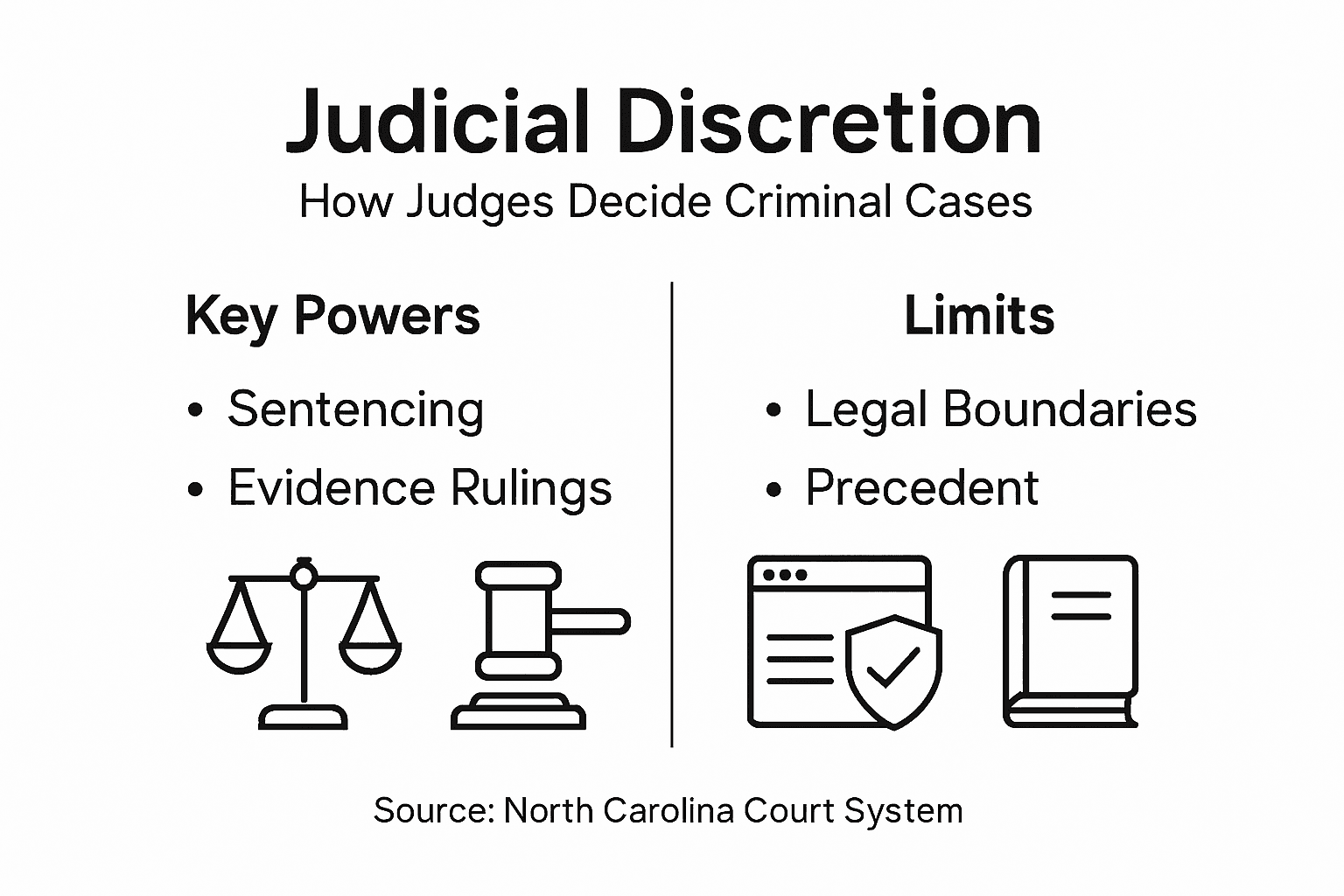
Think of discretion as a highway with guardrails. The judge can steer within the lanes but can’t drive off the road. When a judge exceeds those bounds, decisions become subject to appeal or reversal.
Here’s where judges exercise the most discretion in criminal cases:
- Sentencing decisions: Within sentencing guidelines, judges have significant flexibility
- Evidentiary rulings: Judges decide what evidence gets admitted or excluded
- Motion decisions: Whether to grant continuances, suppress evidence, or allow discovery
- Bail determinations: Setting conditions and amounts for pretrial release
But discretion isn’t random preference. It’s expert judgment under legal standards, requiring judges to balance formal rules with practical problem-solving. A judge can’t sentence harshly simply because they dislike a defendant; they must justify decisions within legal frameworks.
Abuse of discretion happens when judges act arbitrarily or ignore legal constraints. This becomes your appellate argument. A sentencing that ignores mitigating factors or contradicts established precedent is vulnerable to challenge.
In North Carolina courts, judges operate within sentencing grids, constitutional protections, and appellate oversight. You challenge discretion by showing judges overstepped legal boundaries, not by disagreeing with their choices.
Your job: Know the guardrails. Identify where judges have discretion and where they don’t. Push against arbitrary decisions. The most effective advocates recognize what discretion exists and exploit it strategically.
Judicial discretion is constrained authority, not unlimited power. Your defense succeeds by understanding those constraints and holding judges accountable within them.
Pro tip: Document every discretionary ruling and compare it against that judge’s previous decisions in similar cases—patterns reveal whether discretion is being exercised consistently or abused, giving you grounds for appeal or settlement leverage.
Ensuring Fairness and Due Process in Court
Fairness isn’t abstract. It’s the foundation your entire defense rests on. When judges fail to provide due process, your case becomes vulnerable to appeal and reversal. This is where you hold judges accountable.
Procedural fairness and due process are foundational to the justice system, ensuring parties receive equitable treatment, notice, and impartial hearings. Core elements include the right to be heard, transparency, and unbiased decision-makers. Without these, the entire trial becomes illegitimate.
Your client has fundamental rights that judges must protect. These aren’t optional courtesies; they’re constitutional obligations. A judge who denies these rights creates appellate gold.
Key due process protections include:
- Right to be heard: Your client must have opportunity to present their defense
- Adequate notice: Your client knows charges and has time to prepare
- Impartial decision-maker: The judge cannot have personal interest in the outcome
- Transparent procedures: Court rules are applied consistently and explained
- Right to counsel: Your client has effective assistance throughout proceedings
Judges maintain fairness through respectful behavior, neutral tone, and clear explanations. Research shows that how fairly courts treat people significantly influences public trust and compliance with law. Even correct legal decisions feel illegitimate when delivered dismissively.
In practice, this means judges must explain rulings, listen to both sides equally, and avoid appearing biased. A judge who cuts off your arguments or shows frustration with your client undermines fairness perception and creates reversible error.
Document every fairness violation. When a judge denies you adequate time to prepare, interrupts witnesses repeatedly, or shows obvious bias, you have appellate ammunition. These violations become your grounds for reversal or new trial.
Your role is demanding that judges follow procedure. Don’t accept shortcuts or bias. Push back respectfully but firmly on due process violations.
Due process violations aren’t technicalities. They’re fundamental breaches that invalidate convictions and sentences, making them your most powerful appellate tools.
Pro tip: Create a trial notebook documenting every procedural deviation or fairness concern with specific timestamps and rulings—these detailed records become essential evidence for appeal briefs and demonstrate patterns of judicial error.
Impact of Judges on Defense Strategy and Outcomes
Your entire defense strategy hinges on one critical factor: who’s sitting on the bench. The judge you draw determines sentencing severity, evidentiary rulings, and whether your mitigation arguments land. This isn’t speculation; it’s documented reality.
A judge’s background shapes their entire judicial philosophy. Judges with public defender experience tend to impose less severe sentences and are significantly less likely to incarcerate defendants. Their past defense work directly influences sentencing decisions and case outcomes. This matters enormously for your clients.
Conversely, judges with prosecution backgrounds often take harder stances on sentencing and bail. Understanding each judge’s professional history reveals their likely approach to your cases.
Beyond background, judges operate within what academics call courtroom workgroups. You, the prosecutor, and the judge form a triad whose relationships affect case progression and outcomes. The judge’s role within this dynamic influences defense strategies through courtroom management and decision-making.
Here’s what changes based on the judge:
- Bail decisions: Some judges set aggressive bail; others prioritize release
- Motion success rates: Certain judges grant suppression motions readily; others rarely do
- Sentencing ranges: Same crime, different judge equals vastly different sentences
- Plea negotiations: Judge reputation influences whether prosecutors offer reasonable deals
- Trial management: Some judges run efficient trials; others allow extensive discovery disputes
In Catawba, Burke, and Caldwell counties, you likely know which judges favor defense arguments and which don’t. That institutional knowledge is your competitive advantage. Use it.
Your strategy shifts dramatically based on the assigned judge. Before that first hearing, you should know: How does this judge handle Fourth Amendment motions? What’s their sentencing philosophy? Do they value mitigation evidence?
The table below highlights how a judge’s background can influence their decisions and defense strategy:
| Judge’s Background | Common Approach to Cases | Impact on Defense Strategy |
|---|---|---|
| Public Defender | More lenient sentences | Prioritize mitigation, client advocacy |
| Prosecutor | Harsher on sentencing/bail | Focus on legal compliance, negotiation |
| Private Practice | Variable, case-by-case | Research judge’s patterns deeply |
The judge’s philosophy becomes your roadmap. With a defense-friendly judge, aggressive motions might succeed. With a prosecution-leaning judge, negotiation becomes your stronger play.
The judge you draw determines your case trajectory more than any other single factor. Knowing that judge’s patterns and philosophy isn’t optional—it’s foundational to effective advocacy.
Pro tip: Build a judge database tracking each local judge’s sentencing averages, motion grant rates, and case disposition patterns—this data reveals judicial philosophy and informs whether to pursue trial or negotiate based on the specific judge assigned.
Navigate Your Case with Expert Defense Rooted in Local Courtroom Knowledge
Facing the complexity of North Carolina criminal courts means understanding how judges influence every step of your defense. From judicial discretion and sentencing to procedural fairness and evidentiary rulings, your case outcome often depends on the judge assigned. If you are challenged by unpredictable judicial decisions or want to leverage a judge’s courtroom philosophy to your advantage, personalized, experienced legal counsel is critical.
At King & Rowe, we specialize in criminal defense across Catawba, Burke, and Caldwell counties with a deep grasp of regional courts and local judges. Our proven approach offers aggressive advocacy tailored to your assigned judge’s tendencies, ensuring we fight for fair hearings and optimal outcomes. Don’t face the courtroom uncertainty alone. Visit us now at King & Rowe and start building a defense strategy informed by real judicial insight.
Frequently Asked Questions
What is the role of a judge in criminal cases?
A judge in criminal cases serves as an impartial arbiter, ensuring legal procedures are followed and that all parties receive fair treatment during court proceedings.
How does a judge’s background affect their decision-making in criminal cases?
A judge’s background, such as whether they have experience as a prosecutor or a public defender, can significantly influence their approach to sentencing, bail decisions, and evidentiary rulings.
What is judicial discretion and how does it impact criminal cases?
Judicial discretion refers to a judge’s authority to make decisions within the bounds of the law. It impacts criminal cases by allowing judges flexibility in areas like sentencing, evidence admissibility, and motion rulings.
Why is fairness and due process important in criminal trials?
Fairness and due process are crucial because they guarantee that all parties receive equitable treatment, adequate notice, and impartial hearings, which are foundational to legitimate trial outcomes.
Contact King & Rowe Attorneys at Law
 Serving Hickory, NC and surrounding communities
 Phone: 828-466-3858
 Email: kingrowelaw@gmail.com
 Website: www.kingrowelaw.com
Recommended
- Why Hire a Defense Attorney: Protect Your Rights
- Why Choose a Local Law Firm for Your Case
- 5 things to look for in hiring a Defense Lawyer – Hickory Attorneys for Family Law, Criminal Defense, & Estate Planning | King & Rowe
- 7 Key Criminal Defense Strategies for North Carolina Cases
- How Emerging AI Technology Is Transforming Mock Trials Through Synthetic Jurors