
Many people mistakenly believe temporary court orders are permanent rulings that lock in custody or support arrangements for good. In reality, these orders provide stability during ongoing family law cases while courts work toward final decisions. Understanding how temporary orders maintain stability during divorce or custody proceedings covering parenting time, support, and property use helps you navigate your case effectively. This guide explains what temporary court orders involve, how North Carolina courts decide them, and their practical impact on your divorce, custody, or support matter.
Table of Contents
- Understanding Temporary Court Orders In North Carolina Family Law
- Temporary Custody And Visitation Orders: The Child’s Best Interests Standard
- Temporary Child Support Orders: Calculation And Limitations
- Emergency And Ex Parte Temporary Orders: Protecting Children Immediately
- How King & Rowe Can Help With Temporary Court Orders In North Carolina
- Frequently Asked Questions About Temporary Court Orders In North Carolina
Key takeaways
| Point | Details |
|---|---|
| Stability during proceedings | Temporary orders maintain structure for custody, support, and property use while your case progresses toward final resolution. |
| Best interest standard | Courts apply the child’s best interests test for custody decisions, evaluating caregiving history, routines, and safety factors. |
| Child support calculations | Judges use NC guidelines considering income, expenses, and overnights to determine provisional support amounts. |
| Emergency protections | Ex parte orders address immediate risks to children when evidence shows bodily harm or removal from the state. |
| Not permanent rulings | These orders remain temporary and require follow-up hearings before courts issue final judgments. |
Understanding temporary court orders in North Carolina family law
Temporary court orders serve as interim solutions while your family law case moves through the legal system. These orders address urgent needs that cannot wait months for a final hearing. Courts issue them to maintain stability for children and families during divorce, separation, or custody disputes.
These orders typically cover several critical areas:
- Parenting time schedules and custody arrangements
- Child support and spousal support payments
- Use of marital home and vehicles
- Payment of household bills and debts
- Restrictions on asset disposal or relocation
North Carolina courts recognize that families need immediate structure when legal proceedings begin. A family consent order in North Carolina can formalize agreements between parties, but when parents disagree, judges must intervene with temporary rulings based on available evidence.
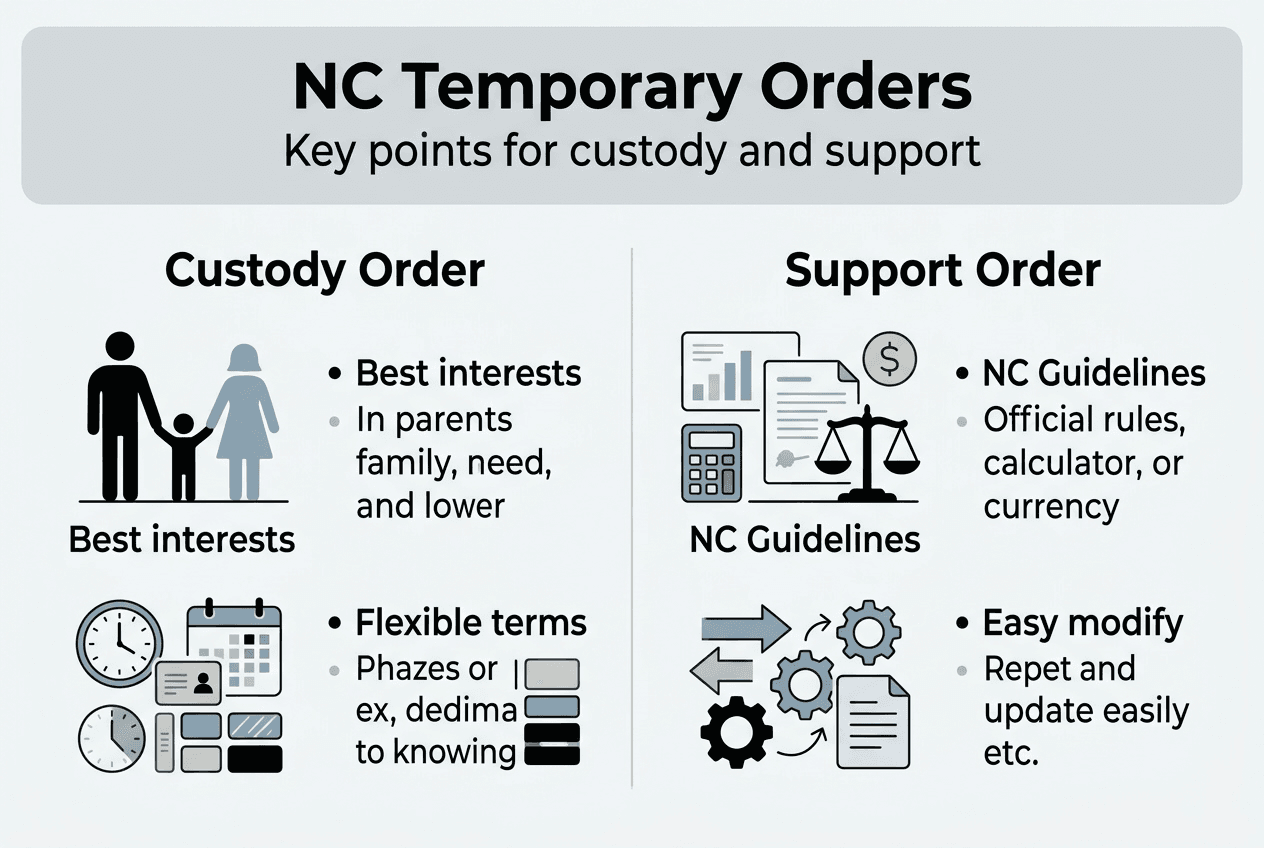
The legal standard varies by issue type. Custody decisions focus on the child’s best interests, while support calculations follow state guidelines. Property and debt matters consider equitable distribution principles, though temporary orders aim for practical solutions rather than final property division.
Pro Tip: Request specific, enforceable terms in your motion for temporary orders. Vague requests like “reasonable visitation” create confusion and conflict. Instead, specify exact days, times, and exchange locations for parenting schedules.
Temporary orders remain in effect until the court modifies them or issues a final judgment. They carry the same legal weight as permanent orders, meaning violations can result in contempt proceedings. However, their provisional nature allows for adjustments as circumstances change or new evidence emerges during the case.
Courts schedule hearings relatively quickly for temporary matters, often within 30 to 60 days of filing. This expedited timeline helps families establish structure without enduring months of uncertainty. You must present your strongest evidence at this hearing, as judges base decisions on the information available at that moment, not on assumptions about what might develop later.
Temporary custody and visitation orders: the child’s best interests standard
When judges apply the child’s best interests standard considering caregiving history, child’s routine, co-parenting ability, and safety, they evaluate multiple factors to determine appropriate temporary custody arrangements. This standard prioritizes the child’s wellbeing over parental preferences or convenience.
North Carolina courts examine these key considerations:
- Primary caregiver history and which parent handled daily childcare responsibilities
- The child’s established routine, including school, activities, and social connections
- Each parent’s ability to provide a stable, safe living environment
- Co-parenting capacity and willingness to facilitate the child’s relationship with the other parent
- Any history of domestic violence, substance abuse, or neglect
- The child’s adjustment to home, school, and community
Judges recognize that temporary custody decisions significantly impact children during an already stressful period. Courts generally favor maintaining consistency with the child’s pre-separation routine when possible. If one parent primarily handled school pickups, homework help, and bedtime routines, the temporary order often reflects that arrangement to minimize disruption.

Visitation schedules in temporary orders typically provide the non-custodial parent regular, structured time with the child. Courts may order supervised visitation if safety concerns exist, but they prefer arrangements allowing both parents meaningful involvement. A detailed child custody guide explains various custody structures and how courts determine appropriate arrangements.
The co-parenting factor carries substantial weight. Parents who demonstrate flexibility, communicate effectively about the child’s needs, and avoid using the child as a messenger or weapon in their conflict fare better in custody evaluations. Conversely, parents who badmouth the other, interfere with scheduled time, or create unnecessary drama risk losing custody time.
Safety concerns override other considerations. If credible evidence shows a parent poses a risk through violence, substance abuse, or severe mental health issues, courts restrict that parent’s access until the situation improves. Understanding winning child custody tips helps you present your case effectively while focusing on your child’s needs rather than personal grievances.
Temporary custody orders are not final determinations. Courts can modify these arrangements as circumstances change or as additional evidence emerges during discovery. However, the temporary arrangement often influences the final custody decision, making it critical to present strong evidence at the initial hearing.
Temporary child support orders: calculation and limitations
Child support calculations in temporary orders follow the North Carolina Child Support Guidelines, which provide a formula based on both parents’ incomes and specific expenses. When child support uses NC guidelines considering income, childcare costs, health insurance, expenses, and overnights, courts aim for consistency and fairness in provisional support amounts.
The calculation process involves several components:
| Factor | How it affects support |
|---|---|
| Gross monthly income | Combined parental income determines the basic support obligation from the guidelines schedule |
| Childcare costs | Work-related childcare expenses are added to the basic obligation and divided proportionally |
| Health insurance | The cost of covering the child is added and allocated between parents based on income shares |
| Overnights | The number of nights each parent has the child adjusts the final support amount |
| Extraordinary expenses | Medical costs, private school, or special needs may increase the obligation |
Courts use the best available financial information when issuing temporary orders. If a parent fails to provide current pay stubs or tax returns, judges may impute income based on employment history, education, and earning capacity. This prevents parents from artificially reducing income to avoid support obligations.
An important legal clarification emerged in recent case law. Temporary child support orders are not permanent and should relate back to the filing date with proper findings, meaning courts must clearly distinguish temporary provisions from final judgments. This distinction matters because temporary orders can be modified more easily than permanent support determinations.
The relation back principle means child support typically begins from the date you filed your complaint or motion, not from when the court issues the order. If you file in January but the hearing occurs in March, support should retroactively cover those intervening months unless the court makes specific findings justifying a different start date.
Pro Tip: Gather complete financial documentation before your temporary hearing. Bring six months of pay stubs, recent tax returns, proof of health insurance costs, and childcare receipts. Incomplete financial information weakens your position and may result in unfavorable support calculations.
Temporary support orders remain modifiable before final judgment if circumstances change substantially. Job loss, significant income changes, or modifications to the parenting schedule can justify adjusting the temporary support amount. However, minor fluctuations do not meet the threshold for modification.
Understanding family law tips for parents helps you navigate the financial aspects of your case while protecting your child’s needs and your own financial stability during this transitional period.
Emergency and ex parte temporary orders: protecting children immediately
When immediate danger threatens a child’s safety, North Carolina law provides expedited procedures for emergency relief. Emergency custody orders authorized when immediate risk to child exists, such as bodily injury or removal from state allow courts to act quickly without the other parent present at the initial hearing.
Ex parte orders represent the most urgent form of temporary relief. The term “ex parte” means one party appears before the judge without notifying the other side beforehand. Courts grant this extraordinary relief only when strict criteria are met and immediate action is necessary to prevent harm.
The process for obtaining emergency custody orders follows these steps:
- File a verified motion or affidavit detailing the specific, immediate risk to the child with supporting evidence like police reports, medical records, or witness statements.
- Demonstrate that notifying the other parent would increase the danger or allow them to flee with the child before the court can act.
- Appear before a judge, often the same day, to present your evidence and explain why emergency intervention is necessary.
- If granted, receive a temporary order immediately restricting the other parent’s access or custody rights.
- Attend a follow-up hearing within 10 days where both parents can present evidence and the court reviews whether to continue the emergency order.
Ex parte relief is short-term based on one-sided facts showing immediate risk, with prompt follow-up hearing ensuring fairness to both parties. The initial order protects the child while giving the other parent an opportunity to respond and present their side of the situation.
Courts require substantial evidence of immediate risk. Vague concerns or past incidents from months ago typically do not meet the emergency threshold. Qualifying situations include active domestic violence, credible threats to harm or abduct the child, severe substance abuse creating immediate danger, or evidence the parent is about to flee the state with the child.
Common mistakes when seeking emergency orders include overstating the urgency, presenting old information as current threats, or failing to provide concrete evidence. Understanding emergency custody filing mistakes helps you avoid procedural errors that could result in denial of your motion.
If your situation does not meet the strict emergency criteria, you can still request an expedited hearing for a regular temporary order. While not as immediate as ex parte relief, expedited hearings typically occur within a few weeks rather than months, providing faster resolution than waiting for a final trial date.
How King & Rowe can help with temporary court orders in North Carolina
Navigating temporary court orders requires understanding complex legal standards and presenting compelling evidence under tight deadlines. The family law team at King & Rowe brings extensive experience helping clients throughout western North Carolina secure favorable temporary orders that protect their children and financial interests during difficult transitions.

Our divorce and family law attorneys guide you through every stage of the temporary order process, from drafting clear, enforceable motions to gathering persuasive evidence and presenting your case effectively at hearings. We understand how local judges in Catawba, Burke, and Caldwell counties approach these matters and tailor our strategies accordingly. Whether you need help with family law child custody guidance or require comprehensive support across multiple family law issues, our team provides personalized attention to your unique circumstances. We also offer estate planning attorneys to help you protect your legacy while managing family transitions. Contact King & Rowe today to discuss how we can help you achieve stability and protection through appropriate temporary court orders.
Frequently asked questions about temporary court orders in North Carolina
What is the duration of a temporary court order?
Temporary orders remain in effect until the court modifies them or issues a final judgment in your case. The timeframe varies based on case complexity, typically lasting several months to over a year. Courts can extend or adjust temporary orders as your case progresses through discovery and toward trial.
Can temporary orders be modified before final judgment?
Yes, you can request modifications to temporary orders if circumstances change substantially. Job loss, relocation, safety concerns, or significant changes in the child’s needs may justify modification. You must file a motion showing the changed circumstances and why the current order no longer serves the child’s best interests or is no longer appropriate.
How do I request a temporary order?
File a motion for temporary orders with the court, clearly stating what relief you seek and why it is necessary. Include supporting affidavits, financial documents, and evidence backing your requests. The court schedules a hearing where both parties present evidence, and the judge issues an order based on the information provided.
What happens if the other parent violates the temporary order?
Violations of temporary orders can result in contempt proceedings. Document each violation with dates, times, and details. File a motion for contempt with the court, and if found in contempt, the violating party may face fines, attorney fees, makeup time, or even jail time for serious or repeated violations.
Is legal help necessary to obtain temporary orders?
While you can represent yourself, having an attorney significantly improves your chances of securing favorable temporary orders. Family law procedures are complex, and presenting evidence effectively requires legal knowledge and courtroom experience. Understanding legal risks of DIY family law helps you make informed decisions about representation. An attorney ensures you meet procedural requirements, present persuasive arguments, and protect your rights throughout the process.
Recommended
- Understanding a Family Consent Order in North Carolina – Hickory Attorneys for Family Law, Criminal Defense, & Estate Planning | King & Rowe
- Top Mistakes to Avoid When Filing for Emergency Custody in North Carolina – Hickory Attorneys for Family Law, Criminal Defense, & Estate Planning | King & Rowe
- What Happens When a Custody Order No Longer Fits Real Life in Hickory, NC? – Hickory Attorneys for Family Law, Criminal Defense, & Estate Planning | King & Rowe
- What Happens If a Domestic Violence Protective Order (DVO) Is Violated in North Carolina? – Hickory Attorneys for Family Law, Criminal Defense, & Estate Planning | King & Rowe