
High-conflict divorce cases in North Carolina often push legal teams into situations where the usual strategies are not enough to address tangled finances or child custody concerns. For attorneys, understanding the role of expert witnesses can clarify hidden assets, reveal true property values, or guide decisions focused on children’s welfare. This overview explains how expert witnesses meet rigorous standards, offering reliable insight that transforms uncertainty into clear solutions for asset division and custody outcomes.
Table of Contents
- Defining Expert Witnesses In Divorce Cases
- Key Types Of Divorce Expert Witnesses
- Legal Standards For Expert Testimony In NC
- Expert Witness Impact On Custody And Assets
- Challenges And Mistakes When Using Witnesses
Key Takeaways
| Point | Details |
|---|---|
| Role of Expert Witnesses | Expert witnesses bring specialized knowledge to divorce cases, helping courts make informed decisions on financial, psychological, and child custody matters. |
| Selection Criteria | Professionals must meet strict standards, including current licensing, proven expertise, and the ability to provide objective, impartial testimony. |
| Impact on Proceedings | Expert witnesses provide essential insights that can significantly affect asset division and child custody arrangements, reinforcing the importance of their role. |
| Best Practices | Attorneys should thoroughly vet expert witnesses, reviewing credentials and past testimony to ensure their reliability and effectiveness in court. |
Defining Expert Witnesses in Divorce Cases
Expert witnesses play a critical role in divorce litigation, serving as specialized professionals who provide authoritative testimony on complex issues that require professional insight beyond typical legal understanding. These professionals bring deep technical expertise to help courts make informed decisions about financial, psychological, and child welfare matters during divorce proceedings.
In the realm of family law, expert witnesses must meet rigorous professional standards. Family law procedural rules mandate that these professionals demonstrate several key qualifications:
- Current professional licensing
- Proven expertise in their specific domain
- Demonstrated capacity for objective analysis
- Commitment to providing impartial testimony
- No significant conflicts of interest
Typical expert witnesses in divorce cases might include:
- Financial Experts
- Forensic accountants
- Business valuation specialists
- Certified public accountants
- Psychological Professionals
- Child psychologists
- Family therapists
- Mental health counselors
- Real Estate Professionals
- Property appraisers
- Real estate market analysts
- Home valuation specialists
These professionals are not merely presenting subjective opinions but providing scientifically grounded, professionally validated assessments that courts rely on for making critical determinations about asset division, child custody, and spousal support.
Here’s a summary of how expert witnesses benefit different areas of divorce cases:
| Domain | Key Role of Expert Witness | Typical Expert Credentials |
|---|---|---|
| Asset Division | Provide accurate valuations and trace hidden assets | CPA, business appraiser |
| Child Custody | Offer psychological assessments and parenting capacity insights | Licensed psychologist |
| Financial Analysis | Uncover complex income streams and portfolio value | Forensic accountant |
| Property Valuation | Assess real estate and business interests | Certified appraiser |
Pro tip: Always verify an expert witness’s professional credentials, recent testimony history, and potential biases before engaging them in your divorce litigation strategy.
Key Types of Divorce Expert Witnesses
Divorce litigation often requires specialized professionals who can provide detailed insights into complex financial, psychological, and property-related matters. Forensic experts play a critical role in helping courts navigate the intricate landscape of asset division, support calculations, and child welfare assessments.
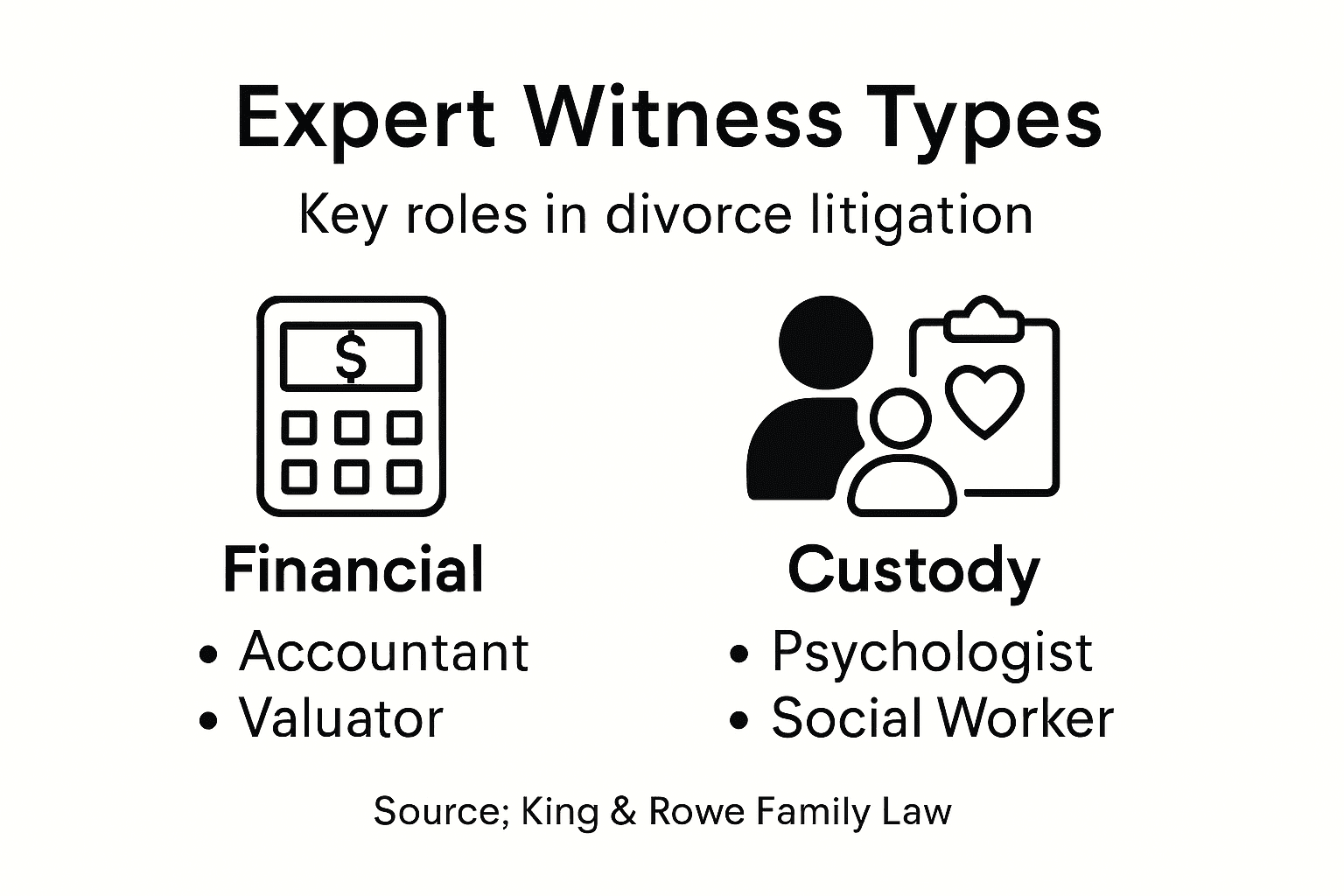
The most common types of expert witnesses in divorce cases include:
- Financial Experts
- Forensic accountants
- Business valuation specialists
- Investment portfolio analysts
- Tax strategy consultants
- Property and Asset Valuation Professionals
- Real estate appraisers
- Business valuation experts
- Art and collectible appraisers
- Machinery and equipment valuators
- Psychological and Custody Experts
- Child psychologists
- Family therapists
- Custody evaluation specialists
- Trauma and behavioral assessment professionals
- Specialized Financial Investigators
- Pension and retirement fund analysts
- Cryptocurrency and digital asset trackers
- International finance experts
- Forensic financial investigators
Each type of expert brings unique skills to divorce proceedings, helping attorneys and judges make informed decisions about complex financial distributions, child custody arrangements, and potential hidden assets. Their testimony can significantly impact the final settlement by providing objective, professional insights that go beyond typical legal understanding.
Expert witnesses transform complicated financial and emotional landscapes into clear, legally actionable information for divorce proceedings.
The selection of an appropriate expert witness depends on the specific nuances of each divorce case. Attorneys must carefully evaluate the professional’s credentials, recent testimony history, and ability to communicate complex information clearly and objectively.
Pro tip: Always request and thoroughly review an expert witness’s recent case history, professional certifications, and potential conflicts of interest before engaging their services.
Legal Standards for Expert Testimony in NC
North Carolina maintains stringent legal standards for expert witness testimony to ensure the reliability and credibility of professional opinions presented in court. North Carolina Rule of Evidence 702 establishes comprehensive guidelines that govern the admissibility of expert testimony in divorce and other legal proceedings.
The key requirements for expert testimony in North Carolina include:
- Specialized Knowledge
- Demonstrable expertise in a specific professional domain
- Relevant professional credentials and experience
- Proven track record of professional practice
- Factual Foundation
- Testimony must be grounded in sufficient factual evidence
- Clear connection between expert’s specialized knowledge and case circumstances
- Objective and verifiable basis for professional opinions
- Methodological Reliability
- Use of scientifically accepted and reliable investigative methods
- Ability to explain and validate analytical approaches
- Consistent application of professional standards
- Relevance and Applicability
- Direct relevance to the specific legal issues being examined
- Clear explanation of how expert insights assist the court’s decision-making
- Avoiding speculation or unsupported conjecture
North Carolina courts have significant discretion to evaluate and potentially exclude expert testimony that fails to meet these rigorous standards.
The legal framework aligns with the Daubert standard, which requires judges to act as gatekeepers, carefully scrutinizing the scientific validity and reliability of expert testimony. This approach ensures that only well-founded, professionally substantiated opinions are considered during divorce proceedings.
Pro tip: Thoroughly document an expert witness’s qualifications, methodological approach, and professional background to preemptively address potential challenges to their testimony.
Expert Witness Impact on Custody and Assets
Divorce proceedings often involve complex financial and emotional dynamics that require specialized professional insights. Expert witnesses play a transformative role in helping courts navigate the intricate landscape of asset division and child custody determinations.
The impact of expert witnesses in divorce cases can be categorized into two primary domains:
- Asset Division Expertise
- Comprehensive property valuation
- Forensic financial investigation
- Tracing and identifying hidden assets
- Evaluating complex investment portfolios
- Assessing business valuation and potential future earnings
- Child Custody Assessment
- Psychological evaluations of parental capabilities
- Child developmental impact assessments
- Mental health and emotional well-being analysis
- Recommendation of optimal custody arrangements
- Evaluation of potential psychological risks
Expert witnesses transform subjective disputes into objectively assessed, professionally validated recommendations that prioritize children’s best interests and equitable asset distribution.
Financial experts meticulously analyze complex asset structures, uncovering potential hidden income streams or undervalued property. Their detailed forensic investigations provide courts with transparent, comprehensive financial portraits that ensure fair settlements. Similarly, child custody experts conduct in-depth psychological assessments, offering nuanced insights into family dynamics and children’s developmental needs.

Pro tip: Request comprehensive written reports from expert witnesses that clearly outline their methodology, qualifications, and specific findings to strengthen your legal strategy.
Challenges and Mistakes When Using Witnesses
Navigating the complexities of expert witness selection and management requires strategic awareness and meticulous preparation. Common challenges in expert witness engagement can significantly impact the credibility and effectiveness of legal proceedings.
Key challenges attorneys must anticipate include:
- Credibility Risks
- Insufficient professional vetting
- Undisclosed conflicts of interest
- Questionable academic or professional credentials
- Inconsistent historical testimony
- Communication Pitfalls
- Inadequate case briefing
- Poor technical communication skills
- Inability to translate complex information
- Misalignment with legal strategy
- Procedural Complications
- Incomplete documentation
- Missed filing deadlines
- Unclear retainer agreements
- Limited preparation for cross-examination
Expert witness failures can transform a potentially strong case into a vulnerable legal position, underscoring the critical nature of careful selection and preparation.
Successful expert witness management requires proactive strategies that address potential vulnerabilities. Attorneys must thoroughly investigate an expert’s background, validate their credentials, and ensure comprehensive understanding of case-specific requirements. Robust communication, clear expectations, and comprehensive preparation are essential to mitigating potential risks.
To help attorneys avoid critical errors, here is a quick comparison of common mistakes vs. effective best practices for managing expert witnesses:
| Common Mistake | Effective Practice | Resulting Impact |
|---|---|---|
| Incomplete vetting | Comprehensive background check | Boosts credibility in court |
| Poor briefing | Detailed case orientation | Enhances clarity of testimony |
| Missing deadlines | Strict calendar tracking | Prevents procedural complications |
| Weak communication | Regular, clear updates | Supports well-aligned legal strategy |
Pro tip: Conduct a comprehensive background review of potential expert witnesses, including their publication history, previous testimony, and professional reputation, before formal engagement.
Secure Your Divorce Case With Trusted Expert Witness Support
Navigating the complex role of expert witnesses in divorce litigation requires precise legal guidance and sharp advocacy. Whether you face challenges in asset division, child custody evaluations, or uncovering hidden financial details, understanding how expert testimony influences your case is critical. Issues like verifying credentials, ensuring impartiality, and preparing for rigorous courtroom scrutiny demand expert legal support without compromise. King & Rowe specializes in family law in North Carolina, providing deep local knowledge and aggressive representation to help you leverage expert witness insights effectively in your divorce proceedings.
Don’t let uncertainty around expert testimony put your interests at risk. Contact King & Rowe today to get personalized advice and strategic planning tailored to your situation. Visit our main site to learn how our dedicated team can assist with all aspects of divorce litigation including expert witness management. Take the first step toward a confident legal response by reaching out through our consultation page and experience legal advocacy that prioritizes your peace of mind and justice.
Frequently Asked Questions
What is the role of an expert witness in divorce cases?
Expert witnesses provide specialized testimony on complex issues beyond typical legal knowledge, such as financial matters, child custody, and asset valuations, helping courts make informed decisions.
What qualifications should an expert witness have in divorce litigation?
Expert witnesses must possess current professional licensing, proven expertise in their specific field, and a commitment to providing objective, impartial testimony according to family law procedural rules.
How do expert witnesses impact child custody decisions in divorce cases?
Expert witnesses, such as child psychologists, assess parental capabilities and the emotional well-being of children, providing valuable insights that influence custody arrangements and prioritizing the child’s best interests.
What are common mistakes to avoid when using expert witnesses in divorce litigation?
Common mistakes include inadequate vetting of the expert’s credentials, poor communication about case specifics, and missing deadlines. Proper preparation and thorough background checks are essential to ensure their effectiveness in court.
Contact King & Rowe Attorneys at Law
 Serving Hickory, NC and surrounding communities
 Phone: 828-466-3858
 Email: kingrowelaw@gmail.com
 Website: www.kingrowelaw.com
Recommended
- Mediation vs. Litigation in Family Law: Which Is Right for You? – Hickory Attorneys for Family Law, Criminal Defense, & Estate Planning | King & Rowe
- What Happens If My Spouse Won’t Sign Divorce Papers in North Carolina? – Hickory Attorneys for Family Law, Criminal Defense, & Estate Planning | King & Rowe
- 7 Essential Steps in a Divorce Checklist for Attorneys
- What if My Partner Wants a Divorce and I Don’t? – Hickory Attorneys for Family Law, Criminal Defense, & Estate Planning | King & Rowe
- Expert Witness Role in Digital Forensics – Legal Impact