
Facing the family law intake process for divorce, custody, or adoption in Catawba, Burke, or Caldwell counties can feel overwhelming, especially when every detail counts. Securing the right information and documents is the first step toward protecting your interests and your family’s future. This guide explains how to build a solid foundation by focusing on comprehensive documentation and clear communication, helping you approach your case with confidence and clarity.
Table of Contents
- Step 1: Gather Essential Family and Legal Information
- Step 2: Prepare and Organize Required Documentation
- Step 3: Schedule and Attend Your Initial Consultation
- Step 4: Review and Confirm Intake Details with Your Attorney
- Step 5: Finalize Intake and Begin the Legal Process
Quick Summary
| Key Point | Explanation |
|---|---|
| 1. Gather Comprehensive Information | Collect vital family and legal details to build a strong foundation for your case strategy. |
| 2. Organize and Protect Documentation | Systematically compile all essential legal documents to ensure they support your legal representation effectively. |
| 3. Prepare for Initial Consultation | Come organized with relevant information and a list of questions to maximize the effectiveness of your meeting with your attorney. |
| 4. Review and Confirm Details Thoroughly | Ensure accuracy of personal information and legal goals with your attorney to prevent misunderstandings in your case. |
| 5. Finalize Intake Process Efficiently | Complete necessary legal agreements and confirm communication protocols to officially begin your legal journey. |
Step 1: Gather Essential Family and Legal Information
Successfully navigating a family law case begins with comprehensive information gathering. Your objective is to collect critical details that will form the foundation of your legal strategy and support the best possible outcome for your case.
When gathering family and legal information, start with comprehensive documentation that provides a clear picture of your family’s current situation. Skilled intake interviewing strategies are essential for uncovering key details. Focus on collecting the following critical categories of information:
- Full legal names of all involved family members
- Current residential addresses
- Employment details for all adult parties
- Existing custody arrangements (if applicable)
- Financial information and income sources
- Contact information for extended family members
- Any previous legal documents related to family relationships
The intake process requires meticulous attention to detail. Verify every piece of information through multiple sources when possible. Birth certificates, social security documents, and government-issued identification can help confirm basic facts. Additionally, be prepared to discuss sensitive topics like family dynamics, potential conflict areas, and children’s specific needs.
The following table summarizes common challenges encountered during family law intake and practical strategies to address them:
| Challenge | Potential Impact | Practical Solution |
|---|---|---|
| Missing documents | Delays case progress | Request official replacements quickly |
| Inaccurate information | Weakens legal strategy | Cross-check details with multiple sources |
| Sensitive topics | Hinders communication | Foster respectful, confidential dialogue |
| Incomplete legal goals | Confuses planning | Clarify and prioritize objectives with attorney |
| Unclear custody details | Complicates negotiations | Obtain formal confirmation and supporting records |
Thorough and accurate information gathering is the cornerstone of developing an effective legal strategy for your family law case.
Organize your documents systematically. Create both physical and digital folders to track all collected information. Scan and backup important documents to ensure nothing gets lost during the legal process.
Pro tip: Bring a comprehensive folder with all relevant documents to your first consultation to maximize the effectiveness of your initial meeting with an attorney.
Step 2: Prepare and Organize Required Documentation
Documentation can make or break your family law case. Your goal in this step is to systematically compile, organize, and protect all critical legal and personal documents that will support your legal strategy.
Systematic document collection is crucial for building a strong legal foundation. Begin by gathering the following essential documentation:
- Marriage certificate or divorce decree
- Birth certificates for all children
- Proof of income (tax returns, pay stubs)
- Bank statements and financial records
- Property ownership documents
- Insurance policies
- Existing court orders or legal agreements
- Communication records relevant to family dynamics
Create a comprehensive documentation system that ensures easy access and protection of sensitive materials. Consider using both physical and digital storage methods. Invest in a secure, fireproof document safe for physical copies and use encrypted digital storage for electronic files.

Here is a comparison of physical and digital document storage options for sensitive legal materials:
| Storage Type | Security Level | Convenience | Backup Recommendations |
|---|---|---|---|
| Physical | High with safe or lockbox | Limited access, but tangible | Store originals in fireproof safe |
| Digital | Variable based on encryption | Easily accessible, searchable | Use password protection and cloud backup |
Meticulous documentation preparation can significantly impact the effectiveness of your legal representation.
Ensure all documents are current, legible, and complete. Make certified copies of original documents and store originals in a secure location. When possible, obtain official certified copies from relevant government offices to ensure maximum legal validity.
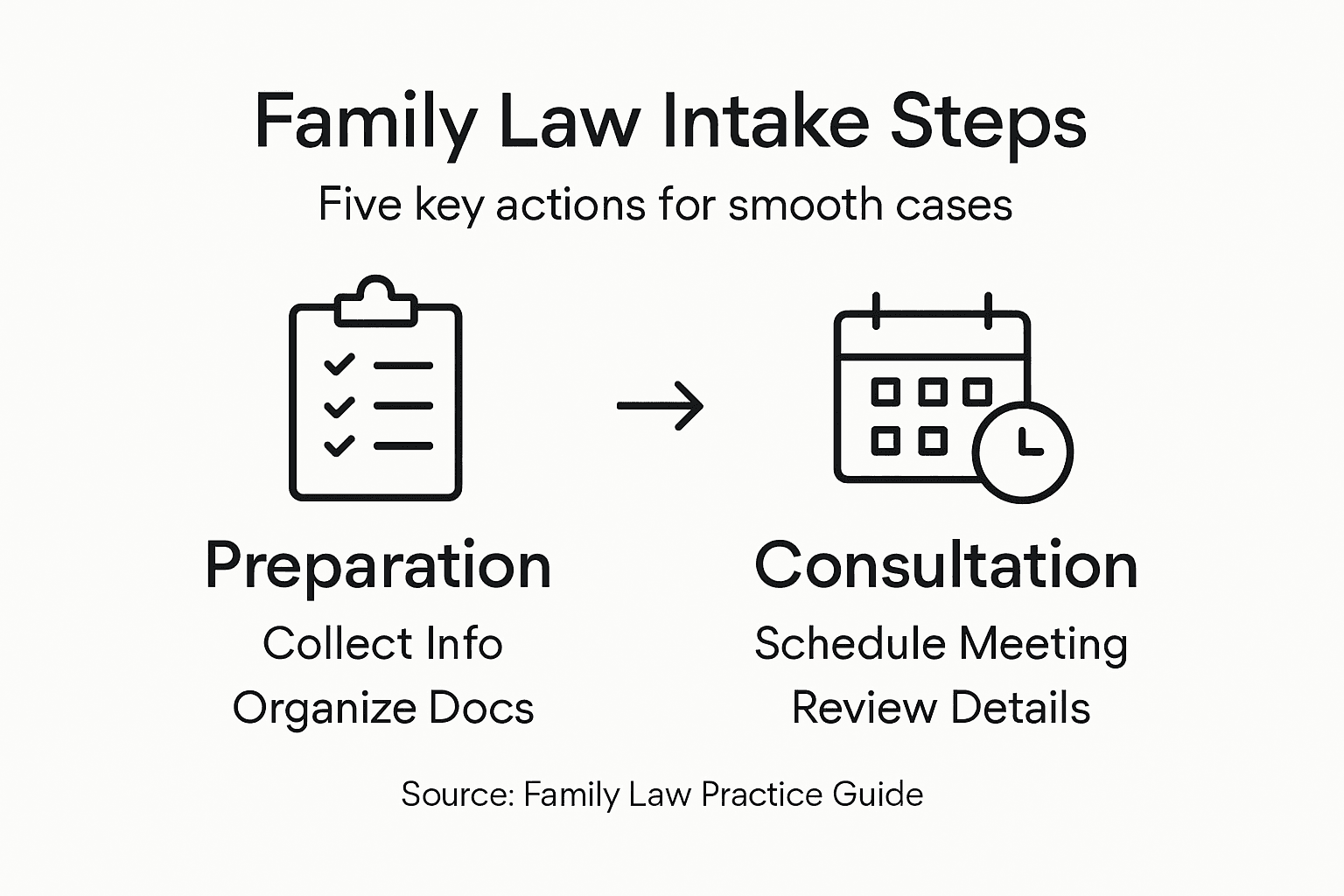
Pro tip: Create a digital backup of all important documents and store them in a secure, password-protected cloud service with two-factor authentication to prevent potential loss.
Step 3: Schedule and Attend Your Initial Consultation
The initial consultation is your first critical opportunity to establish a strong legal strategy and build a productive relationship with your family law attorney. This meeting will set the foundation for how your entire case will proceed.
Intake assessment strategies are crucial for effectively communicating your legal needs. Prepare for your consultation by following these key steps:
- Contact the law firm to schedule an appointment
- Verify the required documentation to bring
- Understand the consultation’s estimated duration
- Prepare a list of specific questions and concerns
- Gather all relevant personal and financial documents
- Consider your primary legal objectives
- Plan to discuss potential case strategies
Approach the consultation professionally and come prepared with a clear, organized overview of your situation. Be ready to provide detailed information about your family dynamics, legal challenges, and desired outcomes. Bring all prepared documentation to maximize the meeting’s effectiveness.
Your first consultation is an opportunity to establish trust and set clear expectations with your legal representation.
During the consultation, be prepared to discuss sensitive topics openly and honestly. Your attorney needs a comprehensive understanding of your situation to provide the most effective legal guidance. Listen carefully to their initial assessment and recommendations.
Pro tip: Take brief notes during the consultation and request a summary of key discussion points to ensure you retain all important information shared by your attorney.
Step 4: Review and Confirm Intake Details with Your Attorney
The review and confirmation stage is critical for establishing a clear, accurate understanding of your family law case. This step ensures that every detail is precisely documented and aligns with your legal objectives.
Legal intake documentation processes require careful and systematic review. During this phase, focus on confirming the following key elements:
- Accuracy of all personal information
- Completeness of submitted documentation
- Clarity of your legal goals and expectations
- Understanding of potential case challenges
- Verification of financial and custody details
- Identification of critical legal strategies
- Discussion of potential case timelines
Approach the review meticulously and ask clarifying questions about any information that seems unclear. Your attorney will help you understand the nuanced details of your case and potential legal pathways. Pay close attention to every document and ensure all information is correct and comprehensive.
Thorough verification during the intake process can prevent misunderstandings and complications later in your legal proceedings.
Be prepared to provide additional context or documentation if your attorney requests further information. Maintain open and honest communication throughout this process, as transparency will help your legal team develop the most effective strategy for your specific situation.
Pro tip: Create a personal checklist of discussed items and request a written summary of the intake review to maintain a clear record of your case’s initial details.
Step 5: Finalize Intake and Begin the Legal Process
The final intake stage transforms your preliminary discussions into an official legal journey. This critical moment marks the transition from preparation to active legal representation, setting the foundation for your entire case.
Informed consent processes are essential for officially launching your legal proceedings. During this phase, you will complete several critical steps:
- Sign comprehensive legal representation agreements
- Review and initial all official documents
- Understand fee structures and billing arrangements
- Confirm communication protocols with your attorney
- Establish case strategy and initial action plan
- Determine potential case timeline
- Discuss potential challenges and mitigation strategies
Carefully read every document before signing. Your signature represents a formal commitment and legal authorization for your attorney to represent your interests. Ask questions about any language or terms you do not fully comprehend.
Your signed intake documents transform your legal strategy from a concept into an actionable plan.
Be prepared to provide additional information or clarification if required. Maintain a collaborative relationship with your legal team, understanding that open communication will be crucial throughout your case.
Pro tip: Request a complete copy of all signed documents for your personal records and create a dedicated file folder to track your case progression.
Take Control of Your Family Law Case with Expert Guidance
Mastering the family law intake process is vital to ensuring your case moves forward smoothly without delays or misunderstandings. From gathering accurate personal and financial documents to preparing for your initial consultation, these crucial steps can feel overwhelming when facing sensitive challenges like child custody, alimony, or divorce. King & Rowe understands these obstacles and offers trusted support that transforms confusing intake procedures into clear, confident action.

Start your journey with a partner who knows how to navigate every detail with care and precision. Benefit from a client-centered approach backed by deep local knowledge and proven results. Whether you need help organizing your documentation or want expert advice on scheduling your consultation, King & Rowe is ready to help you stand strong. Visit King & Rowe today to schedule your consultation and take the first step toward controlling your family law case with clarity and confidence.
Frequently Asked Questions
What essential information should I gather for the family law intake process?
To master the family law intake process, you should gather full legal names, current addresses, employment details, custody arrangements, financial information, and any relevant legal documents. Organize this information into a comprehensive folder to facilitate discussion with your attorney.
How can I ensure accuracy in the documentation I provide for my family law case?
Verify all documentation by cross-checking details with multiple sources, such as birth certificates and government-issued IDs. This thorough verification will strengthen your legal strategy and minimize potential complications during your case.
What should I prepare for my initial consultation with a family law attorney?
Prepare a list of specific questions and concerns, along with all relevant personal and financial documents. Arriving organized will enhance the effectiveness of your consultation and help to establish a collaborative relationship with your attorney.
How do I review and confirm intake details with my attorney?
During your follow-up meeting, meticulously review the accuracy of your personal information and the completeness of your submitted documents. Confirm your legal goals and expectations, which will help solidify your case strategy.
What steps finalize the intake process and launch my family law case?
To finalize the intake process, review and sign the legal representation agreement, understand fee structures, and confirm communication protocols. Ensure you also establish an initial case strategy and discuss potential challenges to effectively start your legal journey.
Contact King & Rowe Attorneys at Law
 Serving Hickory, NC and surrounding communities
 Phone: 828-466-3858
 Email: kingrowelaw@gmail.com
 Website: www.kingrowelaw.com
Recommended
- Mediation vs. Litigation in Family Law: Which Is Right for You? – Hickory Attorneys for Family Law, Criminal Defense, & Estate Planning | King & Rowe
- Divorce Mediation Process Guide for a Peaceful Resolution
- 7 Essential Steps in a Divorce Checklist for Attorneys
- What to Expect During Your Divorce Consultation with Your Attorney – Hickory Attorneys for Family Law, Criminal Defense, & Estate Planning | King & Rowe
- Creare Site Avocat – Ghid Complet pentru Prezența Online
- despărțire – Psiholog clinician și psihoterapeut Denisa Ilea
- Insurance Claim Process Guide For Maximizing Settlements