Every parent in North Carolina faces uncertainty when family law disputes involve custody and parental rights. Understanding the difference between legal custody and physical custody is crucial, as both determine how decisions about education, healthcare, and daily living are made. With the recent passage of the Parents’ Bill of Rights, parents are guaranteed broader authority, yet the courts still prioritize the best interests of children. This article clarifies common misconceptions and empowers you to protect your role as a parent.
Table of Contents
- Defining Parental Rights And Misconceptions
- Types Of Custody And Parental Authority
- Legal Protections And Recent Nc Laws
- Essential Duties And Court Expectations
- Risks, Mistakes, And How To Safeguard Rights
Key Takeaways
| Point | Details |
| Understanding Parental Rights | Parental rights in North Carolina include essential decision-making capabilities regarding education, healthcare, and moral guidance while remaining subject to court supervision for child welfare. |
| Types of Custody | Legal and physical custody distinctions impact parental rights, emphasizing that legal authority does not always align with the child’s primary residence. |
| Legal Protections | Recent legislation strengthens parental rights, ensuring legal authority in educational and healthcare decisions while still allowing for state intervention in cases of abuse or neglect. |
| Court Expectations | North Carolina courts prioritize parental responsibilities, evaluating parents on their ability to provide a nurturing environment and clear communication with co-parents. |
Defining Parental Rights and Misconceptions
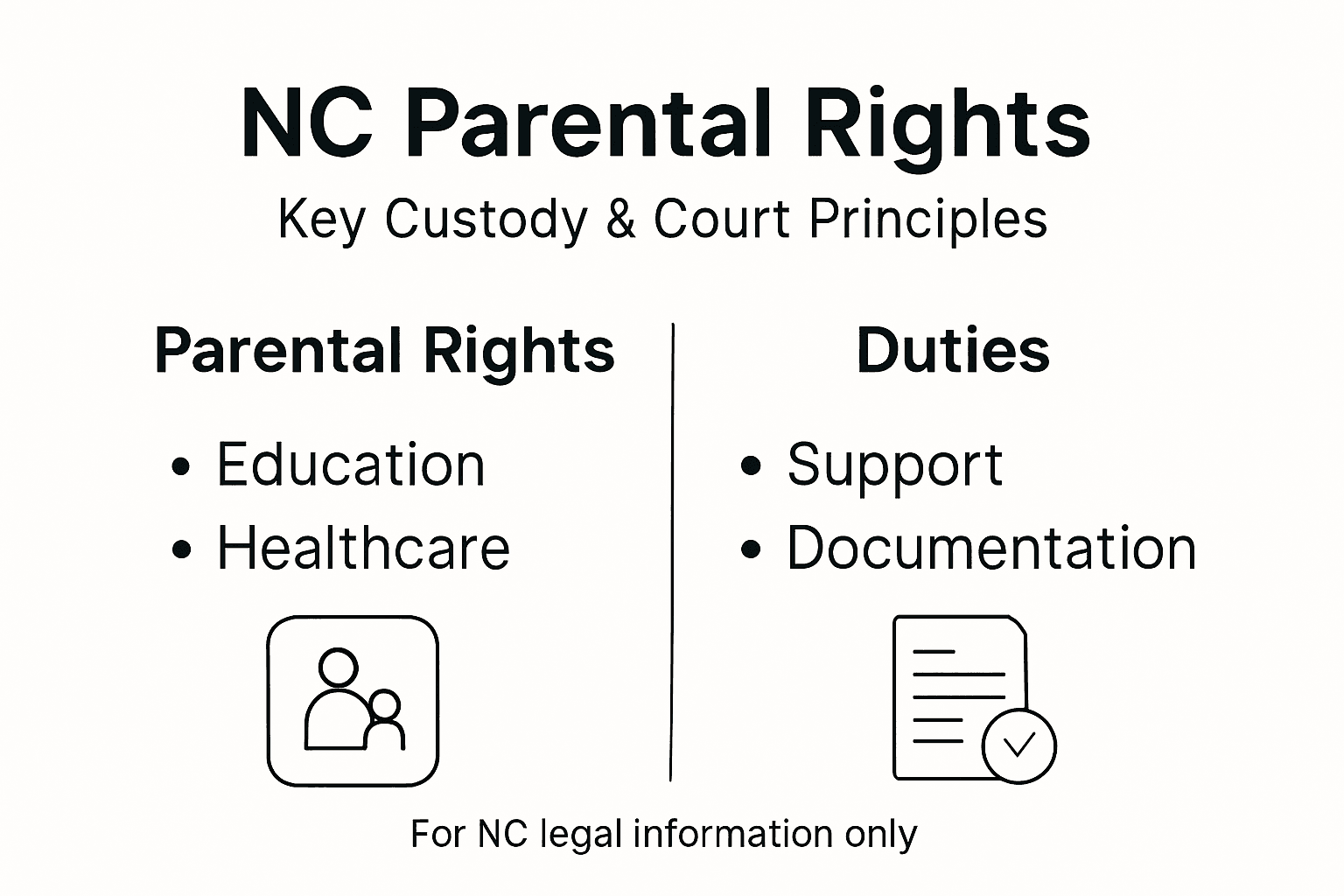
Parental rights represent a complex legal framework that extends far beyond simple caretaking responsibilities. In North Carolina, these rights encompass critical legal protections that safeguard parents’ ability to make fundamental decisions about their children’s upbringing, education, healthcare, and overall welfare.
Legal experts recognize several core parental rights that form the foundation of family law:
- The right to make educational decisions
- The right to provide medical consent
- The right to determine religious upbringing
- The right to disciplinary and moral guidance
- The right to maintain a direct relationship with children
However, many parents misunderstand the scope and limitations of these rights. Parental rights under legal frameworks are not absolute and can be modified or restricted by court interventions when a child’s best interests are at stake. Courts consistently prioritize child welfare over unrestricted parental control, especially in situations involving potential harm or neglect.
Common misconceptions about parental rights often emerge from misunderstandings about state intervention and individual autonomy. For instance, parents might incorrectly assume they have unlimited authority to dictate school curricula or demand specialized educational accommodations. In reality, public institutions maintain significant discretion in establishing standard educational practices.
Parental authority is not about complete control but about responsible guardianship. This means parents have a duty to provide safe, nurturing environments while respecting legal boundaries that protect children’s fundamental rights. The legal system recognizes parents as primary caregivers but also acknowledges that governmental bodies can intercede when children’s wellbeing is compromised.
Parental rights are a balance between personal autonomy and societal protection of children’s interests.
Pro tip: Consult with a family law attorney to understand the precise legal nuances of parental rights in your specific circumstances.
Types of Custody and Parental Authority
In North Carolina, child custody is a nuanced legal concept that goes far beyond simple living arrangements. Child custody laws in North Carolina distinguish between two primary types of custody that determine parental rights and responsibilities: legal custody and physical custody.
The two primary custody classifications include:
- Legal Custody: Involves decision-making authority for critical child-related choices
- Physical Custody: Determines the child’s primary residence and living arrangements
- Joint Custody: Shared responsibilities between parents
- Sole Custody: One parent retains exclusive rights
Legal custody empowers parents to make significant decisions regarding their child’s education, healthcare, religious upbringing, and overall welfare. Physical custody, conversely, addresses the actual living situation and determines which parent provides day-to-day care. Courts in North Carolina recognize that these custody types can be distributed independently, meaning a parent might have legal decision-making authority without primary physical custody.
Here’s a concise overview of the main types of custody and their practical impact:
| Custody Type | Decision Authority Level | Impact on Child’s Daily Life | Typical Court Preference |
| Legal Custody | High | Indirect, affects major choices | Shared or sole, case-by-case |
| Physical Custody | Moderate to high | Direct, residence and routines | Often split or joint |
| Joint Custody | Shared between parents | Balanced between homes | Encouraged for cooperation |
| Sole Custody | One parent full authority | Child lives primarily with one | Used in special circumstances |
Courts evaluate multiple factors when determining custody arrangements, prioritizing the child’s best interests over parental preferences. Critical considerations include:
- Each parent’s relationship with the child
- Child’s emotional and developmental needs
- Stability of each parent’s home environment
- History of family interactions
- Potential impact of custody arrangement on child’s well-being
Custody decisions are not about parental rights, but about protecting the child’s fundamental interests and ensuring their holistic development.
Navigating custody arrangements requires a nuanced understanding of legal frameworks and a commitment to collaborative co-parenting. While legal proceedings can feel adversarial, the ultimate goal remains supporting the child’s emotional and developmental needs.

Pro tip: Document all parental interactions and maintain a cooperative attitude during custody negotiations to demonstrate your commitment to your child’s well-being.
Legal Protections and Recent NC Laws
North Carolina has recently strengthened parental rights through significant legislative developments, most notably the Parents’ Bill of Rights, which comprehensively defines and protects parental authority across multiple domains of child-rearing.
The key provisions of these new legal protections include:
- Explicit rights in educational decision-making
- Comprehensive healthcare consent authority
- Protection of parental access to children’s records
- Safeguards for moral and religious training choices
- Notification requirements for school and medical interventions
Under the new legislation, parental rights extend to critical areas of child development. Parents now have legally guaranteed authority to access their children’s educational and medical records, make fundamental healthcare decisions, and maintain significant input into their children’s moral and educational experiences. This legislative framework explicitly defines a ‘parent’ as anyone with legal custody, broadening the traditional understanding of parental roles.
The legal protections also establish important boundaries and exceptions. Courts and governmental entities can still intervene in cases involving potential child abuse, neglect, or dependency. These nuanced provisions ensure that while parental rights are robust, the ultimate protection of the child remains paramount.
Legal protections are not about unlimited control, but about ensuring responsible and compassionate child-rearing.
Critical exceptions to these parental rights include:
- Situations involving potential child abuse
- Cases of demonstrated parental neglect
- Investigations by child protective services
- Legal proceedings concerning child welfare
- Emergency medical interventions
Navigating these complex legal landscapes requires a sophisticated understanding of both parental rights and corresponding responsibilities. Parents must remain informed about their legal standing while maintaining a collaborative approach with educational and healthcare institutions.
Pro tip: Maintain detailed documentation of all communications and interactions related to your children’s education and healthcare to protect your parental rights effectively.
Essential Duties and Court Expectations
North Carolina courts establish rigorous expectations for parents, focusing on comprehensive parental responsibilities that extend far beyond basic caregiving. The legal system evaluates parents not just on their intentions, but on their consistent ability to provide stable, nurturing environments for their children.
The primary parental duties recognized by North Carolina courts include:
- Maintaining consistent financial support
- Ensuring regular and meaningful child communication
- Providing emotional and psychological stability
- Supporting educational engagement
- Demonstrating responsible decision-making
- Protecting the child’s physical and mental well-being
Courts closely examine a parent’s demonstrated capacity to meet these fundamental responsibilities. Parental performance is assessed through multiple lenses, including the quality of interactions, commitment to child-rearing, and ability to collaborate with co-parents and educational institutions. This holistic evaluation means that courts look beyond surface-level compliance and seek evidence of genuine, sustained parental investment.
Specific court expectations demand that parents:
- Communicate respectfully with each other about child-related matters
- Minimize conflict in the child’s presence
- Support the child’s relationship with the other parent
- Attend required parenting classes or counseling
- Provide transparent financial documentation
A parent’s legal standing is determined not by perfection, but by consistent, good-faith efforts to support their child’s development.
Failure to meet these expectations can result in significant legal consequences. Courts may modify custody arrangements, reduce parental rights, or mandate additional interventions designed to protect the child’s best interests. The underlying principle remains clear: parental rights are a privilege accompanied by substantial responsibilities.
This table summarizes key court expectations for North Carolina parents and the potential legal consequences:
| Expectation | Why It Matters | Possible Consequence if Missed |
| Consistent financial support | Ensures child’s basic needs | Modification of custody or rights |
| Respectful communication | Reduces conflict, supports child | Court-mandated counseling |
| Support for co-parent’s bond | Fosters healthy relationships | Visitation reductions |
| Full financial transparency | Prevents disputes, builds trust | Legal penalties or restrictions |
Pro tip: Document all child-related interactions, communications, and support efforts to demonstrate your commitment and protect your parental rights during potential legal proceedings.
Risks, Mistakes, and How to Safeguard Rights
Parental rights in North Carolina can be surprisingly fragile, with procedural safeguards playing a critical role in protecting parents from unintentional rights erosion. Understanding the potential risks and proactively addressing them becomes paramount in maintaining legal standing.
Common risks that can jeopardize parental rights include:
- Consistent failure to pay child support
- Demonstrating persistent emotional or physical unavailability
- Engaging in high-conflict interactions with co-parents
- Neglecting children’s educational and healthcare needs
- Violating existing custody agreements
- Substance abuse or criminal behavior
Legal vulnerabilities emerge when parents fail to understand or comply with court expectations. North Carolina courts take a comprehensive approach to evaluating parental fitness, examining not just isolated incidents but patterns of behavior that might compromise a child’s well-being. This means that even seemingly minor infractions can accumulate and potentially impact custody arrangements.
To effectively safeguard parental rights, parents must:
- Maintain detailed documentation of child interactions
- Consistently meet financial obligations
- Communicate respectfully with co-parents
- Attend court-mandated counseling or parenting classes
- Seek legal counsel when facing complex situations
Protecting parental rights requires proactive engagement, not passive compliance.
Critical mistakes that can lead to rights restrictions often stem from misunderstandings about legal boundaries. Parents might inadvertently violate custody agreements through unauthorized travel, inconsistent communication, or unilateral decision-making. Understanding the nuanced legal landscape is essential for maintaining a strong parental position.
Pro tip: Create a comprehensive record-keeping system that documents all child-related interactions, communications, and financial contributions to demonstrate consistent, responsible parenting.
Protect Your Parental Rights with Experienced Legal Support
Navigating the complexities of parental rights and custody in North Carolina can be overwhelming. From understanding distinctions between legal and physical custody to safeguarding your fundamental rights in education and healthcare decisions, every step involves critical legal nuances. If you are facing challenges such as custody disputes, modifications, or concerns about protecting your role as a parent, knowing your rights and responsibilities is essential.

At King & Rowe, our North Carolina family law attorneys specialize in advocating for parents like you. We help you understand court expectations, protect your parental authority, and maintain a stable environment for your child. With offices in Hickory and Newton, our deep local knowledge of regional courts and family law makes us a trusted ally. Do not let misunderstandings or conflicts put your parental rights at risk. Take control of your family’s future today by visiting King & Rowe to schedule your consultation and get the personalized legal support you deserve.
Frequently Asked Questions
What are the core parental rights in North Carolina?
Parental rights in North Carolina include the right to make educational decisions, provide medical consent, determine religious upbringing, offer moral guidance, and maintain a direct relationship with children. These rights are protected by law, but can be subject to court intervention if a child’s best interests are at stake.
How does child custody work in North Carolina?
Child custody in North Carolina consists of legal custody and physical custody. Legal custody involves decision-making authority for important child-related issues, while physical custody determines where the child will primarily reside. Custody arrangements can be joint or sole, depending on various factors considered by the court.
What recent laws have been enacted to protect parental rights?
Recent legislation, such as the Parents’ Bill of Rights, has strengthened parental rights in areas like educational decision-making, healthcare consent, and access to children’s records. This law emphasizes that while parents have significant authority, courts can still intervene in cases involving child abuse or neglect.
What are the essential duties expected of parents in custody arrangements?
Parents in custody arrangements are expected to provide consistent financial support, ensure meaningful communication with the child, maintain emotional stability, support educational involvement, and demonstrate responsible decision-making. Courts evaluate these duties to ensure the child’s well-being and may impose consequences if not met.
Contact King & Rowe Attorneys at Law
 Serving Hickory, NC and surrounding communities
 Phone: 828-466-3858
 Email: kingrowelaw@gmail.com
 Website: www.kingrowelaw.com