
Facing a felony accusation in North Carolina can bring uncertainty and fear about what comes next. Felonies, the most serious criminal charges under North Carolina law, carry not just the threat of prison but also the permanent loss of certain civil rights and serious hurdles in daily life. This guide breaks down what defines a felony, common misunderstandings, and how an experienced local attorney can help you protect your rights every step of the way.
Table of Contents
- Felony Definition And Common Misconceptions
- Types Of Felonies In North Carolina Law
- Felony Charges And Legal Procedures
- Consequences And Long-Term Impacts Of A Felony
- Defending Felony Charges In North Carolina
Key Takeaways
| Point | Details |
|---|---|
| Understanding Felony Classification | Felonies in North Carolina are categorized into nine classes, each with different sentencing guidelines and implications for the defendant. |
| Long-Term Consequences | A felony conviction can severely impact employment, civil rights, housing, and professional licensing opportunities. |
| Legal Process Awareness | Familiarity with the stages of felony legal proceedings is crucial for defendants to protect their rights and navigate the system effectively. |
| Defense Strategy Importance | Developing a comprehensive defense strategy is essential for challenging felony charges in North Carolina’s complex legal environment. |
Felony Definition and Common Misconceptions
In the complex landscape of criminal law, a felony represents the most serious category of criminal offenses. Historically rooted in English common law, felonies traditionally distinguish themselves from lesser criminal infractions through their severity and potential consequences.
Unlike misdemeanors, felonies involve significant legal ramifications that can dramatically alter an individual’s life trajectory. Here are the key characteristics of a felony:
- Typically punishable by imprisonment exceeding one year
- Often involve serious criminal acts like murder, rape, burglary, and drug trafficking
- Can result in permanent loss of certain civil rights
- May require mandatory prison time
- Potentially involve substantial financial penalties
Many people misunderstand the broad implications of a felony conviction. Contrary to popular belief, a felony is not simply a “bad crime” – it represents a fundamental legal classification with long-lasting personal and professional consequences. In North Carolina, felonies are categorized into different classes (A through I) that determine specific sentencing guidelines and potential punishments.
A felony conviction can fundamentally reshape an individual’s legal standing, affecting employment, voting rights, and personal freedoms.
The legal landscape surrounding felonies is complex and nuanced. While the traditional definition involves crimes punishable by more than one year of imprisonment, modern legal interpretations have expanded to include a broader range of serious criminal activities.
Pro tip: If you are facing potential felony charges in North Carolina, immediately consult with a criminal defense attorney who understands local legal procedures and can help protect your rights.
Types of Felonies in North Carolina Law
North Carolina’s criminal justice system categorizes felonies into nine distinct classes, ranging from the most severe Class A to the least serious Class I. Felony classifications in North Carolina determine the potential penalties and long-term consequences for criminal offenses.
The felony classes are structured to provide a systematic approach to sentencing based on the severity of the crime and the defendant’s criminal history. Here are the key characteristics of North Carolina’s felony classifications:
- Class A Felonies: Most serious, potentially punishable by life imprisonment or death
- Class B1-B2 Felonies: Extremely serious crimes with substantial prison sentences
- Class C-D Felonies: Significant criminal offenses with moderate to severe penalties
- Class E-F Felonies: Less severe but still significant criminal actions
- Class G-I Felonies: Lowest-level felonies with less extensive but still serious consequences
Each felony class carries specific sentencing guidelines that consider both the nature of the crime and the individual’s prior criminal record. Violent crimes, drug offenses, and serious property crimes typically fall into these classifications. The specific penalties can include:
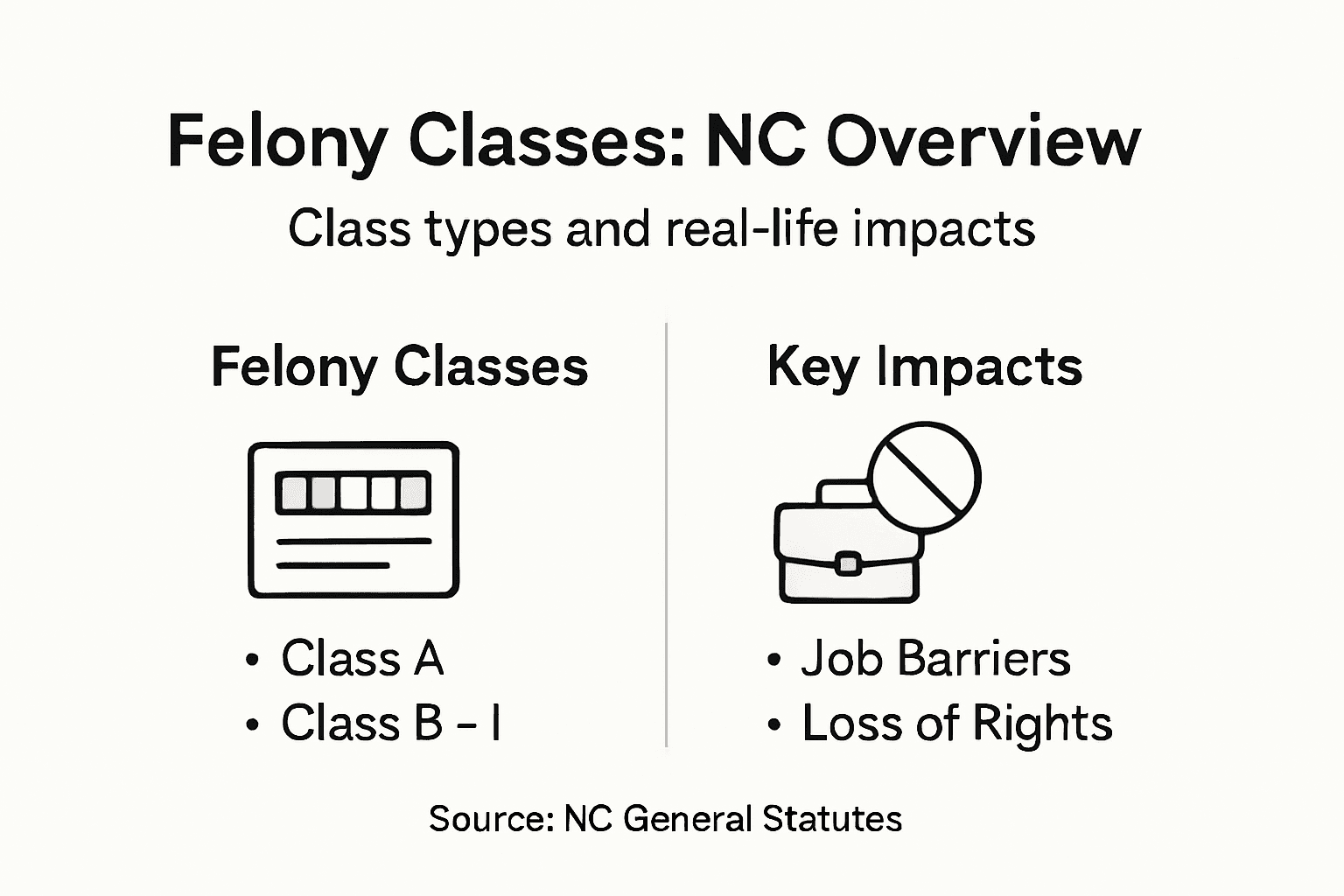
Here’s a summary of how felony classes differ in North Carolina:
| Felony Class | Typical Sentencing Range | Example Offenses |
|---|---|---|
| Class A | Life imprisonment or death | First-degree murder |
| Class B1-B2 | 12-63 years imprisonment | Armed robbery, sexual assault |
| Class C-D | 3-19 years imprisonment | Burglary, serious assault |
| Class E-F | 1-6 years imprisonment | Larceny, drug trafficking |
| Class G-I | 3 months-3 years imprisonment | Credit card fraud, possession offenses |
- Mandatory prison time
- Substantial financial penalties
- Permanent loss of certain civil rights
- Long-term impact on employment and personal opportunities
- Mandatory supervision and rehabilitation programs
The complexity of North Carolina’s felony classification system underscores the critical importance of understanding the potential legal consequences of criminal actions.
Understanding these classifications is crucial for anyone navigating the criminal justice system in North Carolina. The impact of felony charges on gun rights can be particularly significant, potentially restricting fundamental constitutional rights.
Pro tip: If you are facing felony charges, consult with a local criminal defense attorney who can provide detailed guidance specific to your case and the nuanced North Carolina legal system.
Felony Charges and Legal Procedures
Navigating the legal landscape of felony charges in North Carolina requires a comprehensive understanding of the intricate judicial processes. Initial defendant appearances represent the critical first step in the criminal justice system, where fundamental legal rights are established and explained.
The legal procedure for felony charges typically follows a structured sequence of critical stages:
- Arrest and Booking: Initial documentation and formal charging
- Initial Appearance: First court hearing where charges are formally presented
- Preliminary Hearing: Examination of prosecutorial evidence
- Arraignment: Formal reading of charges and defendant’s plea
- Pre-Trial Motions: Legal arguments and potential case dismissal opportunities
- Trial: Formal presentation of evidence and legal arguments
- Sentencing: Determination of legal consequences
Each stage of the legal process carries significant implications for the defendant’s future. The courts carefully evaluate several key factors during felony proceedings:
- Strength of prosecutorial evidence
- Defendant’s prior criminal history
- Circumstances surrounding the alleged offense
- Potential mitigating or aggravating factors
- Community safety considerations
Defendants have fundamental constitutional rights that must be protected throughout the entire legal process, regardless of the severity of the charges.
Understanding the nuanced Classes of Felonies in North Carolina becomes crucial in comprehending potential legal outcomes and strategic defense approaches.
Pro tip: Immediately contact a criminal defense attorney when facing felony charges to ensure your legal rights are fully protected and you receive comprehensive guidance through each stage of the legal process.
Consequences and Long-Term Impacts of a Felony
A felony conviction carries profound and lasting consequences that extend far beyond the immediate legal penalties. Criminal conviction consequences can fundamentally reshape an individual’s personal and professional landscape in ways that are often unexpected and deeply challenging.
The extensive impacts of a felony conviction typically manifest across multiple critical life domains:
- Employment Opportunities: Significant restrictions on job prospects
- Professional Licensing: Potential loss of existing or future professional credentials
- Civil Rights: Potential limitations on voting, firearm ownership, and jury service
- Housing: Challenges in securing rental agreements or mortgage approvals
- Educational Access: Potential barriers to college admissions and financial aid
Beyond the immediate legal ramifications, individuals with felony convictions often face substantial long-term challenges:
The following table overviews the major long-term impacts of a felony conviction:
| Area Affected | Short-Term Impact | Ongoing Consequence |
|---|---|---|
| Employment | Potential job loss | Reduced future job options |
| Civil Rights | Suspension of rights | Loss of voting, gun rights |
| Housing | Denied rental/mortgage | Fewer housing opportunities |
| Professional Licenses | Possible suspension | Barred from certifications |
- Reduced earning potential
- Social stigmatization
- Limited career advancement opportunities
- Increased difficulty obtaining professional certifications
- Potential immigration consequences
A felony conviction is not just a legal event, but a transformative life experience with ripple effects across personal and professional spheres.
Understanding the impact of felony charges on gun rights can be particularly critical, as constitutional rights may be permanently altered.

Pro tip: Consult with a criminal defense attorney immediately to explore potential expunction or mitigation strategies that could minimize the long-term consequences of a felony conviction.
Defending Felony Charges in North Carolina
Defending felony charges requires a strategic, comprehensive approach that goes beyond basic legal representation. Higher-level felony defense strategies demand meticulous preparation and expert legal navigation through North Carolina’s complex criminal justice system.
Successful defense strategies typically involve multiple critical components:
- Case Investigation: Comprehensive evidence gathering and independent fact-finding
- Witness Analysis: Thorough examination of eyewitness credibility and testimony
- Forensic Evaluation: Detailed scrutiny of scientific and physical evidence
- Constitutional Rights Protection: Identifying potential procedural violations
- Mitigation Strategy Development: Exploring alternative sentencing options
Defense attorneys must carefully evaluate several key factors when developing a legal strategy:
- Strength of prosecutorial evidence
- Potential constitutional or procedural challenges
- Defendant’s prior criminal history
- Specific circumstances of the alleged offense
- Available alternative legal approaches
A robust defense is not about proving innocence, but systematically challenging the prosecution’s ability to prove guilt beyond a reasonable doubt.
Understanding key criminal defense strategies becomes crucial in developing an effective legal approach tailored to North Carolina’s specific legal landscape.
Pro tip: Immediately document every detail of your case and avoid discussing specifics with anyone except your legal counsel to preserve the integrity of your potential defense.
Protect Your Future with Experienced North Carolina Felony Defense
Facing a felony charge in North Carolina can feel overwhelming and uncertain. The complex classification of felonies and their long-lasting consequences on your civil rights, employment prospects, and personal freedoms require knowledgeable legal support. At King & Rowe, we understand the critical impact these charges can have on your life and are here to fight aggressively for your rights.
Don’t wait to secure a defense that is tailored to the specific nuances of North Carolina law. Visit our website today at King & Rowe to learn how our skilled criminal defense attorneys can guide you through every stage of the legal process. Protect your future by acting now with trusted advocates dedicated to your case and community.
Frequently Asked Questions
What defines a felony in criminal law?
A felony is one of the most serious categories of criminal offenses, typically punishable by imprisonment for more than one year and can include serious crimes such as murder, rape, and drug trafficking.
What are the consequences of a felony conviction in North Carolina?
A felony conviction can lead to significant impacts on employment, loss of civil rights, challenges in housing applications, and restrictions on professional licenses, among other long-term consequences.
How are felonies classified in North Carolina?
In North Carolina, felonies are categorized into nine classes (A through I), each with specific sentencing guidelines based on the severity of the crime and the defendant’s criminal history.
What legal steps should I expect if charged with a felony?
If charged with a felony, you will go through a series of legal processes, including arrest and booking, an initial appearance in court, a preliminary hearing, arraignment, pre-trial motions, a trial, and sentencing.
Contact King & Rowe Attorneys at Law
 Serving Hickory, NC and surrounding communities
 Phone: 828-466-3858
 Email: kingrowelaw@gmail.com
 Website: www.kingrowelaw.com
Recommended
- Classes of Felonies in North Carolina: What Do They Mean for You? – Hickory Attorneys for Family Law, Criminal Defense, & Estate Planning | King & Rowe
- How a Felony Charge Affects Your Gun Rights in Hickory, North Carolina – Hickory Attorneys for Family Law, Criminal Defense, & Estate Planning | King & Rowe
- Will a Misdemeanor Affect My Gun Rights in North Carolina? – Hickory Attorneys for Family Law, Criminal Defense, & Estate Planning | King & Rowe
- What Are the Consequences of Driving Without Insurance in North Carolina? – Hickory Attorneys for Family Law, Criminal Defense, & Estate Planning | King & Rowe
- Day 154: 7 Differences in Misdemeanor and Felony Charges in Arizona » Tamou Law Group