
Most people assume annulment is a simple escape from an unwanted marriage, but the reality is starkly different. In North Carolina, over 90% of marriage dissolutions happen through divorce, not annulment, because the legal grounds for annulment are exceptionally narrow and difficult to prove. This guide breaks down what annulment truly means under North Carolina law, the specific grounds required, and how it compares to divorce so you can choose the right path forward.
Table of Contents
- Definition And Legal Nature Of Annulment In North Carolina
- Legal Grounds For Annulment In North Carolina
- Procedural Process For Obtaining Annulment In North Carolina
- Key Differences Between Annulment And Divorce In North Carolina
- Implications Of Annulment On Children And Property In North Carolina
- Common Misconceptions About Annulment In North Carolina
- Comparison Framework: Annulment Vs Divorce For North Carolina Residents
- Explore Your Legal Options With King & Rowe Family Law Experts
- Frequently Asked Questions About Annulment In North Carolina
Key Takeaways
| Point | Details |
|---|---|
| Annulment nullifies marriage as if it never existed | Courts treat the marriage as void from the beginning under specific legal grounds. |
| Divorce ends a valid marriage legally | Divorce recognizes the marriage existed and dissolves it moving forward. |
| Limited grounds for annulment in NC | Only fraud, bigamy, underage marriage, impotence, duress, or mental incapacity qualify. |
| Strict filing deadlines apply | You must file within specific time limits or lose the right to annulment. |
| Child custody handled identically | Both annulment and divorce address custody and support under the same legal standards. |
Definition and Legal Nature of Annulment in North Carolina
An annulment is a judicial decree declaring your marriage void, erasing it as though it never legally happened. Unlike divorce, which ends a valid marriage while acknowledging its past existence, annulment treats a marriage as void or never legally existed. This fundamental distinction affects everything from property rights to your legal status.
When a court grants an annulment, it eliminates marital rights and duties retroactively. Your marital status reverts to single rather than divorced. Divorce, in contrast, divides assets accumulated during marriage and addresses ongoing responsibilities like spousal support. The legal nature of annulment creates different financial and legal outcomes than divorce.
Key distinctions include:
- Annulment erases the marriage from legal existence
- Divorce terminates a recognized valid marriage
- Annulment typically avoids spousal support obligations
- Divorce addresses property division and alimony
- Both handle child custody and support identically under North Carolina law
Understanding these fundamental differences helps you determine whether your situation qualifies for annulment or whether divorce is the appropriate legal path. Most North Carolina residents pursue divorce because their circumstances do not meet the strict requirements for annulment.
Legal Grounds for Annulment in North Carolina
North Carolina recognizes only specific, limited grounds that justify annulment. You cannot obtain an annulment simply because you regret marrying or discover incompatibility. The legal grounds for annulment require proof that the marriage was invalid from its beginning.
Valid annulment grounds include:
- Underage marriage without proper parental or judicial consent
- Bigamy when one spouse was already married to another person
- Fraud regarding essential marriage aspects like ability to have children
- Duress or force compelling one party into marriage
- Physical impotence existing at time of marriage and continuing
- Mental incapacity preventing understanding of marriage obligations
North Carolina courts require clear and convincing evidence for annulment grounds such as fraud or impotence. This evidentiary standard is higher than typical civil cases. You must present compelling documentation, witness testimony, or expert opinions demonstrating your marriage was fundamentally invalid from inception.
Strict time limits govern annulment filings. For some grounds like fraud, you must file within a reasonable time after discovering the deception. For others like underage marriage, deadlines may extend until the minor reaches legal age. Missing these deadlines permanently bars annulment regardless of how strong your case appears.
Pro Tip: Consult a family law attorney immediately if you believe annulment grounds exist. Evidence requirements and filing deadlines are unforgiving, and professional guidance dramatically improves your chances of meeting North Carolina’s stringent standards.
Procedural Process for Obtaining Annulment in North Carolina
Navigating the annulment process requires strategic timing and thorough evidence preparation. The procedural requirements for annulment differ from divorce procedures, demanding immediate action and stronger proof.
Follow these steps to petition for annulment:
- Verify your situation matches one of North Carolina’s recognized annulment grounds
- Gather compelling evidence like medical records, witness statements, or proof of prior marriage
- File a verified complaint with the appropriate North Carolina family court within applicable deadlines
- Serve your spouse with the annulment petition following proper legal procedures
- Prepare for the annulment hearing where you present evidence and testimony
- Attend the hearing where the judge evaluates whether your proof meets the clear and convincing standard
- Receive the court’s decree either granting or denying the annulment
Annulment hearings may be quicker than divorce proceedings but require strong evidence and strict deadlines. Unlike no fault divorce, which North Carolina permits after one year separation, annulment demands immediate proof of marriage invalidity. Weak evidence or missed deadlines result in case dismissal, leaving divorce as your only option.

Court timelines vary based on case complexity and court schedules. Simple cases with clear evidence might resolve within weeks. Contested annulments where your spouse disputes the grounds can extend for months. Unlike divorce, you cannot wait out a separation period; evidence must establish the marriage was void from day one.
Pro Tip: Document everything immediately. Text messages, emails, medical records, and witness contact information become crucial evidence. The longer you wait, the harder proving your case becomes and the more likely you miss filing deadlines.
Key Differences Between Annulment and Divorce in North Carolina
Choosing between annulment and divorce requires understanding how each process affects your legal status, finances, and future. Annulment nullifies marriage retroactively while divorce ends marriage legally but recognizes past existence. These differences create distinct legal and practical consequences.
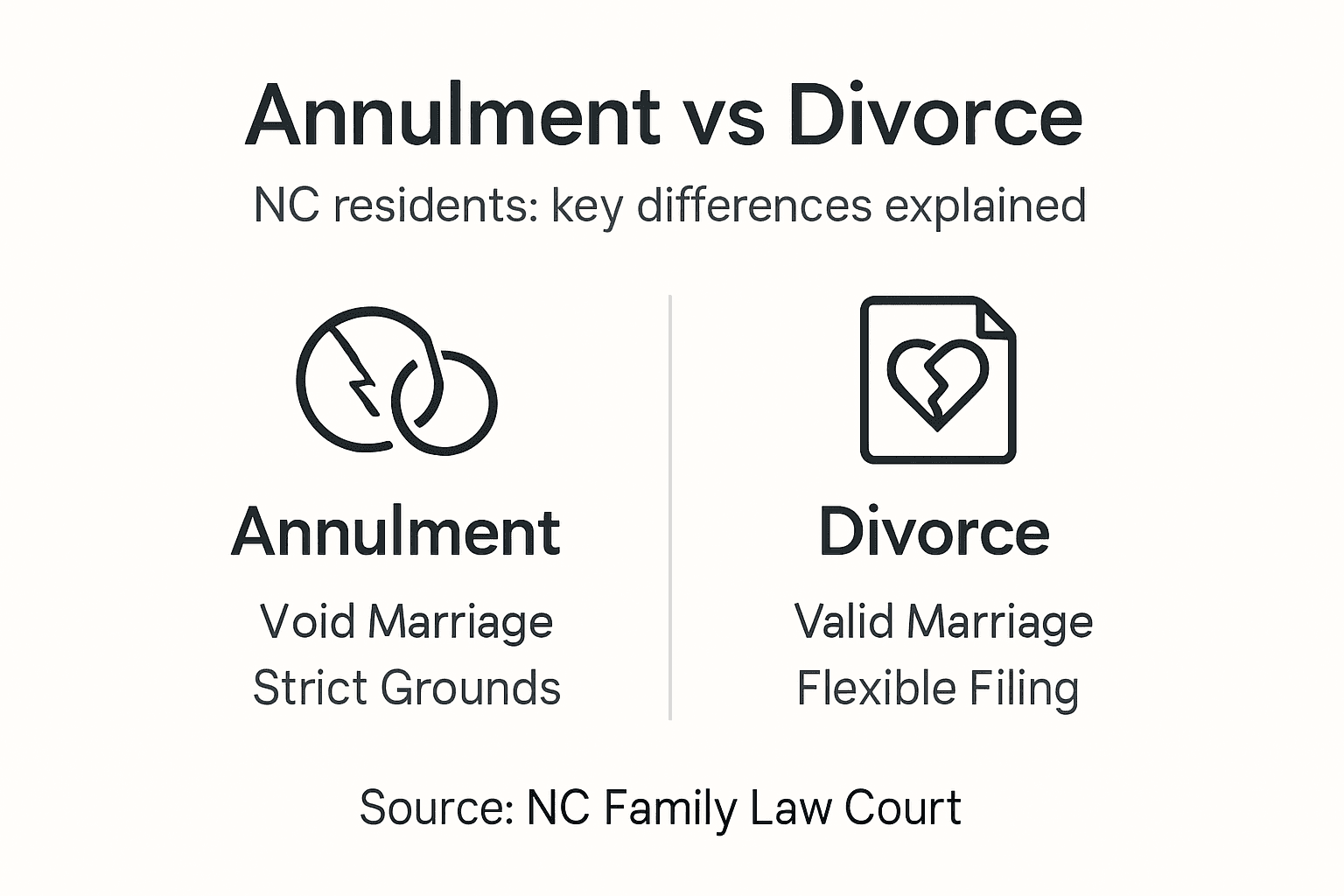
| Aspect | Annulment | Divorce |
|---|---|---|
| Marriage Status | Declares marriage never valid | Ends valid marriage |
| Legal Grounds | Specific defects only | No fault after separation |
| Filing Timeline | Strict deadlines by ground | Flexible after one year separation |
| Spousal Support | Typically not awarded | May be required |
| Property Division | Varies by circumstances | Equitable distribution applies |
| Child Custody | Same standards as divorce | Same standards as annulment |
Property division and alimony treatment differ significantly. Annulment can avoid spousal support obligations because the marriage never legally existed. However, property acquired during the relationship receives different treatment than in divorce. North Carolina courts must determine whether to apply marital property laws or treat assets as separate property. The property implications of divorce versus annulment create different financial outcomes.
Key distinctions to consider:
- Annulment requires proving marriage was invalid; divorce requires only separation
- Annulment must be filed quickly; divorce allows more time
- Annulment typically eliminates spousal support; divorce may require alimony
- Both processes handle child custody and support identically under North Carolina law
- Annulment changes legal status to single; divorce changes status to divorced
Child custody and support obligations remain identical whether you pursue annulment or divorce. North Carolina law prioritizes children’s best interests regardless of how parents dissolve their relationship. Courts apply the same custody standards, support calculations, and parenting time considerations in both proceedings.
Implications of Annulment on Children and Property in North Carolina
Many people wrongly assume annulment eliminates all marital obligations, including those involving children and property. The reality is more complex. Child custody implications of annulment mirror those in divorce proceedings because North Carolina law protects children regardless of their parents’ marital status.
Annulment does not change child custody and support standards. Courts evaluate the best interests of children using identical factors whether parents seek annulment or divorce. Physical custody, legal custody, visitation schedules, and child support calculations follow the same statutory guidelines. Biological parentage creates legal obligations that annulment cannot erase.
Property distribution after annulment depends on specific circumstances and how courts interpret North Carolina law. Unlike divorce where equitable distribution clearly applies to marital property, annulment creates ambiguity. Some courts may treat property as if the parties were never married, potentially affecting how assets and debts are divided.
Key implications include:
- Child custody determined by best interests standard in both annulment and divorce
- Child support calculated using same guidelines regardless of dissolution method
- Property division after annulment may differ from equitable distribution in divorce
- Annulment removes spousal rights retroactively but preserves parental obligations
- Debts incurred during the relationship may be allocated differently than in divorce
Understanding these implications helps you prepare for realistic outcomes. If you have children or significant property, consult an attorney to understand how annulment versus divorce affects your specific situation. The choice between these processes creates long term consequences for your financial security and parental rights.
Common Misconceptions About Annulment in North Carolina
Misconceptions about annulment lead many people to pursue an impossible legal path. Annulment is legally limited to specific grounds and is harder to obtain than divorce. Correcting these false beliefs helps you approach marriage dissolution with realistic expectations.
Widespread myths include:
- Annulment is a quick alternative to divorce requiring no waiting period
- You can get an annulment if you married for the wrong reasons
- Short marriages automatically qualify for annulment
- Annulment is easier to obtain than divorce
- Annulment eliminates all responsibilities including child support
The truth contradicts these assumptions. Annulment requires proving your marriage was legally invalid from the beginning, which demands strong evidence of specific defects. Duration alone does not qualify you. A marriage lasting one day is just as valid as one lasting twenty years unless specific grounds exist.
Annulment is not an escape hatch for marriage regret. North Carolina courts grant annulments only when clear and convincing evidence proves the marriage was void from inception due to fraud, bigamy, incapacity, or other narrow grounds.
Strict filing deadlines pose another challenge many overlook. Unlike divorce where you can file after meeting separation requirements, annulment deadlines vary by ground and often require immediate action. Waiting too long permanently bars annulment even if valid grounds existed initially.
The misconception that annulments are more common than reality reflects confusion with religious annulments, which differ entirely from civil legal annulments. A religious annulment from your church does not affect your legal marital status in North Carolina. Only a civil court annulment has legal force.
Comparison Framework: Annulment vs Divorce for North Carolina Residents
Deciding between annulment and divorce requires evaluating eligibility, timeline constraints, and financial consequences. This framework helps you assess which process fits your situation and goals.
| Criterion | Annulment | Divorce |
|---|---|---|
| Eligibility | Must prove specific grounds | No fault option available |
| Evidence Needed | Clear and convincing proof | Proof of separation period |
| Filing Deadline | Strict limits by ground | One year separation minimum |
| Spousal Support | Rarely awarded | May be required |
| Court Timeline | Can be faster if uncontested | Minimum one year separation |
| Success Rate | Lower due to strict requirements | Higher due to no fault option |
Evaluate your circumstances using these decision criteria:
- Identify whether your situation matches any recognized annulment grounds like fraud, bigamy, or incapacity
- Assess whether you can gather clear and convincing evidence proving the ground existed at marriage
- Determine if you fall within applicable filing deadlines for your claimed ground
- Consider whether avoiding divorced status justifies the difficulty of proving annulment
- Evaluate financial implications including property division and spousal support differences
- Consult a family law attorney to assess your specific case strength and timeline
Most North Carolina residents choose divorce because annulment’s strict requirements eliminate it as an option. If you married believing your spouse could have children but later discover infertility, that likely does not qualify as fraud unless your spouse knowingly concealed the condition. If you married impulsively in Las Vegas, regret alone provides no annulment ground.
Divorce offers more flexibility and certainty. After living separate and apart for one year with intent to remain separated, you qualify for no fault divorce regardless of marriage circumstances. This predictability makes divorce the practical choice for most people seeking to end their marriage.
Explore Your Legal Options with King & Rowe Family Law Experts
Navigating annulment versus divorce requires experienced guidance tailored to North Carolina law and your unique circumstances. Whether your situation involves complex property division, child custody concerns, or time sensitive annulment grounds, professional legal support protects your rights and interests.
King & Rowe’s family law attorneys bring deep knowledge of North Carolina courts, judges, and community dynamics across Catawba, Burke, and Caldwell counties. Our team helps you understand mediation versus litigation options, strategically approaching your case for optimal outcomes. With over 1500 successful cases, we provide the aggressive advocacy and personalized service you need during this challenging transition. Learn why hiring a family law firm makes a critical difference, especially when child custody determination affects your family’s future.
Frequently Asked Questions About Annulment in North Carolina
What are the main grounds for annulment in NC?
North Carolina recognizes six primary grounds: underage marriage without proper consent, bigamy, fraud regarding essential marriage aspects, duress or force, physical impotence existing at marriage, and mental incapacity preventing understanding of marriage obligations. Each ground requires clear and convincing evidence proving the marriage was void from inception.
Can I get an annulment if my spouse refuses to agree?
Yes, you can pursue annulment without your spouse’s agreement if you prove valid grounds exist. Unlike uncontested divorce requiring cooperation, annulment depends on evidence demonstrating marriage invalidity. Your spouse may contest your claims, requiring stronger proof and potentially extending the process.
How long does the annulment process usually take?
Timelines vary from weeks to months depending on case complexity and whether your spouse contests. Uncontested annulments with strong evidence resolve faster than contested cases requiring hearings and testimony. Unlike divorce’s mandatory one year separation, annulment timeline depends on evidence strength and court schedules rather than waiting periods.
Does annulment affect child custody or support?
No, annulment does not change how North Carolina handles child custody or support. Courts apply identical best interests standards and support calculation guidelines whether parents pursue annulment or divorce. Biological parentage creates obligations that annulment cannot eliminate.
Is annulment recognized by federal law for tax purposes?
Federal tax treatment of annulment can be complex. The IRS generally recognizes state annulments as voiding the marriage retroactively, potentially affecting filing status for prior tax years. Consult a tax professional to understand specific implications for your situation, especially regarding previous joint returns.
Recommended
- What Happens If My Spouse Won’t Sign Divorce Papers in North Carolina? – Hickory Attorneys for Family Law, Criminal Defense, & Estate Planning | King & Rowe
- What Happens to the House in a North Carolina Divorce? – Hickory Attorneys for Family Law, Criminal Defense, & Estate Planning | King & Rowe
- Common Mistakes to Avoid During a Divorce in North Carolina – Hickory Attorneys for Family Law, Criminal Defense, & Estate Planning | King & Rowe
- What Is the Difference Between a Dismissal and an Expungement in NC? – Hickory Attorneys for Family Law, Criminal Defense, & Estate Planning | King & Rowe