
Many couples in North Carolina are surprised to learn that common law marriage is not as straightforward as simply living together for several years. The confusion comes from persistent myths, like believing cohabitation alone leads to legal marital status, which is not true in North Carolina. Understanding your rights and responsibilities means cutting through misinformation and knowing how state laws differ. This guide brings clarity on how common law marriage really works so you can make informed decisions about your relationship.
Table of Contents
- Defining Common Law Marriage And Misconceptions
- State Recognition And Legal Framework In The U.S.
- Requirements For A Common Law Marriage
- Rights And Obligations Of Partners
- Ending A Common Law Marriage: Legal Steps
Key Takeaways
| Point | Details |
|---|---|
| Common Law Marriage Definition | A common law marriage is established through mutual agreement and cohabitation without a formal ceremony. |
| Misconceptions | Many mistakenly believe cohabitation alone creates a legal marriage, but mutual consent and public representation are crucial. |
| State Recognition Variations | Recognition of common law marriage varies by state; only a few fully accept them. |
| Legal Rights and Responsibilities | Partners in a common law marriage have rights similar to traditional marriages, including property and inheritance rights. |
Defining Common Law Marriage and Misconceptions
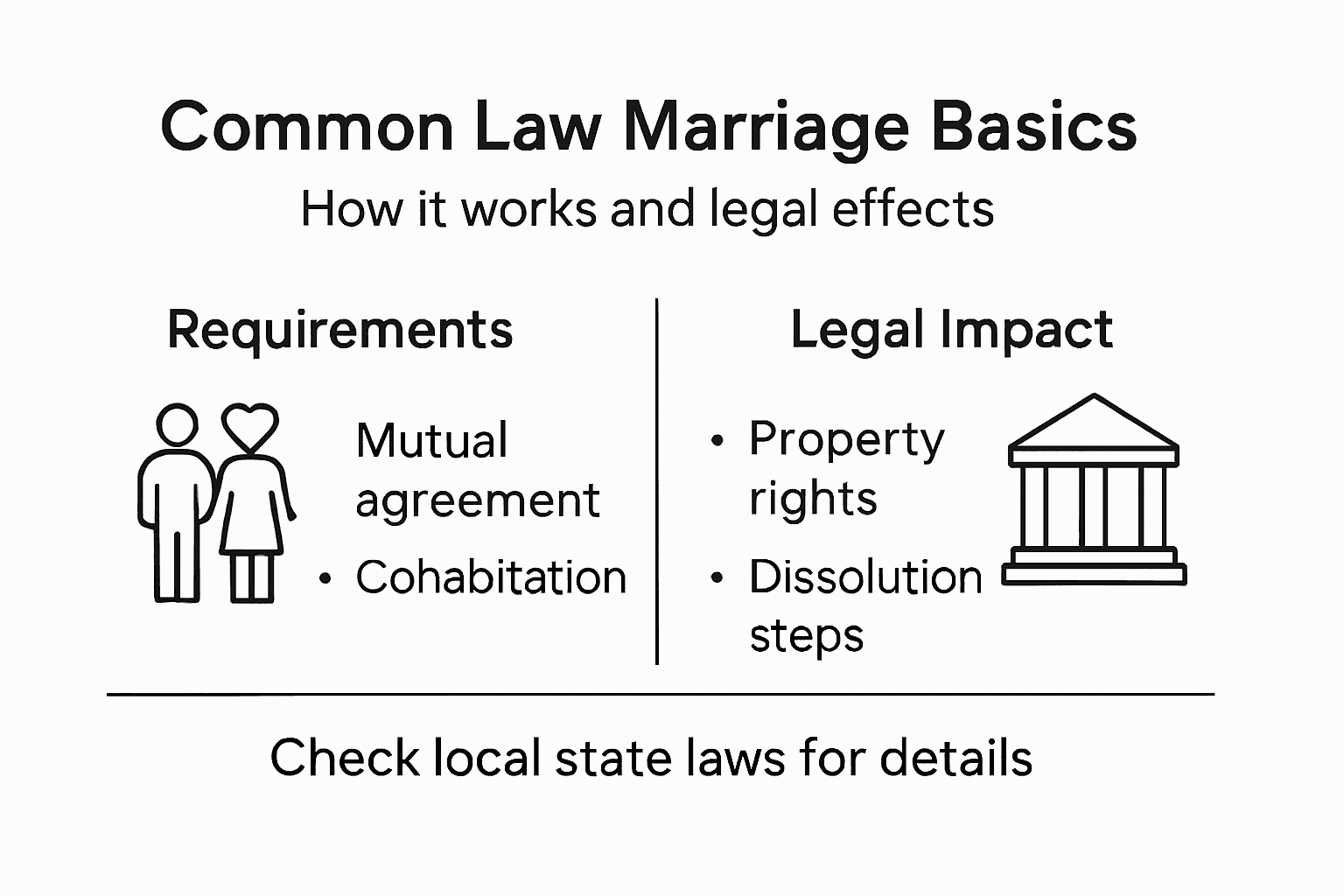
Common law marriage represents a unique legal arrangement where couples can establish a marital relationship without formal ceremony or official marriage license. Unlike traditional marriages, these relationships emerge through mutual agreement and consistent cohabitation. Complex legal criteria determine whether a couple qualifies for common law marriage status.
The primary misconceptions surrounding common law marriage often stem from widespread misunderstandings about its legal requirements. Many people incorrectly assume that simply living together for a specific duration automatically creates a legal marriage. However, the reality is far more nuanced:
- Mutual Consent: Both partners must intentionally agree to be married
- Public Representation: Couples must present themselves publicly as a married unit
- Cohabitation: Living together is necessary but not sufficient alone
- Jurisdictional Variation: Not all states recognize common law marriages
North Carolina, specifically, has unique regulations regarding common law marriage. Legal myths frequently complicate understanding of these arrangements, creating confusion about rights and legal standing. Critically, the state does not automatically grant marital status based on duration of cohabitation or verbal agreements.
Understanding the intricate legal landscape requires careful examination of specific requirements and potential implications. Couples considering this relationship structure must recognize that legal recognition involves more than simply sharing a residence or declaring themselves married.
Pro tip: Consult with a family law attorney to understand the precise legal implications of common law marriage in your specific jurisdiction.
State Recognition and Legal Framework in the U.S.
The legal landscape of common law marriage in the United States is complex and varies dramatically across different jurisdictions. State-specific recognition rules create a patchwork of legal standards that couples must carefully navigate. Currently, only a limited number of states fully recognize these alternative marital arrangements.
The current state of common law marriage recognition can be broken down into several key categories:
- Fully Recognizing States: Approximately 10 states and the District of Columbia
- Grandfathered Marriages: States that no longer create new common law marriages but honor existing ones
- Non-Recognizing States: Majority of states that do not acknowledge common law marriages
- Interstate Recognition: States that respect common law marriages established in other jurisdictions
Constitutional provisions ensure that marriages legally established in one state maintain their validity when couples move across state lines. This means that a common law marriage formed in a recognizing state will typically be respected by other states, even if those states do not independently create such marriages.
The legal framework surrounding common law marriage is intricate, with each state establishing its own specific requirements. These requirements often include demonstrating mutual intent to be married, presenting themselves as a married couple to the community, and meeting specific duration and cohabitation standards. Couples must be acutely aware that these criteria can differ significantly between jurisdictions.
Pro tip: Always document your relationship’s details and consult a local family law attorney to understand your specific legal standing.
Here’s a summary comparing how states treat common law marriages:
| State Category | Policy Toward Common Law Marriage | Example States |
|---|---|---|
| Fully Recognizing | New marriages permitted; full legal status | Colorado, Iowa, District of Columbia |
| Grandfathered Only | Old marriages honored, new ones not allowed | Pennsylvania, Ohio |
| Non-Recognizing | No legal recognition for any duration | North Carolina, California |
| Interstate Recognition | Acknowledges marriages formed elsewhere | Most non-recognizing states |
Requirements for a Common Law Marriage
Establishing a common law marriage involves meeting specific legal criteria that go far beyond simply living together. Legal requirements vary significantly across different jurisdictions, creating a complex landscape for couples seeking alternative marital recognition.
The core requirements for a common law marriage typically include several critical elements:
- Mutual Agreement: Explicit or implied intent to be married
- Cohabitation: Living together as a married couple
- Public Representation: Presenting themselves as spouses in community settings
- Legal Capacity: Being legally eligible to marry (age, no existing marriages)
- Voluntary Participation: Both partners must willingly enter the arrangement
Courts examine comprehensive evidence to validate common law marriages. This investigative process might include reviewing financial documents, property ownership, shared bank accounts, and community perception. The goal is to determine whether the couple genuinely functions as a married unit.
Beyond these fundamental requirements, jurisdictions may impose additional nuanced criteria. Some states require a minimum duration of cohabitation, while others focus more intensely on the couple’s mutual understanding and public presentation. The complexity underscores the importance of understanding local legal specifics.
Pro tip: Document your relationship’s details meticulously, including joint financial records, shared property, and public acknowledgments to strengthen your common law marriage claim.
The following table outlines typical types of evidence courts use to validate common law marriages:
| Evidence Type | Purpose | Common Examples |
|---|---|---|
| Financial Documentation | Shows shared financial life | Joint accounts, shared bills |
| Property Ownership | Proves joint asset management | Both names on home deed |
| Community Perception | Reflects public marital status | Friends know couple as spouses |
| Legal Documents | Confirms intent and recognition | Tax filings, insurance forms |
Rights and Obligations of Partners
Common law marriage partners enjoy a comprehensive set of legal rights and responsibilities that closely mirror those of traditionally married couples. Legal protections extend across multiple domains, creating a complex framework of mutual obligations and entitlements.
The primary rights and obligations for common law partners typically encompass:
- Property Rights: Equal claim to jointly acquired assets
- Financial Support: Mutual responsibility for financial maintenance
- Inheritance Rights: Legal entitlement to deceased partner’s estate
- Healthcare Decisions: Authority to make medical choices
- Child Custody: Similar legal standing as traditionally married parents
- Debt Liability: Potential shared responsibility for financial obligations
Legal presumptions govern relationship dissolutions with significant complexity. When common law marriages end, partners must navigate formal legal procedures similar to traditional divorce processes. This includes potential asset division, spousal support considerations, and resolving financial entanglements.
The intricate nature of these rights underscores the importance of understanding jurisdiction-specific regulations. While common law marriages provide substantial legal protections, the exact scope varies significantly between states. Some jurisdictions offer nearly identical rights to traditional marriages, while others maintain more restrictive interpretations.
Pro tip: Consult a local family law attorney to precisely understand the specific rights and obligations applicable to your unique common law marriage situation.
Ending a Common Law Marriage: Legal Steps
Legal dissolution of common law marriages mirrors traditional divorce proceedings, requiring formal legal intervention rather than simple separation. Contrary to popular misconception, couples cannot terminate their relationship through informal means when a common law marriage has been legally established.
The critical steps for legally ending a common law marriage typically involve:
- Legal Filing: Formal divorce petition in local court
- Property Division: Equitable distribution of jointly acquired assets
- Spousal Support: Potential alimony or financial maintenance considerations
- Child Custody: Formal arrangements for dependent children
- Debt Allocation: Resolving shared financial responsibilities
Divorce proceedings demand comprehensive documentation to establish the legitimate marital relationship. Courts require substantial evidence demonstrating the existence of a common law marriage before processing dissolution. This typically includes proving cohabitation, mutual financial entanglement, and public representation as a married couple.
Jurisdictional variations significantly impact the dissolution process. Some states impose additional requirements or have specific procedural nuances that couples must navigate carefully. The complexity underscores the importance of obtaining professional legal guidance to ensure a legally sound separation.
Pro tip: Gather comprehensive documentation of your relationship before initiating divorce proceedings to streamline the legal process and strengthen your legal position.
Protect Your Rights in Common Law Marriage with Expert Legal Support
Understanding the complex legal nature of common law marriage and its implications can be overwhelming in North Carolina. Whether you are clarifying your legal standing, dealing with property disputes, or facing the legal process to end a common law marriage, it is critical to have knowledgeable guidance tailored to your unique situation. Key concerns such as mutual consent, public representation, and the specific rights and obligations you hold require careful navigation to protect your interests.
King & Rowe specializes in family law in North Carolina and offers personalized support for issues surrounding common law marriage. With a strong record of success and deep knowledge of local courts in Catawba, Burke, and Caldwell counties, our team understands how to handle sensitive matters like divorce, asset division, and custody with care and precision.
Facing questions about your common law marriage status or need help securing your legal rights?

Take control of your future today by contacting King & Rowe to receive trusted legal advice and aggressive advocacy. Explore how we can guide you through divorce and family law challenges at King & Rowe Family Law Services. Learn more about our approach and schedule a consultation at King & Rowe’s main website. Don’t wait until complications arise. Protect your rights now by partnering with legal experts who know North Carolina family law inside and out.
Frequently Asked Questions
What is common law marriage?
Common law marriage is a legal arrangement where couples are recognized as married without a formal ceremony or marriage license, based on mutual agreement and cohabitation.
What are the requirements for a common law marriage?
Common law marriage typically requires mutual agreement to be married, cohabitation, public representation as a married couple, legal capacity to marry, and voluntary participation in the arrangement.
How do rights and obligations differ in common law marriage compared to traditional marriage?
Common law marriage partners have similar legal rights and obligations as traditionally married couples, including property rights, financial support, inheritance rights, and responsibilities for debt.
How can I legally end a common law marriage?
To legally end a common law marriage, you must file a formal divorce petition in court, which includes steps for property division, spousal support, and child custody arrangements.
Contact King & Rowe Attorneys at Law
 Serving Hickory, NC and surrounding communities
 Phone: 828-466-3858
 Email: kingrowelaw@gmail.com
 Website: www.kingrowelaw.com
Recommended
- Mediation vs. Litigation in Family Law: Which Is Right for You? – Hickory Attorneys for Family Law, Criminal Defense, & Estate Planning | King & Rowe
- How Is Alimony Determined? – Hickory Attorneys for Family Law, Criminal Defense, & Estate Planning | King & Rowe
- Common Mistakes to Avoid During a Divorce in North Carolina – Hickory Attorneys for Family Law, Criminal Defense, & Estate Planning | King & Rowe
- My Spouse Just Asked for a Divorce – What Do I Do Now? – Hickory Attorneys for Family Law, Criminal Defense, & Estate Planning | King & Rowe
- Day 67: Bigamy: The Unusual Crime and Its Penalty in Arizona » Tamou Law Group