Many people assume community service is a voluntary act of giving back, but in North Carolina, it’s frequently a court-ordered legal obligation with serious consequences for non-compliance. Whether you face family law issues or criminal charges, understanding how community service operates within over 90% of deferred sentencing agreements can prevent costly penalties and protect your future. This guide breaks down what community service means legally, how it differs across case types, and what you need to know to stay compliant.
Table of Contents
- Definition And Legal Framework Of Community Service
- Role Of Community Service In Family Law Cases
- Community Service As A Sentencing Alternative In Criminal Defense
- Procedures And Eligibility For Court-Ordered Community Service In North Carolina
- Common Misconceptions About Community Service Obligations
- Impact Of Community Service On Case Outcomes And Rehabilitation
- How King & Rowe Can Support Your Community Service Legal Needs
- Frequently Asked Questions
Key takeaways
| Point | Details |
|---|---|
| Legal mandate | Community service in North Carolina is court-ordered, not voluntary, with strict compliance requirements. |
| Context matters | It serves different purposes in family law cases versus criminal defense, affecting hours and monitoring. |
| Non-compliance risks | Failure to complete assigned hours can trigger probation revocation or jail time. |
| Proven benefits | Community service reduces re-offense rates by 20% among misdemeanor offenders. |
| Court approval required | All placements must be pre-approved, and completion must be documented to satisfy legal obligations. |
Definition and legal framework of community service
Community service is a mandated form of unpaid work assigned by North Carolina courts as part of criminal sentences or, less commonly, family law orders. The legal foundation rests on state statutes that allow judges to impose service hours as an alternative to incarceration or fines. Hour requirements typically range from 50 to 200 hours depending on offense severity and judicial discretion.
Courts integrate community service into both deferred prosecution agreements and active sentences to promote accountability without incarceration. Each jurisdiction has its own norms regarding service types, approved organizations, and monitoring protocols. Understanding North Carolina felony classes helps clarify why service hours vary widely across cases.
Key characteristics of court-ordered community service include:
- Unpaid labor benefiting public or nonprofit organizations
- Specific hour requirements set by the judge or probation officer
- Mandatory completion within court-imposed deadlines
- Documentation requirements to prove fulfillment
- Supervision by probation officers or designated coordinators
The legal framework emphasizes rehabilitation and restitution rather than pure punishment. Courts view service as a way to repair harm to the community while giving defendants an opportunity to demonstrate responsibility. This approach reflects North Carolina’s broader sentencing philosophy that balances accountability with second chances.
Role of community service in family law cases
Family courts use community service differently than criminal courts, focusing on corrective parental behavior rather than punishment. Courts may order service to demonstrate commitment in custody disputes involving neglect or compliance issues. The goal centers on improving child welfare outcomes by encouraging parents to show responsibility through tangible actions.
In custody battles, a judge might assign limited service hours to a parent who needs to prove stability or commitment to their child’s wellbeing. Support order violations can also trigger service requirements, particularly when financial penalties prove ineffective. These assignments typically involve fewer hours than criminal cases, often 20 to 50 hours, and emphasize positive behavioral change.
Family law applications of community service include:
- Demonstrating parental responsibility in contested custody cases
- Addressing minor compliance failures in support orders
- Showing willingness to prioritize child welfare
- Providing alternatives to contempt sanctions
- Encouraging rehabilitation of parenting skills
The rehabilitative intent distinguishes family law community service from punitive measures. Courts prefer orders that strengthen parent-child relationships rather than simply sanctioning bad behavior. This philosophy aligns with the broader family law emphasis on the best interests of children and preserving family bonds whenever possible.
Community service as a sentencing alternative in criminal defense
Criminal courts in North Carolina frequently impose community service for misdemeanor offenses to reduce jail populations while maintaining accountability. Approximately 45% of misdemeanor sentences include community service as an alternative to fines or incarceration. This approach benefits defendants who cannot afford steep financial penalties and provides courts with flexible sentencing options.
Typical cases receiving service orders include minor drug possession, first-time DUIs, shoplifting, and vandalism. Judges assign specific hour totals and completion deadlines based on offense severity, prior record, and individual circumstances. The service functions as community restitution, allowing defendants to repay society through productive work rather than sitting in jail.
Over 90% of deferred sentencing agreements in North Carolina criminal courts include community service mandates, reflecting its central role in rehabilitation-focused justice.
Common criminal cases involving community service in misdemeanor sentencing include:
- First-offense DUI or DWI charges
- Simple possession of controlled substances
- Petty theft or shoplifting under $1,000
- Criminal mischief or property damage
- Disorderly conduct or public intoxication
Courts view service as a win for everyone involved. Defendants avoid jail records that complicate employment, communities receive free labor for public projects, and the justice system conserves resources for serious offenders. This alternative sentencing model has gained traction as research demonstrates its effectiveness in reducing repeat offenses.
Procedures and eligibility for court-ordered community service in North Carolina
Before starting any community service hours, you must secure court or probation officer approval of your proposed placement. North Carolina courts require prior site approval, eligibility verification, and ongoing monitoring to ensure compliance. Defendants who fail to follow these procedures risk having their hours rejected or facing additional penalties.

Eligibility depends on your physical ability to perform assigned tasks, transportation access, and availability during required work periods. Probation officers assess these factors before approving placements to prevent setup for failure. Once approved, you must maintain regular contact with your supervisor and submit documentation proving completion of hours within the court-ordered timeframe.
Follow these steps to ensure court procedures for community service compliance:
- Request approved organization lists from your probation officer or court clerk
- Contact potential placements to verify they accept court-ordered workers
- Submit placement information to probation for official approval before starting
- Keep detailed records of dates, hours worked, and supervisor signatures
- File completion documentation with the court before your deadline
- Maintain communication with probation throughout the service period
Pro Tip: Always get written confirmation of your approved placement before starting any hours. Verbal agreements mean nothing if the court later rejects your work, forcing you to repeat hours or face sanctions.
Failure to complete service by the deadline triggers serious consequences. Courts may revoke probation, impose jail time, or extend supervision periods. Documentation must include supervisor signatures, specific dates, and hour totals to satisfy legal requirements. Never assume informal arrangements will satisfy court orders.
Common misconceptions about community service obligations
Many defendants wrongly believe community service is optional or that courts will overlook minor compliance failures. In reality, court-ordered service carries the same legal weight as any other sentence component. Non-compliance leads to probation revocation and jail in 25% to 40% of cases nationally, demonstrating courts take these orders seriously.
Another widespread myth suggests all community service requirements are identical across case types. Family law service focuses on rehabilitation and typically involves fewer hours than criminal sentences. Criminal service emphasizes restitution and accountability, often with stricter monitoring. Understanding these distinctions helps you meet obligations appropriately.
Common misconceptions about community service include:
- Believing service is voluntary once ordered by the court
- Assuming missed deadlines will receive automatic extensions
- Thinking any volunteer work counts toward court-ordered hours
- Expecting courts to accept incomplete or undocumented service
- Underestimating consequences of non-compliance
“Community service is not a suggestion. It’s a court order with the same force as any other legal obligation. Treating it casually invites serious legal consequences.”
Courts enforce compliance strictly because service orders reflect bargains that kept defendants out of jail or reduced other penalties. Judges view failure to complete service as violating that agreement, justifying harsher sanctions. Understanding the legal reality helps you avoid costly mistakes that could derail your case.
Impact of community service on case outcomes and rehabilitation
Research consistently shows community service produces measurable benefits for defendants and communities. Service participation reduces repeat offenses by 20% among misdemeanor offenders in North Carolina. This improvement stems from increased community connection, skill development, and accountability that service fosters.
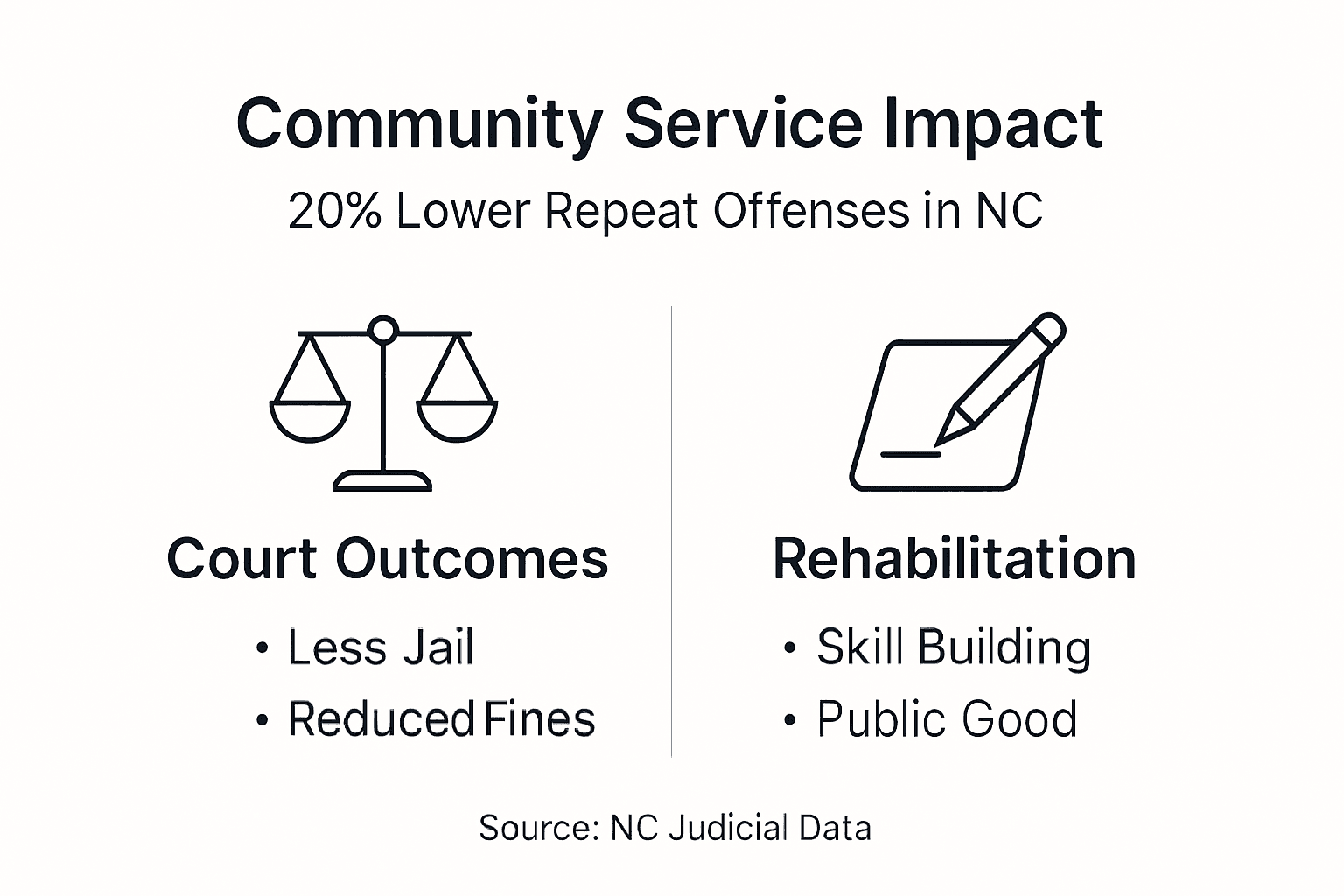
In family law contexts, completing service demonstrates commitment to positive change, improving outcomes in custody disputes and support compliance cases. Communities benefit from thousands of free labor hours supporting parks, schools, food banks, and other public services. The ripple effects extend beyond individual cases to strengthen civic bonds.
Successful completion also enhances your legal standing for future opportunities. Courts look favorably on defendants who fulfill obligations without needing reminders or enforcement actions. Employers and licensing boards view completed service as evidence of accountability and rehabilitation.
| Outcome Measure | Impact of Community Service | Comparison Group |
|---|---|---|
| Recidivism rate | 20% lower | No service ordered |
| Family law compliance | 35% improvement | Standard monitoring |
| Community value | $2.5 million annually | N/A |
| Employment retention | 15% higher | Incarceration alternative |
Pro Tip: Document your service experience thoroughly. Keep copies of supervisor evaluations and thank-you letters. These materials prove valuable if you later need character references for employment, housing, or legal matters.
The community service impact on recidivism reflects courts’ growing preference for rehabilitation over punishment. Service allows defendants to repay communities while developing skills and connections that support long-term success. This evidence-based approach benefits everyone involved in the justice system.
How King & Rowe can support your community service legal needs
Navigating community service obligations requires understanding complex court procedures and compliance requirements. Legal professionals clarify your specific responsibilities and help you avoid pitfalls that lead to violations.
King & Rowe brings over a decade of experience handling family law tips and criminal defense strategies throughout western North Carolina. Our attorneys understand local court preferences, approved placement options, and documentation standards that satisfy judges. We provide personalized guidance on meeting service requirements while protecting your broader legal interests. Whether you face missed court date consequences or need clarity on service obligations, our team offers the aggressive advocacy and local knowledge you deserve. Contact us today for a consultation that puts your needs first.
Frequently asked questions
What happens if I cannot complete my community service hours on time?
Courts may grant extensions if you request one before the deadline and show good cause like medical emergencies or work conflicts. Failing to request an extension or simply ignoring the deadline typically results in probation violations that can lead to jail time. Contact your probation officer immediately if completion seems unlikely.
Can I choose where to perform my court-ordered community service?
You may suggest placements, but all locations require court or probation officer approval before you start working. Most jurisdictions maintain pre-approved organization lists to streamline the process. Working at unapproved sites means your hours will not count toward your obligation.
Does community service count as a criminal conviction on my record?
Community service itself is not a conviction but rather part of a sentence following a conviction or deferred prosecution agreement. The underlying charge determines what appears on your record. Completing service as ordered may help you avoid harsher penalties or satisfy deferred prosecution terms that keep convictions off your record.
How is community service different from probation in North Carolina?
Probation is a supervision period with various conditions that may include community service as one requirement. You can be on probation without community service, but court-ordered service usually comes with probation supervision to ensure compliance. Violating either probation terms or service requirements can result in sanctions.
Can community service hours be reduced or waived?
Courts rarely reduce assigned hours without compelling reasons like serious medical conditions verified by doctors. You would need to file a formal motion requesting modification and demonstrate why the original order is impossible to fulfill. Simply finding service inconvenient will not justify a reduction.
Recommended
- Classes of Felonies in North Carolina: What Do They Mean for You? – Hickory Attorneys for Family Law, Criminal Defense, & Estate Planning | King & Rowe
- NC DUI Sentences 2026: 60 Days to 10 Years Explained
- Can I Get My Bail Reduced in North Carolina? A Closer Look at Bail Modification Hearings – Hickory Attorneys for Family Law, Criminal Defense, & Estate Planning | King & Rowe
- Criminal Record Explained: Impact on North Carolina Life