
You’ve probably heard someone dismiss important information as “just hearsay” and assume it can’t be used in court. That’s only partly true. Many statements are admissible when not offered to prove truth or under exceptions. North Carolina law defines hearsay precisely and recognizes six major exceptions that allow critical evidence in family law, criminal defense, and estate planning cases. This article clarifies what hearsay really means under NC law and how it impacts your legal situation.
Table of Contents
- Understanding Hearsay: Legal Definition And Basic Principles
- Why Courts Generally Exclude Hearsay: Fairness And Reliability
- Key Exceptions To Hearsay In North Carolina Law
- Hearsay In Family Law Context
- Hearsay In Criminal Defense Cases
- Hearsay In Estate Planning And Probate
- Common Misconceptions About Hearsay
- Applying Hearsay Understanding: What This Means For Your North Carolina Case
- How King & Rowe Can Help With Your North Carolina Legal Needs
- What Is Hearsay? Frequently Asked Questions
Key Takeaways
| Point | Details |
|---|---|
| Legal Definition | Hearsay is an out-of-court statement offered to prove the truth of what it asserts, generally inadmissible unless an exception applies. |
| Why Excluded | Courts exclude hearsay to protect fairness, reliability, and your constitutional right to cross-examine witnesses. |
| Six Major Exceptions | Admissions by party opponent, excited utterances, business records, dying declarations, medical treatment statements, and will execution statements. |
| Family Law Impact | Hearsay exceptions help prove abuse or neglect in custody cases while protecting children’s interests. |
| Criminal Defense | Strict hearsay rules protect defendants’ rights, requiring early challenges to inadmissible evidence. |
Understanding Hearsay: Legal Definition and Basic Principles
North Carolina law defines hearsay as a statement made outside the trial or hearing that is presented to prove the truth of the matter asserted. General Statutes 8C-801 and 802 establish this framework. The rule generally bars such statements unless a specific exception exists.
Hearsay isn’t limited to spoken words. It includes oral, written, or nonverbal conduct intended as an assertion. A nod indicating “yes,” pointing to identify someone, or even specific gestures can qualify as hearsay if offered to prove what they assert.
Under North Carolina law, a “statement” means any assertion of fact. Written documents, recorded conversations, text messages, emails, and even social media posts can be hearsay. The critical question is always the purpose: is the statement offered to prove the truth of what it says?
Not every out-of-court statement is hearsay. Statements offered for purposes other than proving their truth escape the hearsay definition entirely. For example, words showing the speaker’s state of mind, proving notice was given, or demonstrating the effect on the listener aren’t hearsay. Context matters significantly.
Key elements defining hearsay:
- Statement made outside the current court proceeding
- Offered to prove the truth of its assertion
- Generally inadmissible without a qualifying exception
- Applies to oral, written, and nonverbal communications
- Must constitute an assertion of fact or belief
Why Courts Generally Exclude Hearsay: Fairness and Reliability
The hearsay rule exists because cross-examination necessity and defendants’ right to confront witnesses drives fair trials. When someone testifies about what another person said outside court, you can’t question that original speaker. You lose the chance to test their memory, perception, or honesty.
Cross-examination is the most powerful tool for revealing truth in court. Without it, judges and juries must accept secondhand information at face value. That creates unacceptable risks of误 inaccuracy and manipulation.
Hearsay threatens fairness in multiple ways:
- The original speaker never swears an oath to tell the truth
- You cannot observe their demeanor or credibility firsthand
- No opportunity exists to challenge inconsistencies or biases
- The statement may be misremembered or misreported
- Context and tone can be lost or distorted through retelling
The Confrontation Clause in the Sixth Amendment provides constitutional protection, especially in criminal cases. Defendants have a fundamental right to face their accusers. Admitting hearsay can violate this protection when testimonial statements are introduced without the opportunity for cross-examination.
Pro Tip: Always consider whether you can cross-examine the original speaker when evaluating if hearsay evidence should be admitted in your case.
Reliability concerns also drive the exclusion rule. Secondhand information naturally degrades through transmission. Details get forgotten, exaggerated, or changed. Courts need the best evidence available, which means firsthand testimony whenever possible.
Key Exceptions to Hearsay in North Carolina Law
North Carolina recognizes specific exceptions including admissions by party opponent, excited utterances, business records, dying declarations, and statements for medical treatment. Each exception exists because reliability indicators substitute for cross-examination.
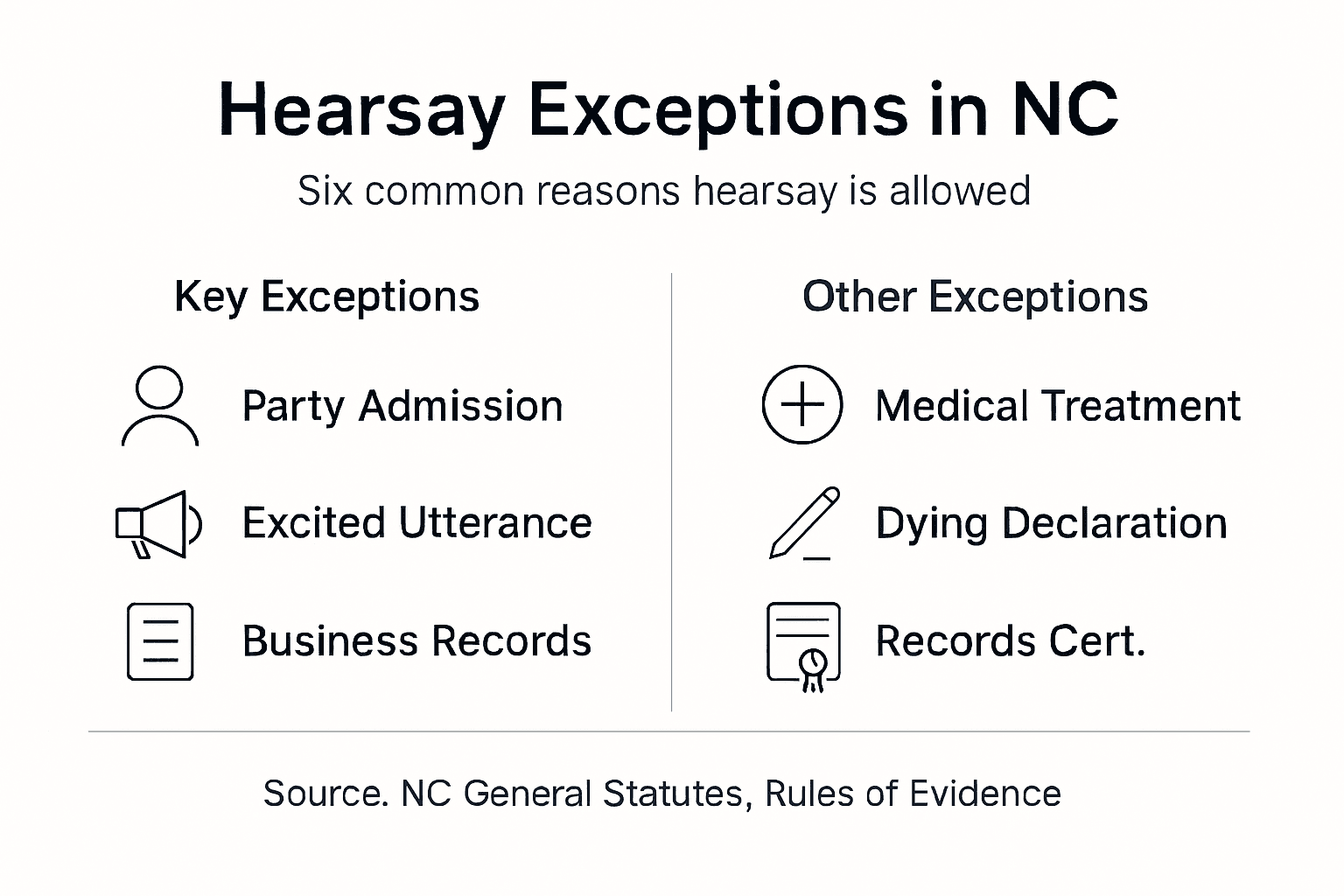
Understanding these exceptions is crucial for your case. An admission by a party opponent means anything you said can be used against you. If your spouse admits to hiding assets in a divorce, that statement comes in as evidence. The rationale is simple: people don’t usually make false statements against their own interests.
Excited utterances are spontaneous statements made during or immediately after a startling event. The shock of the moment reduces the chance for deliberate fabrication. A victim’s immediate cry after an assault typically qualifies.

Business records maintained in the regular course of business are admissible because routine record keeping ensures reliability. Medical records, financial statements, and employment files often fall under this exception.
Comparison of major hearsay exceptions:
| Exception | Description | Typical Use Case |
|---|---|---|
| Party Opponent Admission | Statement by opposing party | Divorce asset disclosure, contract disputes |
| Excited Utterance | Spontaneous statement during shocking event | Assault cases, accident testimony |
| Business Records | Documents kept in regular business course | Medical records, financial statements |
| Medical Treatment | Statement for diagnosis or treatment | Describing symptoms, injury causes |
| Dying Declaration | Statement made believing death is imminent | Homicide cases |
| Will Execution | Statement about will creation or terms | Probate disputes |
Statements made for medical diagnosis or treatment are admissible because patients have strong motivation to be truthful when seeking care. Describing how an injury occurred to a doctor typically comes into evidence.
Dying declarations, though rare, allow statements made by someone who believes death is imminent. The assumption is that people facing death speak truthfully.
Pro Tip: Knowing which specific exception applies to evidence in your case can dramatically impact whether critical information gets admitted or excluded.
Understanding hearsay exceptions helps whether you’re working on family consent orders or preparing for emergency custody hearings where admissible evidence makes the difference.
Hearsay in Family Law Context
Family courts handle hearsay differently than criminal courts, particularly in child protection matters. Hearsay can be admitted under exceptions when proving abuse or neglect in custody cases. The court’s primary concern is the child’s welfare, which sometimes outweighs strict evidentiary rules.
Excited utterances frequently arise in custody disputes. A child’s spontaneous statement about witnessing domestic violence may be admissible if made immediately after the traumatic event. The key is timing and the emotional state preventing fabrication.
Statements for medical treatment or diagnosis are particularly important in abuse cases. When a child tells a doctor how injuries occurred, those statements typically come into evidence. The medical treatment exception recognizes that patients need to be truthful for proper care.
Common hearsay issues in family law:
- Child statements about parental fitness or home conditions
- Third-party observations about abuse or neglect
- School or counselor reports about child welfare
- Text messages or emails between parties
- Social media posts about parenting or behavior
Limitations still exist. A parent cannot simply repeat what a child said about preferring one home over another without meeting an exception. Courts scrutinize hearsay carefully to prevent manipulation while protecting children.
Family courts balance evidentiary rules with the urgent need to protect vulnerable children. In child custody determinations, judges may admit certain hearsay that would never survive in criminal court when the child’s safety hangs in the balance.
Documentation matters significantly. Written records from teachers, counselors, or medical providers carry more weight than oral hearsay. The business records exception often applies to professional observations recorded in the regular course of work.
Hearsay in Criminal Defense Cases
Criminal courts apply strict hearsay scrutiny to protect defendants’ right to a fair trial and presumption of innocence. The stakes are highest when liberty is at risk. North Carolina criminal procedure demands rigorous application of hearsay rules.
The Confrontation Clause prevents admitting hearsay that deprives defendants of cross-examination rights. Testimonial statements by absent witnesses violate constitutional protections unless the witness is unavailable and the defendant had a prior opportunity to cross-examine.
Defense attorneys routinely file motions to suppress hearsay evidence. These challenges must be timely. Failing to object at trial can waive the issue for appeal. Identifying hearsay early in case preparation is essential.
Steps to challenge hearsay in criminal defense:
- Review all prosecution evidence for out-of-court statements offered as truth
- Identify which statements lack applicable exceptions
- File pretrial motions to exclude inadmissible hearsay
- Object immediately when hearsay is introduced at trial
- Preserve the issue for appellate review with specific objections
- Request jury instructions about limited use if partially admitted
Pro Tip: Early identification and challenge of hearsay evidence is vital for defense success because waiting until trial may be too late to exclude damaging statements.
Witness statements to police often create hearsay problems. If a witness told an officer what they saw but won’t testify at trial, that statement typically can’t come in through the officer’s testimony. The prosecution must produce the actual witness for cross-examination.
Confidential informant information presents special hearsay challenges. Defendants have the right to confront accusers, but revealing informant identities raises safety and practical concerns. Courts carefully balance these competing interests.
Effective criminal defense strategies include aggressive hearsay challenges. Excluding unreliable evidence can mean the difference between conviction and acquittal.
Hearsay in Estate Planning and Probate
Probate courts encounter hearsay when disputes arise over will validity or interpretation. Courts allow statements related to execution or terms of wills as exceptions to hearsay rules in probate disputes. These exceptions recognize the unique nature of testamentary evidence.
When someone challenges whether a will was properly executed, statements by witnesses to the signing can be crucial. Even if a subscribing witness has died, their prior statements about the execution ceremony may be admissible under specific exceptions.
Statements by the deceased about their testamentary intent often arise in will contests. If the testator told someone why they included or excluded particular beneficiaries, those statements might come in under the state of mind exception.
Hearsay issues in estate disputes:
- Witness testimony about will signing and testator capacity
- Statements by deceased about asset distribution intent
- Documents evidencing testamentary wishes
- Communications about trust provisions
- Records of asset ownership and transfers
Business records maintained by financial institutions, accountants, or attorneys regularly appear in probate. Bank statements, deeds, and corporate records typically satisfy the business records exception because they were created in the regular course of business.
Estate planning hearsay exceptions:
| Evidence Type | Exception Applied | Reliability Basis |
|---|---|---|
| Will execution witness statements | Ancient documents, unavailable witness | Contemporaneous observation |
| Testator’s intent statements | State of mind | Declarant’s direct knowledge |
| Financial records | Business records | Routine record keeping |
| Attorney file notes | Business records | Professional documentation |
| Medical capacity evaluations | Medical treatment | Expert professional assessment |
Capacity challenges often involve medical records and expert testimony. A doctor’s notes about the testator’s mental state fall under the medical records exception. These records help establish whether the person understood what they were doing when signing the will.
Understanding how hearsay works in probate helps when planning your estate. Proper documentation, like explaining decisions in letters or recordings, can create admissible evidence of intent if disputes arise. Learn more about protecting digital assets in your estate plan where documentation becomes critical.
Common Misconceptions About Hearsay
Many people misunderstand what hearsay actually means. The biggest myth is that all out-of-court statements are hearsay. That’s wrong. Only statements offered to prove the truth of their assertions qualify.
Another misconception is that hearsay is always inadmissible. As we’ve covered, numerous exceptions allow hearsay evidence. In fact, trials routinely include properly admitted hearsay under recognized exceptions.
People often think only spoken words count as hearsay. Not true. Written documents, text messages, emails, and even nonverbal conduct like nodding or pointing can be hearsay if offered to prove what they assert.
Clearing up hearsay myths:
- Not every out-of-court statement is hearsay; purpose determines admissibility
- Many hearsay statements are admissible under established exceptions
- Nonverbal conduct can constitute hearsay when intended as assertion
- The same statement may be hearsay for one purpose but not another
- Hearsay rules apply similarly in civil and criminal cases with some procedural differences
Some believe hearsay rules only apply in criminal court. Actually, North Carolina applies hearsay rules across all case types, though criminal cases add constitutional protections through the Confrontation Clause.
The confusion often stems from legal dramas where attorneys dramatically object to hearsay. Real courtroom practice involves more nuance. Attorneys must identify the specific hearsay issue and whether an exception applies.
Understanding what hearsay actually means helps you evaluate evidence in your case realistically. Don’t assume important information is automatically excluded or admitted without analyzing the specific legal framework.
Applying Hearsay Understanding: What This Means for Your North Carolina Case
Now that you understand hearsay, you can actively participate in your legal case. Identifying potential hearsay issues early helps your attorney develop effective strategies.
Start by reviewing all documents and witness statements in your case. Ask yourself: is this an out-of-court statement being offered to prove what it says? If yes, determine whether an exception applies.
Timely objections matter significantly. Once evidence is admitted without objection, challenging it later becomes difficult or impossible. Your attorney needs to know about hearsay issues before trial.
Steps to prepare your case involving hearsay:
- Identify all out-of-court statements in your evidence or the opposition’s evidence
- Determine the purpose for offering each statement
- Research which NC hearsay exceptions might apply
- Document when and how each statement was made
- Discuss admissibility strategies with your attorney early
- Prepare witnesses to testify about exceptions like excited utterances or business records
- File necessary pretrial motions to exclude or admit specific hearsay evidence
Pro Tip: Preserve the hearsay issue early by raising objections and filing motions before trial to protect your rights and create a strong record for any appeal.
Working with specialized attorneys makes a significant difference. Family law attorneys understand how courts apply hearsay exceptions in custody and divorce cases. Criminal defense attorneys know how to challenge hearsay that violates your constitutional rights.
Your attorney should explain how hearsay affects your specific situation. Ask questions about which evidence may be excluded and which exceptions might help your case. Understanding the strategy empowers you to provide better information and make informed decisions.
Document everything carefully. Written records created contemporaneously often satisfy the business records exception. If you’re in a custody dispute, keep detailed notes about incidents. In criminal cases, preserve any favorable statements made by witnesses.
How King & Rowe Can Help with Your North Carolina Legal Needs
Navigating hearsay rules requires experienced legal counsel who understands North Carolina courts. King & Rowe has successfully handled over 1500 cases across family law, criminal defense, and estate planning since 2014.

Our attorneys know how to challenge inadmissible hearsay and get favorable evidence admitted under proper exceptions. We’ve defended clients in Catawba, Burke, and Caldwell counties, developing deep familiarity with local judges and court procedures.
Our hearsay and evidence services include:
- Reviewing all case evidence for hearsay issues
- Filing motions to exclude unreliable hearsay testimony
- Identifying applicable exceptions to admit critical evidence
- Preparing witnesses to establish exception requirements
- Challenging constitutional violations in criminal hearsay
- Documenting evidence properly for business records exceptions
Whether you’re facing a custody battle where hearsay about abuse matters, a criminal charge depending on witness statements, or an estate dispute over testamentary intent, we provide aggressive advocacy grounded in North Carolina law.
Our family law services include protecting your parental rights by properly handling hearsay evidence. Our criminal defense team fights to exclude unreliable hearsay that threatens your freedom. Contact us for a consultation to discuss how hearsay rules impact your specific situation.
What Is Hearsay? Frequently Asked Questions
What exactly is hearsay in simple terms?
Hearsay is when someone testifies about what another person said outside of court, and that testimony is offered to prove the out-of-court statement is true. For example, if a witness says “John told me he was at the store,” and this is offered to prove John was actually at the store, that’s hearsay. The key factor is whether the statement is used to prove the truth of what was said.
What are the most common hearsay exceptions in North Carolina?
The six most frequently used exceptions are admissions by a party opponent (anything you said can be used against you), excited utterances (spontaneous statements during shocking events), business records (regularly maintained documents), statements for medical treatment (telling a doctor about injuries), dying declarations (statements made believing death is imminent), and will execution statements (testimony about creating or signing wills). Each exception has specific requirements that must be met.
How is hearsay treated differently in criminal versus civil cases?
Criminal cases apply stricter hearsay rules because constitutional protections like the Confrontation Clause give defendants the right to cross-examine witnesses. Testimonial hearsay that violates this right cannot be admitted even if an exception might otherwise apply. Civil cases, including family law matters, have more flexibility, particularly when child welfare is at stake, though the same basic hearsay rules and exceptions apply.
How do I challenge hearsay evidence in my case?
You must object when hearsay is offered, specifically identifying it as hearsay and explaining why no exception applies. In criminal and complex civil cases, file pretrial motions to exclude hearsay evidence before trial begins. Work with your attorney to identify hearsay issues early during case preparation. Failing to object at trial typically waives your right to challenge the evidence later on appeal.
Can nonverbal conduct be considered hearsay?
Yes, nonverbal conduct counts as hearsay if it’s intended as an assertion and offered to prove what it asserts. For example, if someone nods to indicate “yes” or points to identify a person, and a witness testifies about this gesture to prove what it communicated, that’s hearsay. The conduct must be intended as communication, so merely observing someone’s actions without communicative intent typically doesn’t qualify as hearsay.
When can a child’s statement be used in a custody case?
A child’s out-of-court statement can be admitted if it qualifies under a hearsay exception like excited utterance (spontaneous statement during or right after a traumatic event) or medical treatment (statement to a doctor about how injuries occurred). Courts are more flexible with children’s statements when safety is at stake but still require the statement to meet exception requirements. Simply repeating what a child prefers without meeting an exception is generally inadmissible hearsay.
Recommended
- Top Mistakes to Avoid When Filing for Emergency Custody in North Carolina – Hickory Attorneys for Family Law, Criminal Defense, & Estate Planning | King & Rowe
- How a Felony Charge Affects Your Gun Rights in Hickory, North Carolina – Hickory Attorneys for Family Law, Criminal Defense, & Estate Planning | King & Rowe
- Can My Child Choose Which Parent to Live With in North Carolina? – Hickory Attorneys for Family Law, Criminal Defense, & Estate Planning | King & Rowe
- Cannabis Law in North Carolina: What’s Changing in 2026 and What You Need to Know – Hickory Attorneys for Family Law, Criminal Defense, & Estate Planning | King & Rowe