
Every parent faces tough choices after separation, especially when it comes to deciding what child custody means for your family in Catawba, Burke, and Caldwell counties. Custody isn’t just about who your child lives with—it’s about who makes major decisions and how daily life unfolds. Courts prioritize the best interests of the child, examining home stability, parental involvement, and your ability to provide care. Understanding these legal principles helps you create arrangements that protect your child’s well-being while keeping both parents meaningfully involved.
Table of Contents
- What Child Custody Means For Families
- Types Of Custody And Key Distinctions
- Legal Principles Guiding Custody Decisions
- Parental Rights, Duties, And Common Myths
- How Custody Protects Children’s Well-Being
Key Takeaways
| Point | Details |
|---|---|
| Understanding Custody Types | Child custody is primarily categorized into legal and physical custody, each serving distinct functions regarding major decisions and daily care. |
| Best Interests of the Child | Courts prioritize the child’s welfare in all custody decisions, assessing home stability, parental involvement, and the child’s preferences. |
| Custody Flexibility | Custody arrangements can be modified to adapt to changing circumstances, ensuring continual alignment with the child’s needs. |
| Parental Responsibilities | Parents must fulfill their obligations, including financial support and encouraging the child’s relationship with both parents to uphold their rights. |
What Child Custody Means for Families
Child custody is fundamentally about legal authority and physical responsibility. When courts establish custody arrangements, they’re determining who has the power to care for your child and who makes critical decisions about their upbringing. This isn’t just paperwork—it shapes where your child lives, who decides their education, medical care, and religious upbringing, and how often each parent is involved in daily life.
Custody comes in two main forms. Legal custody involves decision-making authority over major life choices like healthcare, schooling, and religious matters. Physical custody determines where your child actually lives and who supervises them day-to-day. These two types operate independently, meaning you could have physical custody while sharing legal custody decisions with your former spouse, or vice versa.
In North Carolina, custody arrangements typically fall into these categories:
- Sole custody: One parent has both legal and physical custody, with the other parent potentially having visitation rights
- Joint legal custody: Both parents share decision-making authority, though one may have primary physical custody
- Joint physical custody: Children spend significant time with both parents, often alternating weeks or following a split schedule
- Joint custody (both legal and physical): Parents share responsibility for decisions and daily care
The courts here prioritize the best interests of the child above all else. This principle guides every custody decision in Catawba, Burke, and Caldwell counties. Courts examine factors like each parent’s relationship with the child, stability of each home, the child’s needs and preferences (depending on age), and each parent’s ability to provide care and make sound decisions.
Your custody arrangement becomes a legal document that courts enforce, making clarity and specificity essential for protecting your child’s future and preventing future conflicts.
Many parents in your area wonder whether custody is permanent. The answer is no—custody orders can be modified if circumstances change significantly. A job relocation, a change in your child’s needs, or shifts in either parent’s ability to provide care can all be grounds for modification. This flexibility exists specifically to keep arrangements aligned with your child’s welfare over time.
One critical detail: custody doesn’t have to be awarded only to parents. North Carolina courts can award custody to grandparents, aunts, uncles, or other caregivers if that arrangement serves the child’s best interests. This becomes especially relevant in situations involving substance abuse, incarceration, or parental unavailability.
Establishing clear custody arrangements prevents confusion about daily responsibilities and protects your child legally. Without formal custody orders, neither parent has clear authority to make medical decisions, enroll the child in school, or handle emergencies. Schools, hospitals, and other institutions require documented custody authorization before releasing information or taking direction from a parent.
Pro tip: Document your current caregiving arrangement and parenting schedule before meeting with an attorney—courts value established patterns when determining custody, so clear records strengthen your position in custody discussions.
Types of Custody and Key Distinctions
Custody arrangements in North Carolina fall into distinct categories, and understanding the differences between them is crucial for your situation. The two fundamental types are legal custody and physical custody, and they operate separately from each other. This means your arrangements might split these responsibilities in various ways depending on what works best for your family and what the court determines serves your child’s best interests.
Legal custody gives a parent the authority to make major decisions about the child’s life. These aren’t day-to-day choices like what time for bed or which friends to invite over. These are the big-picture decisions: which school your child attends, what medical procedures they receive, whether they participate in religious activities, and how their overall upbringing is shaped. Physical custody is different entirely—it’s about where your child lives and who provides day-to-day care and supervision.
Here’s a quick comparison of legal custody versus physical custody to clarify their unique roles:
| Aspect | Legal Custody | Physical Custody |
|---|---|---|
| Core Focus | Major life decisions | Daily living arrangements |
| Typical Topics | Education, health, religion | Residence, daily supervision |
| Can Be Shared? | Yes, decisions by agreement | Yes, time split by schedule |
| Impact on Parent Role | Controls child’s direction | Manages child’s daily routine |
| Court Consideration | Parental cooperation, judgment | Home stability, caregiving |
Here’s how the four main custody arrangements work:
- Sole legal custody: One parent makes all major decisions without requiring the other parent’s input. The non-custodial parent typically has visitation rights but no say in significant choices.
- Shared legal custody: Both parents share decision-making authority and must communicate about major choices. This requires cooperation and is common when both parents remain involved after separation.
- Sole physical custody: Your child lives primarily with one parent, and that parent handles day-to-day care. The other parent may have scheduled visitation.
- Shared physical custody: Your child spends substantial time living with both parents, often alternating weeks or following a split schedule that keeps them connected to each household.
These arrangements combine in different ways. You might have sole legal custody with shared physical custody, meaning you make the big decisions but your child lives with both parents equally. Or you might share legal custody while one parent has primary physical custody. Many families in Catawba, Burke, and Caldwell counties find that shared legal custody paired with one parent having primary physical custody works well—it keeps both parents involved in decision-making while providing the child with one primary home base.
The key distinction is this: legal custody controls decision-making power, while physical custody determines daily living arrangements. Courts craft these separately because what’s best for decisions might differ from what’s best for stability and day-to-day care.
Visitation rights matter as much as custody itself. Even when one parent has sole legal and physical custody, courts typically grant the other parent visitation rights unless there are serious safety concerns. Visitation can be structured (specific days and times) or flexible (whatever parents agree works), and it keeps non-custodial parents meaningfully involved in their child’s life.
The specific arrangement you end up with depends on several factors. Courts examine each parent’s relationship with the child, each parent’s ability to care for the child and make sound decisions, the child’s own preferences (especially for older children), the stability of each household, and whether both parents can cooperate on decisions. In contested situations, the court decides based on the child’s best interests rather than what either parent prefers.
One detail that surprises many parents: you don’t have to accept whatever the court initially orders. If both parents agree on a different arrangement, you can negotiate and formalize a different agreement. Courts prefer when parents work together rather than fight it out in front of a judge. If circumstances change significantly after your custody order is finalized, you can petition the court for modification.
Pro tip: If you’re negotiating custody arrangements, write out a detailed parenting schedule showing exactly which parent has the child on specific dates and times—courts favor specific, clear schedules over vague agreements because they prevent future disputes.
Legal Principles Guiding Custody Decisions
Every custody decision made in North Carolina courts rests on a single overarching principle: the best interests of the child. This isn’t vague legal language—it’s the concrete framework that judges use when determining custody arrangements. When you’re facing custody decisions, understanding what courts actually mean by this principle helps you see how decisions will be made and what factors carry the most weight.
The best interests of the child doctrine guides courts to evaluate multiple dimensions of your situation. Courts don’t look at just one factor; they examine a comprehensive picture. This includes parental fitness and ability to care for the child, the child’s own wishes and preferences (especially for older children), the emotional and physical health of each parent, the stability and quality of each home environment, each parent’s work schedule and availability, the child’s relationship with siblings and extended family, and any history of abuse, neglect, or substance issues.
When courts evaluate custody, they consider these specific factors:
- Parental capability: Can each parent meet the child’s physical, emotional, and developmental needs?
- Child’s preferences: How old is your child, and what do they want? Courts weigh older children’s preferences more heavily.
- Home stability: Which parent provides a more stable, safe living environment with access to school, healthcare, and community resources?
- Parental involvement: Which parent has been more involved in the child’s day-to-day care and decision-making historically?
- Mental and physical health: Does either parent have health conditions affecting their ability to parent?
- Work and availability: Can a parent balance employment with meaningful time and presence with the child?
- Sibling relationships: Courts generally prefer to keep siblings together unless circumstances make separation necessary.
- History of violence or substance abuse: This weighs heavily against a parent’s custody prospects.
Courts don’t award custody to punish one parent or reward the other—they award custody to serve the child’s welfare. This distinction matters because it means emotional arguments alone don’t sway judges; evidence of what actually serves your child’s development does.
In North Carolina, courts apply these principles consistently across Catawba, Burke, and Caldwell counties, though individual judges may emphasize certain factors based on the specifics of your case. When evaluating your situation, judges also consider whether both parents can cooperate on major decisions. Parents who communicate effectively and prioritize their child’s needs over their own conflict often find courts favor shared legal custody arrangements, even if physical custody is primarily with one parent.
One critical point: courts don’t favor either mother or father by default. Gender doesn’t determine custody outcomes—parental involvement, stability, and demonstrated commitment to the child do. A father who has been the primary caregiver can win custody just as easily as a mother who has been. What matters is your actual role and relationship with your child.
Another principle guides North Carolina custody law: courts presume that frequent contact with both parents serves the child’s best interests, assuming both parents are fit and safe. This means courts prefer arrangements allowing meaningful involvement from both parents whenever possible. This doesn’t mean 50-50 custody in every case, but it does mean the court starts from a presumption that your child benefits from relationships with both parents.
Courts also recognize that custody decisions aren’t permanent. If circumstances change meaningfully—a parent relocates, loses employment stability, develops health problems, or the child’s needs shift—you can petition for modification. Courts modify custody when the change serves the child’s best interests better than the current arrangement.
When courts examine your specific situation, they’re essentially asking: “What living arrangement and decision-making structure will best support this child’s physical health, emotional development, education, and overall welfare?” That’s not a subjective question, even though it requires judgment. Evidence matters: documented involvement with your child, stable housing, reliable employment, and healthy relationships all strengthen your position.
Pro tip: Keep detailed records of your parenting involvement—school activities attended, medical appointments you’ve managed, time spent with your child—because courts rely on documented patterns of involvement, not just promises of future commitment.
Parental Rights, Duties, and Common Myths
Parental rights and responsibilities are two sides of the same coin, and understanding the difference between myth and reality can dramatically change how you approach custody. Many parents in Catawba, Burke, and Caldwell counties operate under misconceptions about what rights they actually have and what the court expects from them. Clearing up these misunderstandings now prevents costly mistakes and protects your relationship with your child.
Parental rights include the authority to make major decisions affecting your child’s life. You have the right to determine your child’s education, make healthcare decisions, choose their religious upbringing, and direct their overall care and guidance. You also have the right to be with your child and maintain a relationship with them. However, these rights come with corresponding parental duties. You’re legally obligated to support your child financially, provide safe housing, ensure adequate nutrition and healthcare, and create a stable environment for their development. Failing to meet these responsibilities can actually affect your ability to exercise your rights.
Here are the most common myths parents believe—and the reality:
This summary highlights common myths and the reality about parental rights in North Carolina:
| Common Myth | Actual Legal Reality |
|---|---|
| Mothers are always favored for custody | Courts are gender-neutral by law |
| Non-custodial parents lose all rights | They often keep legal input and visitation rights |
| Child support controls custody rights | Support and custody determined independently |
| Children choose where to live at 13 | Court considers preferences, not sole decision |
| Denying visitation for unpaid support | Violates court orders; contempt risk |
- Myth: Mothers automatically get custody. Reality: Courts are gender-neutral. Both parents start with equal rights, and parental rights and responsibilities are determined based on what serves the child’s best interests, not the parent’s gender.
- Myth: A non-custodial parent has no legal rights. Reality: Non-custodial parents typically have visitation rights and often share legal custody, giving them input on major decisions.
- Myth: If you’re behind on child support, you lose all custody rights. Reality: While support is serious, courts separate custody from support issues. However, being significantly behind can influence custody modifications against you.
- Myth: Your child can refuse to visit the other parent at age 13 or 14. Reality: A child’s preference matters more as they age, but it doesn’t override the court’s custody order unless the child is older (typically mid-to-late teens).
- Myth: You can prevent the other parent from seeing your child if they’re not paying support. Reality: This violates court orders and can result in contempt charges against you, even if support is overdue.
Your rights as a parent are not gifts from the court—they’re responsibilities the law expects you to fulfill. Courts grant custody and rights to parents who demonstrate they’ll use that authority for the child’s benefit, not their own.
Parental responsibilities are equally important as rights. North Carolina law expects parents to provide financial support through court-ordered child support. This isn’t optional or negotiable—it’s a legal obligation. You must also maintain a safe, stable home; ensure your child attends school; provide medical and dental care; and handle their physical and emotional well-being. These aren’t suggestions; they’re legal obligations that courts enforce.
One reality many parents don’t anticipate: courts expect both parents to encourage and facilitate the child’s relationship with the other parent, even after divorce or separation. If you actively prevent your child from spending time with their other parent without a legitimate safety reason, courts view this as parental alienation. This behavior can result in custody modifications against you. Courts prefer parents who prioritize their child’s wellbeing over their own conflict with the ex-partner.
Another misconception: having custody doesn’t mean the other parent disappears. Even sole custody arrangements typically include visitation rights for the non-custodial parent. The default assumption in North Carolina courts is that frequent contact with both parents serves the child’s best interests. You can’t use custody as leverage to prevent the other parent from being involved unless there’s documented abuse or endangerment.
Your responsibilities also extend to how you handle custody disputes. Using your child as a messenger between parents, forcing them to choose sides, or discussing adult conflicts in front of them—all of these undermine your credibility with the court. Courts want to see parents who shield their children from conflict and who handle disagreements professionally.
Pro tip: Document how you fulfill your parental responsibilities—proof of school involvement, healthcare provider names, proof of support payments, and evidence of maintaining a safe home. These records demonstrate you take your duties seriously, which strengthens your position if custody is ever contested.
How Custody Protects Children’s Well-Being
A clear custody arrangement does far more than settle a legal question—it creates the foundation for your child’s healthy development. When custody is established, formalized, and stable, children experience measurable improvements in emotional health, academic performance, and social development. The psychological and practical benefits of having a defined custody arrangement extend far beyond the courtroom into every aspect of your child’s daily life.
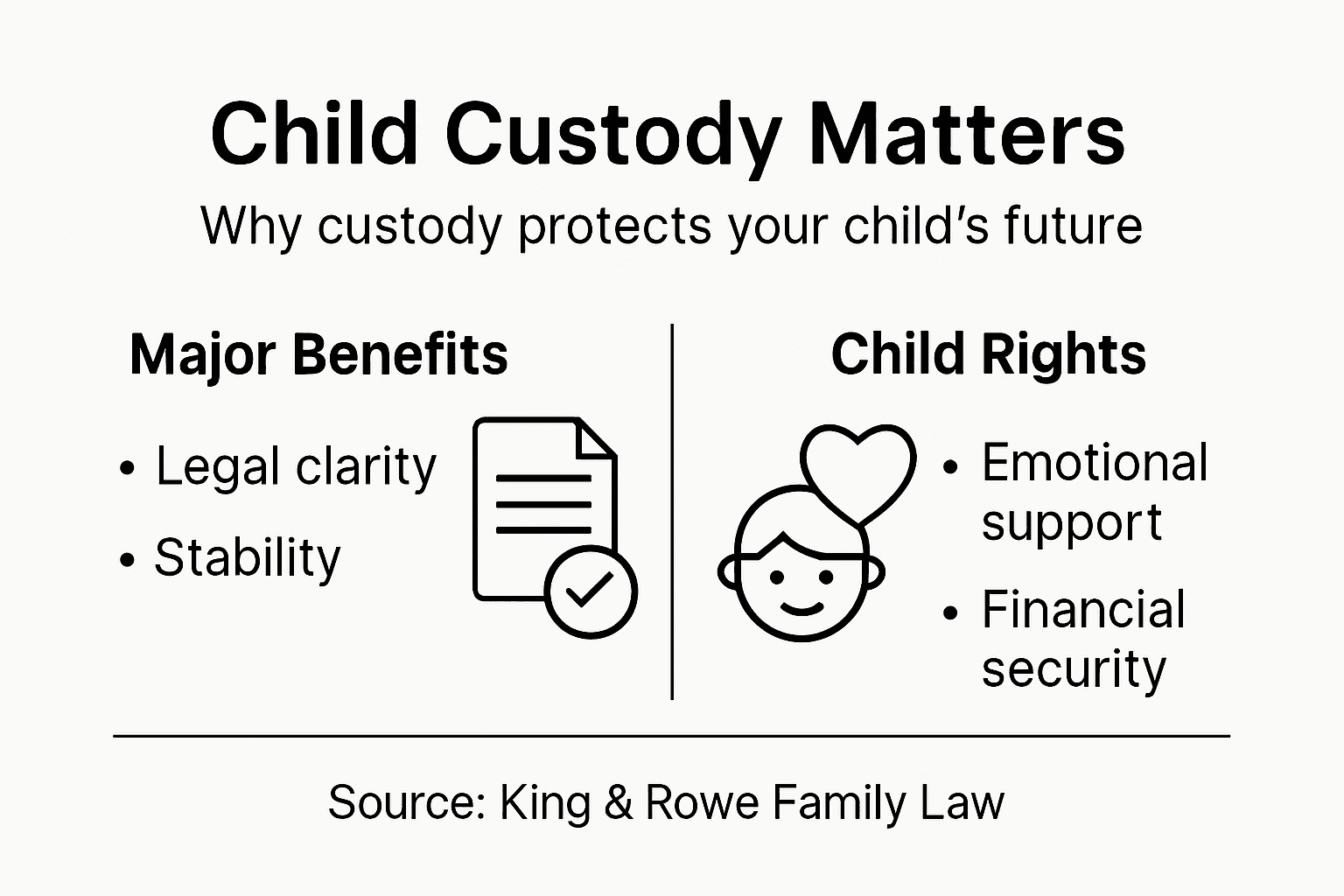
Stability is the cornerstone of child well-being. Children thrive when they understand where they’ll be, who will care for them, and what to expect from day to day. A formal custody order provides exactly this kind of predictability. Rather than navigating uncertain arrangements that could shift based on parental conflict, your child knows they have two homes, two parents, and clear expectations. This stability reduces anxiety and allows children to focus on school, friendships, and normal development instead of worrying about custody changes.
Joint physical custody arrangements show particularly strong outcomes for children’s well-being. When children spend substantial time with both parents, research demonstrates they develop better socio-emotional health and psychological resilience. They maintain stronger relationships with both parents, reducing the sense of loss that sole custody can create. This doesn’t mean 50-50 is always the answer—the specific arrangement matters less than whether it’s stable and serves the child’s needs.
Custody protections benefit children in these specific ways:
- Emotional security: Clear custody arrangements reduce uncertainty and anxiety about where they’ll live and who’s responsible for them.
- Stronger relationships: Defined visitation and custody time ensures consistent contact with both parents, deepening attachments.
- Academic focus: When custody is settled, children perform better academically because they’re not stressed about parental conflict or unstable living situations.
- Reduced parental conflict exposure: Formal arrangements minimize the need for parents to negotiate day-to-day, reducing conflict your child witnesses.
- Legal protection: Custody orders ensure your child’s inheritance rights, health insurance coverage, and medical decision-making are protected.
- Resilience building: Children with stable custody arrangements develop better coping skills and psychological resilience.
Custody isn’t about winners and losers—it’s about creating the stable, nurturing environment where your child can grow. A child with clear custody arrangements feels secure enough to develop friendships, pursue interests, and build confidence.
Without a formal custody arrangement, children live in uncertainty. One parent might feel entitled to take the child whenever they want. Decisions about school changes, medical procedures, or religious participation might create ongoing conflict. Your child becomes caught in the middle, absorbing the stress of parental disagreement. This uncertainty actively harms child development. Children with unstable or contested custody arrangements show higher rates of anxiety, behavioral problems, and academic struggles.
Custody orders also protect your child legally and financially. A formal custody order ensures that if you become incapacitated or die, the designated parent automatically assumes responsibility rather than leaving your child’s future in question. It protects health insurance coverage—courts can order custodial arrangements that keep your child on a parent’s insurance plan. It clarifies inheritance rights and ensures your child’s needs are legally prioritized.

The psychological research is clear: supportive custody arrangements contribute significantly to healthy child development. Children benefit from knowing both parents remain involved and committed to them. They develop stronger social skills, better emotional regulation, and greater academic success when custody is stable and both parents remain meaningfully present. The protection isn’t just emotional—it’s developmental.
When you establish custody, you’re not just settling a legal question. You’re creating the stable foundation your child needs to thrive. You’re signaling to your child that despite the separation, both parents remain committed to them. You’re protecting them from ongoing conflict and uncertainty. You’re giving them permission to maintain relationships with both parents without guilt or fear.
One often-overlooked benefit: custody arrangements protect your child’s identity and sense of belonging. Children in stable custody arrangements know which parent they’ll be with and can maintain meaningful relationships with extended family on both sides. They don’t have to choose loyalty to one parent over the other. They can be fully themselves in both homes.
Pro tip: When developing your custody arrangement, focus on what schedule allows your child to maintain strong relationships with both parents while minimizing transitions and providing stability—courts favor arrangements designed around your child’s needs and school schedule rather than parental preferences.
Protect Your Child’s Future with Trusted Child Custody Guidance
Facing child custody challenges requires clear understanding and strong legal support to protect your child’s well-being and secure a stable future. The article highlights critical pain points such as navigating legal versus physical custody, establishing formal arrangements, and ensuring decisions serve the best interests of your child. Terminology like “joint legal custody,” “best interests of the child,” and “parental responsibilities” show the complexity of these cases. Without expert help, confusion and costly conflicts can harm your child’s stability and emotional health.
At King & Rowe, we specialize in family law matters centered on child custody issues affecting Catawba, Burke, and Caldwell counties. Our team is deeply familiar with local courts and prioritizes personalized solutions to craft clear, enforceable custody orders that emphasize your child’s safety and emotional security. We help you document caregiving schedules, protect parental rights and responsibilities, and defend your interests in court. Don’t wait while uncertainty impacts your child’s well-being.

Get proactive about your child’s future today by consulting with experienced custody attorneys who understand the local landscape. Visit King & Rowe to learn how we can guide you through every step of establishing or modifying your child custody arrangement. Protect what matters most by acting now to create a stable, nurturing environment for your child. Start your journey to confidence and clarity with family law support from King & Rowe today.
Frequently Asked Questions
What is child custody?
Child custody refers to the legal authority and physical responsibility concerning a child. It determines who has the power to make critical decisions regarding the child’s upbringing and where the child will live.
What are the main types of custody arrangements?
The main types of custody arrangements include sole custody, joint legal custody, joint physical custody, and joint custody (both legal and physical). Each arrangement defines the responsibilities and living situations of the parents and the child.
How does a court determine the best interests of the child?
Courts evaluate multiple factors to determine the best interests of the child, such as each parent’s relationship with the child, home stability, the child’s needs and preferences, and parental cooperation in decision-making.
Can custody arrangements be modified in the future?
Yes, custody arrangements are not permanent. They can be modified if there are significant changes in circumstances, such as a parent’s relocation, changes in employment, or shifts in the child’s needs.
Contact King & Rowe Attorneys at Law
 Serving Hickory, NC and surrounding communities
 Phone: 828-466-3858
 Email: kingrowelaw@gmail.com
 Website: www.kingrowelaw.com
Recommended
- What Do I Do If I Suspect or Have Proof My Ex is Putting My Child at Risk? – Hickory Attorneys for Family Law, Criminal Defense, & Estate Planning | King & Rowe
- How is Child Custody Determined? – Hickory Attorneys for Family Law, Criminal Defense, & Estate Planning | King & Rowe
- Top Mistakes to Avoid When Filing for Emergency Custody in North Carolina – Hickory Attorneys for Family Law, Criminal Defense, & Estate Planning | King & Rowe
- Can My Child Choose Which Parent to Live With in North Carolina? – Hickory Attorneys for Family Law, Criminal Defense, & Estate Planning | King & Rowe
- Child Custody Lawyer NH | Protect Your Parental Rights