
Many parents assume custody orders are permanent unless both parties agree to change them, but North Carolina law recognizes that life circumstances evolve and children’s needs shift over time. Failing to file for custody modification when justified can leave your child in an unsafe or unstable environment. Whether you’re facing relocation, safety concerns, or escalating conflict with your co-parent, understanding when and why to pursue modification protects your child’s well-being. This guide explains the legal grounds for custody changes in North Carolina, the circumstances that warrant filing, and the practical steps to navigate the modification process successfully.
Table of Contents
- Understanding Why And When To File For Custody Modification In North Carolina
- Common Circumstances Prompting Custody Modification Petitions
- How North Carolina Courts Evaluate And Decide Custody Modification Requests
- Practical Steps For Parents Filing A Custody Modification In North Carolina
- Get Expert Legal Support For Custody Modifications
- FAQ
Key takeaways
| Point | Details |
|---|---|
| Substantial change standard | North Carolina requires proof that circumstances have changed significantly enough to affect your child’s best interests before modifying custody. |
| Safety and conflict matter | High-conflict escalation and child safety risks now qualify as grounds for modification under recent case law. |
| Court prioritizes children | Judges evaluate modification requests based solely on what serves the child’s physical, emotional, and developmental needs. |
| Evidence drives decisions | Clear documentation of changes, including records and professional evaluations, strengthens your petition significantly. |
| Legal guidance helps | Experienced family law attorneys navigate complex procedures and increase your chances of achieving a favorable outcome. |
Understanding why and when to file for custody modification in North Carolina
Custody modification allows parents to request changes to existing custody orders when circumstances warrant a new arrangement. North Carolina General Statutes Section 50-13.7 governs these modifications, requiring parents to demonstrate a substantial change in circumstances that affects the child’s best interests. This legal threshold exists to prevent constant litigation and provide stability for children, but it also recognizes that rigid orders can become harmful when life changes dramatically.
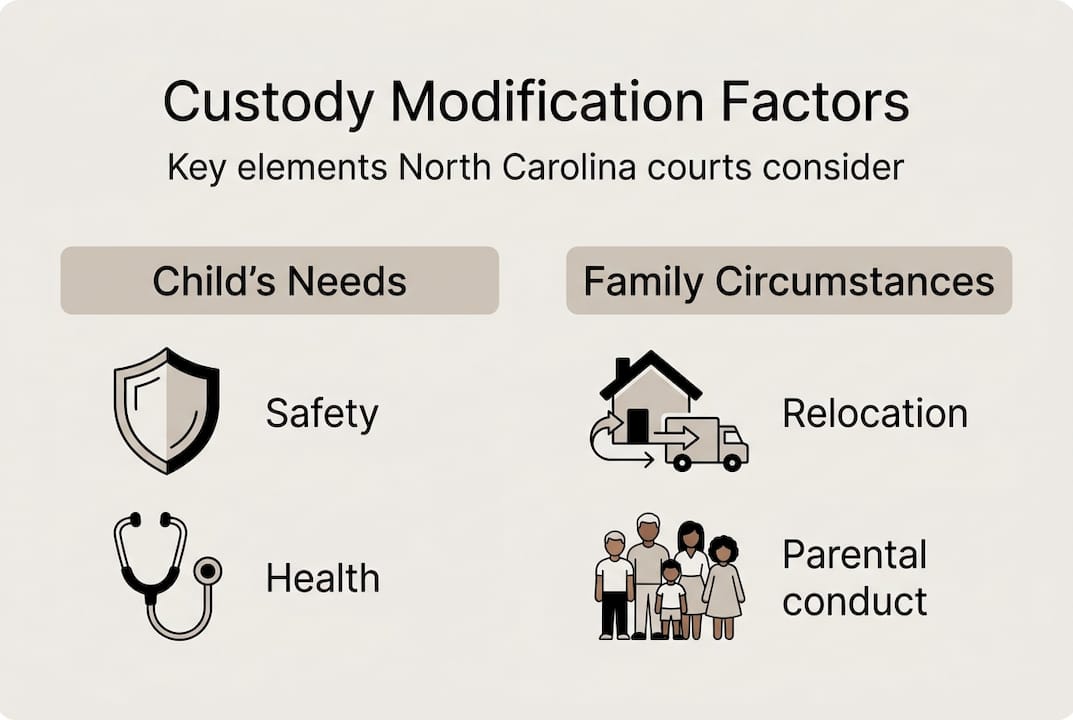
A substantial change means more than minor inconveniences or temporary disruptions. Courts look for significant, ongoing shifts that impact the child’s safety, health, education, or emotional development. For example, a parent’s relocation to another state, a diagnosis requiring specialized care, or evidence of neglect all meet this standard. The key question judges ask is whether the current custody arrangement still serves the child’s needs or whether modification would better support their well-being.
Recent case law expands what qualifies as substantial change. The Durbin v. Durbin decision in 2025 recognized that high-conflict escalation between parents can constitute grounds for modification when it threatens the child’s safety or emotional stability. This ruling acknowledges that ongoing hostility, harassment, or inability to co-parent effectively harms children and justifies court intervention. Parents no longer need to wait for physical danger to emerge before seeking protection through custody changes.
Common qualifying changes include:
- Parent relocation affecting the child’s school, community ties, or access to the other parent
- Substance abuse or mental health crises compromising a parent’s ability to provide safe care
- Changes in the child’s needs, such as medical conditions or educational requirements
- Evidence of abuse, neglect, or unsafe living conditions
- Significant shifts in a parent’s work schedule or living situation impacting their availability
Understanding these grounds helps you assess whether your situation justifies filing. If your current custody order no longer fits real life and you can demonstrate how the change affects your child, you have a viable path forward. Courts want to see that modification serves the child’s interests, not just parental preferences or convenience.
Common circumstances prompting custody modification petitions
Relocation ranks among the most frequent triggers for modification requests. When one parent moves to a different city or state, the existing custody schedule often becomes impractical or impossible to maintain. The relocating parent may seek primary custody to avoid constant travel, while the other parent may file to prevent the move or adjust the arrangement. North Carolina courts evaluate whether relocation serves the child’s interests, considering factors like educational opportunities, family support networks, and the child’s relationship with both parents.
Changes in a child’s health, education, or developmental needs also warrant modification. A child diagnosed with autism may require specialized therapies available only near one parent’s home. A teenager struggling academically might benefit from attending a different school district where the other parent lives. These situations demonstrate how children’s evolving needs can outgrow existing custody arrangements, making modification necessary rather than optional.

Parental behavior changes present serious grounds for modification. Substance abuse relapses, criminal charges, domestic violence incidents, or mental health crises all raise legitimate safety concerns. When you suspect or have proof your ex is putting your child at risk, documenting these issues becomes critical. Courts prioritize child safety above all else, and evidence of dangerous behavior typically results in swift modifications to protect the child.
High-conflict escalation between parents now qualifies as substantial change under the Durbin 2025 ruling. If ongoing disputes, harassment, or inability to communicate effectively threatens your child’s emotional well-being, you can seek modification even without physical danger. This includes situations where one parent consistently undermines the other, exposes the child to conflict, or refuses to follow court orders. The law recognizes that chronic hostility harms children and justifies intervention.
Other common circumstances include:
- A parent’s work schedule changing dramatically, affecting their availability for parenting time
- New romantic partners or household members creating unsafe environments
- Financial hardships impacting a parent’s ability to provide adequate housing or care
- One parent consistently violating custody orders or interfering with the other’s time
- The child expressing strong preferences as they mature and gain capacity to voice their needs
Pro Tip: Start documenting relevant incidents immediately. Keep detailed records of communication with your co-parent, photographs of concerning conditions, medical or school reports, and witness statements. This evidence forms the foundation of your modification case and helps demonstrate the substantial change courts require.
How North Carolina courts evaluate and decide custody modification requests
North Carolina judges apply the best interests of the child standard when evaluating modification requests, examining multiple factors to determine what arrangement serves the child most effectively. Unlike initial custody determinations that start from a neutral position, modifications require proving both substantial change and that the new arrangement better serves the child. This higher burden exists because courts value stability and avoid disrupting children’s lives without compelling reasons.
Key factors courts consider include the child’s safety and physical well-being, emotional bonds with each parent, stability of each home environment, each parent’s ability to meet the child’s needs, and the child’s adjustment to school and community. Judges also evaluate each parent’s willingness to facilitate the relationship with the other parent, history of domestic violence or substance abuse, and the child’s reasonable preference if they’re mature enough to express one. These factors mirror those used in initial custody determinations, but courts weigh them against the existing order rather than starting fresh.
| Factor | Initial Custody Decision | Modification Decision |
|---|---|---|
| Burden of proof | Neither parent has advantage | Moving party must prove substantial change |
| Starting point | Neutral evaluation of both parents | Existing order presumed appropriate |
| Focus | Establishing best arrangement | Demonstrating current order no longer works |
| Evidence needed | General parenting capabilities | Specific changes since original order |
| Child preference weight | Considered if child is mature | Given more weight as child ages |
The modification process follows specific procedural steps:
- Filing a formal motion for modification with the clerk of court in the county where the original order was entered
- Serving the other parent with notice of your petition and court date
- Attending mediation if required by your county to attempt settlement
- Participating in a hearing where both parties present evidence and testimony
- Receiving the judge’s written order granting or denying modification
Evidence quality significantly influences outcomes. Courts respond to concrete documentation rather than vague allegations or emotional appeals. Medical records showing a parent’s substance abuse treatment, police reports documenting domestic incidents, school records reflecting a child’s struggles, and expert evaluations from therapists or custody evaluators carry substantial weight. Conversely, unsupported claims or attempts to manipulate the system typically backfire and damage credibility.
Pro Tip: Focus all evidence and testimony on your child’s needs rather than criticizing your co-parent. Judges appreciate parents who demonstrate concern for the child’s welfare rather than personal grievances. Presenting child-focused evidence, such as how the modification would improve your child’s school performance or emotional stability, resonates more effectively than attacking the other parent’s character.
Understanding why courts establish custody based on best interests helps you frame your modification request appropriately. Judges want to see that you’re seeking change to benefit your child, not to punish your ex or gain leverage in other disputes.
Practical steps for parents filing a custody modification in North Carolina
Before filing, honestly assess whether your circumstances meet the legal threshold for modification. Ask yourself whether the changes are substantial, ongoing, and directly impact your child’s well-being. Temporary inconveniences or minor disagreements rarely justify modification. However, if you’ve experienced significant life changes affecting your child’s safety, health, education, or emotional development, you likely have grounds to proceed.
Gathering thorough documentation forms the foundation of your case. Collect evidence systematically:
- Communication records showing problematic behavior, threats, or refusal to cooperate
- Medical records documenting health issues, injuries, or treatment needs
- School reports reflecting academic performance, attendance, or behavioral concerns
- Photographs or videos showing unsafe conditions or concerning situations
- Witness statements from teachers, doctors, therapists, or family members who’ve observed relevant issues
- Financial records if economic changes affect a parent’s ability to provide care
- Police reports or court documents related to criminal charges or protective orders
Organize this evidence chronologically and create summaries highlighting key points. Courts appreciate clear, well-organized presentations that make it easy to understand the substantial changes you’re alleging.
Filing the formal petition requires completing specific court forms available from your county clerk of court or online through North Carolina’s judicial system website. The petition must state the substantial change in circumstances, explain why modification serves your child’s best interests, and specify what custody arrangement you’re requesting. Be precise and factual rather than emotional or accusatory. Submit the completed forms to the clerk along with any required filing fees.
Serving the other parent legally is mandatory. North Carolina requires proper service through a sheriff’s deputy or certified process server, ensuring your co-parent receives official notice of your petition and the court date. Never attempt to serve papers yourself, as this violates procedural rules and can result in your case being dismissed. After service, the other parent has a specified time to respond, typically 30 days.
Preparing for mediation or hearings requires strategic thinking. Many North Carolina counties mandate mediation before scheduling a custody hearing, giving parents an opportunity to negotiate modifications without trial. Approach mediation with realistic expectations and willingness to compromise on secondary issues while protecting your core concerns. If mediation fails or isn’t required, prepare for a formal hearing where you’ll present evidence, call witnesses, and testify under oath.
Common pitfalls to avoid include:
- Filing prematurely before gathering sufficient evidence
- Violating the existing custody order while your modification is pending
- Badmouthing your co-parent to your child or in court documents
- Failing to follow court procedures or missing deadlines
- Representing yourself in complex cases involving abuse or relocation
- Focusing on punishing your ex rather than advocating for your child
Pro Tip: Consult with a qualified family law attorney early in the process, even if you’re considering self-representation. An initial consultation can help you understand whether your case has merit, what evidence you need, and what outcomes are realistic. Essential family law tips for North Carolina parents can guide you through common challenges, but professional legal advice tailored to your specific situation prevents costly mistakes and improves your chances of success.
Understanding why hiring a family law firm benefits your case helps you make informed decisions about representation. Experienced attorneys know local judges, understand courtroom procedures, and can anticipate opposing arguments, giving you significant advantages in modification proceedings.
Get expert legal support for custody modifications
Navigating custody modification in North Carolina requires both legal knowledge and strategic advocacy. King & Rowe brings over a decade of family law experience to parents facing custody challenges across Catawba, Burke, and Caldwell counties. Our divorce and family law attorneys understand the emotional stakes involved when your child’s welfare hangs in the balance and work tirelessly to protect your parental rights while prioritizing your child’s best interests.

We provide comprehensive support throughout the modification process, from initial case evaluation through final orders. Our team handles evidence gathering, court filings, mediation representation, and trial advocacy, allowing you to focus on your child while we manage the legal complexities. With over 1500 successful cases and deep knowledge of local courts, we deliver personalized strategies that achieve results. Our ultimate guide to child custody offers additional resources, and our estate planning attorneys can help you secure your family’s future beyond custody matters. Contact us today to schedule a consultation and take the first step toward protecting your child’s well-being.
FAQ
What qualifies as a substantial change in circumstances for custody modification?
Substantial changes include relocation, safety risks, and high-conflict escalation that affect your child’s well-being. The change must be significant, ongoing, and directly impact your child’s physical safety, emotional health, education, or overall development. Temporary inconveniences or minor disagreements don’t meet this standard, but major life shifts like a parent’s substance abuse relapse, a child’s new medical needs, or documented abuse qualify.
How long does the custody modification process take in North Carolina?
The process typically takes several months depending on court schedules, case complexity, and whether mediation resolves the dispute. Simple modifications with parental agreement can be finalized in weeks, while contested cases requiring hearings may take six months or longer. Many counties require mediation before scheduling hearings, which can add time but often leads to faster resolutions than trial.
Can I file for custody modification without an attorney?
You can represent yourself, but North Carolina custody procedures are complex and mistakes can harm your case. Courts expect you to follow the same rules as attorneys, including proper evidence presentation, procedural compliance, and legal argument standards. Hiring a family law firm significantly improves your chances of success and reduces stress during an already difficult process. Professional representation is especially critical in cases involving abuse, relocation, or high conflict.
What happens if the court denies my custody modification request?
Denial doesn’t prevent you from filing again if new substantial changes occur or additional evidence emerges. You can also appeal the decision if you believe the judge made legal errors, though appeals require specific procedural grounds and strict deadlines. Courts remain focused on your child’s best interests, so demonstrating how circumstances have changed since the denial can support a new petition. Continue documenting relevant changes and consult an attorney about your options moving forward.
Recommended
- 6 Winning Child Custody Tips for Divorced Parents
- Top Mistakes to Avoid When Filing for Emergency Custody in North Carolina – Hickory Attorneys for Family Law, Criminal Defense, & Estate Planning | King & Rowe
- Role of judge in family law in North Carolina 2026
- 7 Essential Family Law Tips for North Carolina Parents