
Navigating alimony laws in North Carolina presents significant legal and emotional challenges for individuals facing separation or divorce. Understanding eligibility requirements, documentation needs, and strategic considerations is crucial for protecting your financial interests and achieving favorable outcomes. This comprehensive guide clarifies the legal framework governing alimony in North Carolina, outlines essential preparation steps, and provides actionable strategies to help you approach your case with confidence and clarity.
Table of Contents
- Understanding Alimony Basics And Eligibility In North Carolina
- Gathering Documents And Evidence To Support Your Alimony Claim
- Strategizing Your Alimony Case And Court Procedures In North Carolina
- Common Mistakes To Avoid And Verification Steps Before Your Alimony Hearing
- How King & Rowe Can Support Your Alimony Case Preparation
- Frequently Asked Questions
Key takeaways
| Point | Details |
|---|---|
| Alimony eligibility criteria | Awards depend on financial need, ability to pay, and marital misconduct factors under NC law. |
| Misconduct impact | Illicit sexual behavior by the dependent spouse bars alimony, while supporting spouse misconduct may require payment. |
| Documentation requirements | Comprehensive financial records, tax returns, pay stubs, bank statements, and evidence of expenses are essential for case preparation. |
| Post-separation support | This temporary financial aid differs from long-term alimony and serves as interim relief during legal proceedings. |
| Marriage length matters | Longer marriages typically result in extended alimony duration, reflecting established lifestyle and financial interdependence. |
Understanding alimony basics and eligibility in North Carolina
North Carolina law defines two critical roles in alimony proceedings: the dependent spouse and the supporting spouse. The dependent spouse lacks sufficient income or property to meet reasonable needs independently after separation. The supporting spouse possesses the financial capacity to provide assistance while maintaining their own standard of living. These designations form the foundation of every alimony case.
Eligibility for alimony centers on demonstrating genuine financial need and the other party’s ability to pay. Courts evaluate income sources, assets, debts, and living expenses for both parties. Alimony is awarded based on the dependent spouse’s need and the supporting spouse’s ability to pay, considering various factors including marital misconduct. Unlike some states, North Carolina does not automatically grant alimony in divorce cases. You must prove entitlement through evidence and legal argument.
Marital misconduct plays a decisive role in alimony determinations. Illicit sexual behavior can bar a dependent spouse from receiving alimony entirely under North Carolina statutes. Conversely, if the supporting spouse committed such misconduct, courts may require them to pay alimony regardless of other factors. Significant misconduct types include:
- Adultery or extramarital sexual relationships
- Abandonment of family without justification
- Cruel or barbarous treatment endangering life
- Indignities rendering life burdensome
- Excessive use of alcohol or drugs
- Involuntary separation due to criminal conduct
Pro Tip: Document any marital misconduct with dates, witnesses, and supporting evidence immediately. Text messages, emails, and financial records showing suspicious expenditures can substantiate claims that significantly impact alimony eligibility and award amounts.
Understanding these foundational principles helps you assess your case strength realistically. The ultimate alimony guide provides additional resources for evaluating your specific circumstances. North Carolina courts maintain broad discretion in weighing factors, making thorough preparation and strategic presentation essential for protecting your interests throughout the legal process.
Gathering documents and evidence to support your alimony claim
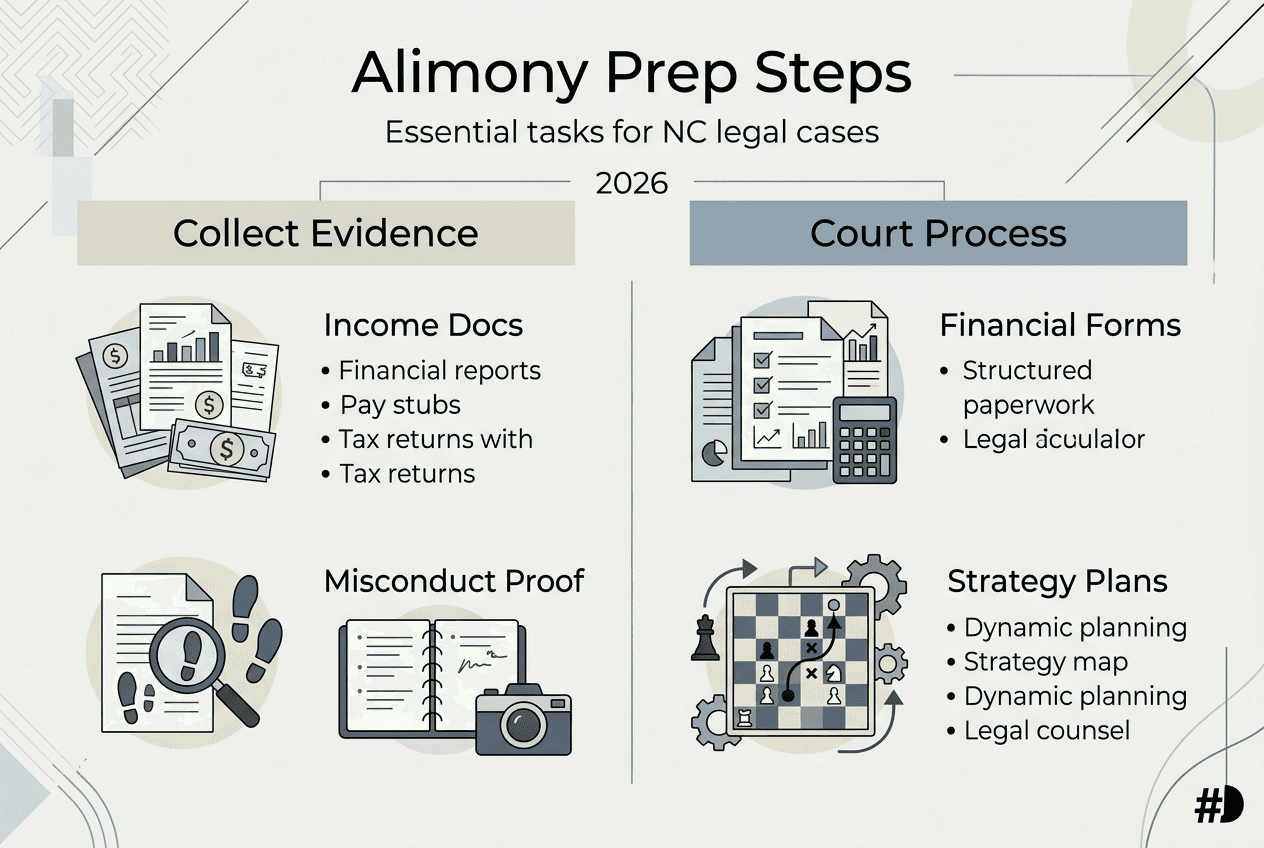
Building a compelling alimony case requires meticulous documentation of financial circumstances and relevant evidence. Courts rely on concrete proof rather than verbal assertions when evaluating need and ability to pay. Start gathering these essential financial documents immediately:
- Federal and state tax returns for the past three to five years
- Recent pay stubs, W-2 forms, and 1099 statements showing all income sources
- Bank statements for checking, savings, and investment accounts covering at least 12 months
- Credit card statements and documentation of all outstanding debts
- Mortgage statements, rent receipts, and property tax records
- Utility bills, insurance premiums, and recurring monthly expenses
- Retirement account statements including 401(k), IRA, and pension documentation
- Business financial records if self-employed, including profit and loss statements
The court evaluates all financial resources, including assets and income, not just current earnings. This comprehensive review means you must disclose investment income, rental property proceeds, inheritance, and any other wealth sources. Incomplete disclosures damage credibility and can result in unfavorable rulings or sanctions.

Evidence of marital misconduct requires careful collection and preservation. If misconduct affects your case, gather text messages, emails, photographs, hotel receipts, credit card statements showing suspicious charges, and witness contact information. Create a detailed timeline documenting specific incidents with dates and circumstances. Store digital evidence securely with backup copies to prevent loss or destruction.
Pro Tip: Organize documents chronologically within category folders labeled clearly for easy reference during hearings. Create a master index listing each document type, date range, and folder location to streamline attorney review and court presentation.
Track any post-separation support payments or financial assistance provided since separation. Maintain detailed records showing payment dates, amounts, and methods. This history demonstrates financial patterns and establishes baseline support levels that inform permanent alimony determinations. Courts consider past support when evaluating reasonable ongoing needs.
Avoid common divorce mistakes in North Carolina by maintaining thorough records from separation forward. The quality and completeness of your documentation directly impacts case outcomes. Missing records create gaps that opposing counsel exploits, while comprehensive evidence strengthens your position and facilitates efficient resolution.
Strategizing your alimony case and court procedures in North Carolina
Navigating North Carolina alimony proceedings requires understanding sequential court steps and developing strategy aligned with legal requirements. The process typically follows this progression:
- Filing the initial complaint or counterclaim requesting alimony
- Service of process and opposing party’s response
- Discovery phase exchanging financial information and evidence
- Pre-trial conferences and settlement negotiations
- Temporary hearings for post-separation support if needed
- Final alimony hearing presenting evidence and arguments
- Court order establishing alimony terms and duration
Presenting clear, accurate financial disclosures forms the cornerstone of effective case strategy. The court considers various factors, including income, expenses, and the standard of living during the marriage when determining appropriate support levels. Prepare detailed monthly budget worksheets showing housing costs, transportation, food, healthcare, insurance, debt payments, and discretionary expenses. Compare marital lifestyle to post-separation circumstances, highlighting significant disparities.
Strategic considerations vary based on case-specific factors. If marital misconduct exists, decide whether to pursue or defend against misconduct claims based on available evidence strength. Evaluate negotiation opportunities for settling support amounts and duration outside court, which provides greater control over outcomes and reduces litigation costs. Consider marriage length when proposing alimony duration, as longer marriages justify extended support periods reflecting established interdependence.
| Support Type | Duration | Purpose | Modification |
|---|---|---|---|
| Post-separation support | Temporary until alimony hearing | Bridge financial gap during proceedings | Court may modify based on changed circumstances |
| Alimony | Specified term or permanent | Long-term financial support | Modifiable upon substantial change in circumstances |
Judges exercise considerable discretion evaluating equitable factors beyond strict financial formulas. The role of judge in NC family law involves weighing credibility, assessing evidence quality, and balancing competing interests. Present your case professionally with organized exhibits, coherent testimony, and respectful courtroom demeanor. Judges respond favorably to parties demonstrating preparation, honesty, and reasonable positions.
Develop contingency plans addressing potential outcomes. If the court denies or reduces your requested amount, understand modification procedures and circumstances justifying future adjustments. Alimony remains modifiable upon substantial changes in circumstances like income loss, remarriage, or cohabitation. Building flexibility into your strategy acknowledges legal realities while positioning you for optimal results given your specific situation.
Common mistakes to avoid and verification steps before your alimony hearing
Many alimony cases suffer from preventable errors that undermine otherwise strong positions. Incomplete or inaccurate financial disclosures represent the most damaging mistake. Courts impose sanctions for discovery violations and draw negative inferences against parties hiding assets or income. Triple-check all financial statements for accuracy and completeness before submission. Verify account balances match statements and all income sources appear in documentation.
Ignoring marital misconduct evidence creates strategic vulnerabilities. Even if misconduct seems minor or you prefer avoiding conflict, opposing counsel will exploit documented incidents. Address misconduct proactively in your case strategy rather than reacting defensively during hearings. Prepare explanations for any conduct that might be misconstrued and gather contradictory evidence refuting false allegations.
Failure to organize documents chronologically and categorically wastes valuable hearing time and frustrates judges. Create indexed binders with tabbed sections for each document category. Make multiple copies: one for the court, one for opposing counsel, one for your attorney, and one for your reference. Disorganized presentation suggests lack of preparation and diminishes credibility on substantive issues.
A common misconception is that alimony is automatically awarded in every divorce. You must prove entitlement through evidence demonstrating need and the other party’s ability to pay.
Prepare thoroughly for court questions and potential settlement negotiations. Judges frequently ask detailed questions about specific expenses, income sources, and lifestyle choices. Practice explaining your financial situation clearly and concisely. Anticipate challenging questions about discretionary spending, employment decisions, or cohabitation arrangements. Honest, direct answers maintain credibility even when addressing unfavorable facts.
Verify hearing readiness using this checklist:
- All required financial documents copied, organized, and indexed
- Witness list prepared with contact information and testimony summaries
- Evidence of marital misconduct authenticated and admissible
- Monthly budget worksheet completed with supporting documentation
- Settlement position defined with acceptable ranges and deal breakers
- Transportation and childcare arrangements confirmed for hearing date
- Professional attire selected and courtroom location confirmed
Pro Tip: Conduct a mock hearing with your attorney reviewing potential questions and practicing responses. This preparation builds confidence, identifies weaknesses in your presentation, and ensures you communicate key points effectively under pressure.
Understand that alimony remains conditional rather than guaranteed. Even strong cases face uncertainty given judicial discretion and fact-specific analysis. Avoid common divorce mistakes in North Carolina by maintaining realistic expectations and focusing on controllable preparation elements. Thorough verification and mistake avoidance maximize your chances for favorable outcomes while minimizing stress and uncertainty throughout the process.
How King & Rowe can support your alimony case preparation
Navigating North Carolina alimony laws requires experienced legal guidance tailored to your unique circumstances. King & Rowe provides comprehensive support throughout every stage of alimony case preparation, from initial documentation through final court proceedings. Our divorce and family law attorneys bring deep knowledge of local courts, judges, and procedural requirements across Catawba, Burke, and Caldwell counties.

Our team helps you develop strategic approaches addressing financial disclosures, misconduct considerations, and settlement negotiations. We organize evidence effectively, prepare compelling presentations, and advocate aggressively for your interests during hearings. Beyond alimony matters, our alimony legal resources and estate planning services support long-term financial security and family protection. With over 1500 successful cases, King & Rowe delivers personalized service combining local expertise with proven results for clients throughout western North Carolina.
Frequently asked questions
What is a dependent spouse in North Carolina alimony cases?
A dependent spouse lacks sufficient income, property, or resources to meet reasonable needs independently after separation. This legal status is necessary to seek alimony support from the other party. Courts evaluate all financial resources, not just employment income, when determining dependency.
How does marital misconduct affect alimony awards?
Illicit sexual behavior by the dependent spouse completely bars alimony awards under North Carolina law. Conversely, if the supporting spouse committed such misconduct, courts may require them to pay alimony regardless of other factors. Other misconduct types influence award amounts and duration but do not create absolute bars.
What distinguishes post-separation support from alimony?
Post-separation support provides temporary financial aid pending final alimony determination during divorce proceedings. It serves as a bridge maintaining financial stability while the case progresses. Alimony represents longer-term support awarded after final court decisions based on comprehensive factor analysis.
How does the length of marriage impact alimony duration?
Longer marriages typically result in extended alimony duration, reflecting the lifestyle and financial interdependence developed over time. Courts recognize that spouses in lengthy marriages often sacrifice career opportunities and develop reasonable reliance on marital income. Short marriages generally warrant limited or no alimony absent exceptional circumstances.
Recommended
- Common Mistakes to Avoid During a Divorce in North Carolina – Hickory Attorneys for Family Law, Criminal Defense, & Estate Planning | King & Rowe
- What Happens to the House in a North Carolina Divorce? – Hickory Attorneys for Family Law, Criminal Defense, & Estate Planning | King & Rowe
- 6 Winning Child Custody Tips for Divorced Parents
- What Happens If My Spouse Won’t Sign Divorce Papers in North Carolina? – Hickory Attorneys for Family Law, Criminal Defense, & Estate Planning | King & Rowe