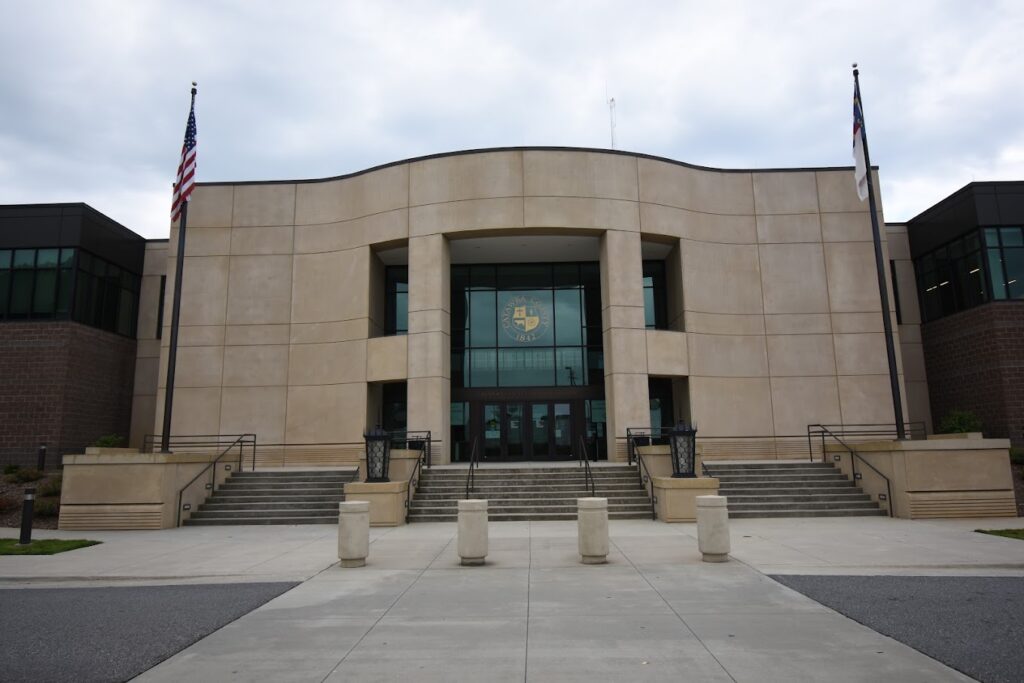
Walking into the Catawba County Justice Center for the first time can feel overwhelming — eight courtrooms can be in session at once, deputies in plain clothes patrol the halls, and the printed signs at the entrance don’t always match what the bailiffs upstairs tell you. This guide is what we wish every client knew before they show up at 100 Government Drive in Newton.
Key takeaways
| Point | Details |
|---|---|
| Where to go | 100 Government Drive, Building E, Newton, NC 28658 — about 10 miles east of Hickory via NC-127 and US-321. |
| Park | Free lots adjacent to the building, plus a parking deck across Government Drive. Arrive at least 30 minutes early on a court day. |
| Bring | Photo ID, your citation or court papers, a notebook, and any documents your attorney asked you to bring. |
| Don’t bring | Weapons of any kind, recording devices inside courtrooms, food, or open drinks. |
| Hours | The building is open 8:00 AM – 5:00 PM, Monday through Friday. District Court calendar call typically begins at 9:30 AM; Superior Court at 9:00 AM. |
What the Catawba County Justice Center handles — and where your case fits
The Catawba County Justice Center is the courthouse where every state-court matter in Catawba County is decided. Newton has been the county seat since 1845, and the current Justice Center consolidated the county’s older court buildings into a single modern complex on Government Drive.
Cases at the Justice Center are split into two main court divisions:
- District Court — handles misdemeanors (including DWI and most criminal traffic), civil family law (divorce, custody, alimony, equitable distribution), small claims, infractions (traffic tickets), and domestic violence protective orders under .
- Superior Court — handles felony charges, civil matters above $25,000, appeals from District Court, and special proceedings.
For most people charged with a crime, ticketed for a traffic offense, or filing a divorce in Catawba County, your case starts (and usually ends) in District Court. Felony cases — drug trafficking, serious assaults, habitual offenses — get transferred to Superior Court after the probable cause hearing.
| Your case type | Court division | Where it’s heard |
|---|---|---|
| DWI / DUI charge | District Criminal | Designated DWI calendar days |
| Misdemeanor (assault, larceny, possession) | District Criminal | Daily criminal calendars |
| Speeding ticket / traffic infraction | District Infractions | Traffic court |
| Felony (Class I through Class A) | Superior Criminal | Periodic sessions, multiple weeks per term |
| Divorce, custody, alimony | District Civil (Domestic) | Family court calendar |
| Domestic violence protective order (50B) | Domestic Violence Court | Specific calendar days |
| Small claims (under $10,000) | Small Claims | Weekly sessions |
| Juvenile matter | Juvenile Court | Closed sessions |
The Justice Center also houses Catawba County’s Veterans Treatment Court, established in 2021. Veterans Court offers eligible veteran defendants an alternative to traditional sentencing that emphasizes treatment, accountability, and connection to VA services. If you’re a veteran charged with a non-violent offense, ask your attorney whether you might qualify — it can substantially change the trajectory of your case.
Pro Tip: The Catawba County Justice Center publishes its full criminal docket online through the North Carolina Administrative Office of the Courts. Before your court date, look up your case at the and confirm your courtroom assignment. Calendars get amended. Cases get moved. Don’t rely on what’s printed on your citation — confirm online the morning before.
Arriving at the Justice Center: parking, security, and entry
The Justice Center is at 100 Government Drive in Newton, marked as Building E within the larger Catawba County government complex. The building sits on the east side of Newton, set back from US-321.
Driving from Hickory: Take NC-127 South through downtown Hickory, then turn east on US-321 toward Newton. The drive is roughly 10 miles and takes about 20 minutes in normal traffic — longer during the morning rush between 7:30 and 9:00 AM, which is also when court traffic is heaviest.
From Lenoir (Caldwell County), allow 35 minutes via US-321 South.
From Morganton (Burke County), allow 40 minutes via I-40 East and US-321 South.
Parking
The Justice Center has two parking options:
- Adjacent surface lots — free, first-come-first-served. These fill up by about 8:45 AM on busy court days.
- The parking deck across Government Drive — also free, with more capacity, but a four-minute walk to the courthouse entrance.
If you have a 9:00 AM court date, plan to arrive by 8:30 AM at the latest. The morning rush at the security checkpoint can run 15 minutes long during a heavy calendar day, and being marked absent at calendar call has serious consequences (more on that below).
Security and entry
Every person entering the Justice Center walks through a metal detector staffed by court deputies (called bailiffs). What you can and cannot bring:
- No weapons of any kind. This includes pocket knives, mace, multitools, and anything else classified as a weapon. There is no “check it at the door” service — if you bring a weapon, you’ll be sent back to your car. Repeat offenders can face their own charges.
- No recording devices inside courtrooms. Phones, cameras, audio recorders, and tablets capable of recording video are prohibited inside courtrooms themselves. Phones are permitted in hallways and waiting areas, but they must be silenced.
- No food or drinks inside courtrooms.
The cell phone rule deserves special attention. Under , disturbing the court — which includes a ringing or buzzing phone during proceedings, a phone going off during testimony, or surreptitiously recording courtroom audio or video — is a Class 2 misdemeanor punishable by up to 30 days in jail. Bailiffs at the Catawba County Justice Center routinely confiscate phones that ring during a hearing. If you’re caught recording, you can be held in contempt on the spot.
Pro Tip: Leave your phone in your car. We know it’s the modern equivalent of leaving your wallet behind, but the convenience of having it isn’t worth forgetting to silence it before walking into court. A surprising number of contempt holdings every year start with someone’s phone going off during a judge’s ruling.
What to wear
There is no formal dress code, but judges and bailiffs treat the courtroom as a place of professional respect — and dressing for that respect can make a meaningful difference.
Avoid:
- Shorts, tank tops, or sleeveless shirts
- Clothing with profanity or drug, weapon, or violent imagery
- Hats indoors (religious head coverings excepted)
- Sunglasses
- Pajamas or sleepwear
What works: business casual. A clean shirt with a collar, slacks or a modest dress, closed-toe shoes. You’re not auditioning for a courtroom drama — you’re showing the judge you take your case seriously.
The courtrooms and how cases are scheduled
The Justice Center has as many as eight courtrooms in session simultaneously during a busy weekday morning. Each courtroom is numbered, and your courtroom assignment is on the printed docket posted outside the main entrance every morning around 8:30 AM.
Most calendars at the Justice Center follow the same general flow:
- Calendar call — the clerk reads every name on the day’s docket. You must be present and answer when your name is called. If you’re not there, the judge may issue a failure-to-appear (FTA) order on the spot.
- Pleas and continuances first — the judge typically handles cases where someone is pleading guilty or asking for a continuance before moving to contested matters. This can take an hour or more.
- Contested matters — if you’re contesting your charge, expect to wait. You may sit in the courtroom for 2–3 hours before your case is called. Bring something to read.
- Resolution — when your case is finally called, you stand at counsel table. Your attorney speaks for you. Answer the judge directly and only when asked. Address the court as “Your Honor.”
Typical court schedules at the Justice Center
| Court / Calendar | Typical days | Typical start |
|---|---|---|
| District Criminal (misdemeanors, traffic infractions) | Monday through Friday | 9:30 AM |
| District DWI calendar | Designated calendar days (confirm) | 9:30 AM |
| Superior Criminal | Selected weeks of the month | 9:00 AM |
| District Civil (family law) | Tuesdays and Thursdays | 9:30 AM |
| Domestic Violence Court (50B hearings) | Designated weekly calendar | 9:30 AM |
| Small Claims | Designated days | 9:00 AM |
| Juvenile Court | Closed sessions, by appointment | Varies |
These schedules shift. Calendar days for DWI, family, and domestic violence courts can change session to session. Always confirm your court date and courtroom assignment online or with your attorney before driving to Newton.
What to expect on the day of your court appearance
A typical morning at the Justice Center looks like this:
8:00 AM — Building opens. The security checkpoint line begins forming around 8:15.
8:30 AM — The day’s dockets are posted near the main entrance. Find your name on the printed list. Note your courtroom number. If your name isn’t on the docket and you have a citation or notice telling you to be there today, go directly to the clerk of court’s office. Cases occasionally get continued or reassigned without proper notification.
9:00–9:30 AM — Calendar call begins in each courtroom. The courtroom doors are open at this point; you can enter and find a seat in the public benches behind the bar. Phones silenced and pocketed. Hats off.
Mid-morning — Most pleas and continuances are processed. If you’re pleading guilty or asking for a continuance, expect to be called before the contested matters.
Late morning — Contested matters begin. If you have a DWI trial, a contested traffic case, or a contested motion, you may be called any time from now until early afternoon.
12:00–1:30 PM — Lunch recess. The courtroom empties. If your case wasn’t reached before recess, you’ll come back at the time the judge specifies — usually 1:30 or 2:00 PM.
1:30 PM — Afternoon calendar resumes. Contested matters continue.
4:30 PM — Most courts try to finish by this time, though contested trials and motion hearings can run later.
Where to find your courtroom
Each floor of the Justice Center has a numbered courtroom directory near the elevators. Bailiffs and clerks at the information desk inside the main entrance can also point you to your assigned courtroom. Don’t wander into courtrooms — interrupting a hearing in progress isn’t a good look in front of any judge.
Pro Tip: When you walk into your courtroom, sit on the public side of the railing (called the bar). The area in front of the bar is reserved for attorneys, defendants currently being addressed, and court personnel. Sitting in the wrong section is one of the fastest ways to draw a bailiff’s attention — and not in a good way.
What happens if you’re late or don’t show up
If you fail to appear when your name is called at calendar call, the consequences are immediate and serious. The judge can:
- Issue a failure-to-appear (FTA) order, which becomes a warrant for your arrest.
- Order your driver’s license suspended for failure to appear on a traffic charge, under .
- Forfeit any bond you posted.
- Set a new court date with additional FTA charges added.
If you’re going to be late, call the clerk of court at (828) 695-6100 immediately. Most judges will hold a case for a brief delay if your attorney is present and can explain. Showing up late without notice — or not at all — almost always makes things worse. (See our full guide on for the recovery options.)
Working with King & Rowe at the Catawba County Justice Center
Our office is at 2017 N Center Street in Hickory, about 10 miles west of the Justice Center. King & Rowe represents clients at the Catawba County Justice Center on most court days — DWI calendars, criminal misdemeanor and felony matters, domestic violence hearings, divorce and custody proceedings, and traffic court.
Because we appear there routinely, we know:
- The current docket clerks and their preferences for scheduling
- Which bailiffs run security on which days, and how they communicate with the bench
- How each judge typically runs their courtroom, and what tends to land well
- The fastest route from the parking deck to each numbered courtroom
- Which morning calendars run quickly and which always run long
We use that familiarity to do three things every client needs:
- Prepare you for the room you’ll walk into. Before your first court date, we walk you through exactly where to park, where to check in, what to bring, and what your case is most likely to look like that day.
- Read the room on court day. We watch the judge’s tone, the prosecutor’s priorities, and the calendar’s pace — and we adjust the strategy in real time.
- Stay through the end. Even if your case is the last one called at 4:45 PM, we don’t leave.
Schedule a consultation
If you’ve been charged with a crime, served with a domestic violence protective order, or received a notice to appear at the Catawba County Justice Center, the next step is to talk to an attorney before your court date — not on the morning of.
Call King & Rowe at (828) 466-3858 to schedule a consultation. We handle , , and matters throughout Catawba County — including Hickory, Newton, Conover, Claremont, and Maiden — and across the broader region in and counties.
You can also reach us through our for a same-day response, or visit our directly.
Frequently asked questions
What is the address of the Catawba County Justice Center?
The Catawba County Justice Center is at 100 Government Drive, Building E, Newton, NC 28658. The main phone number is (828) 695-6100. It’s about 10 miles east of downtown Hickory via NC-127 South and US-321 East.
Can I bring my cell phone into the Catawba County courthouse?
You can bring your phone into the Justice Center and use it in the hallways, public waiting areas, and outside the building. Phones must be silenced and put away inside courtrooms. Recording any courtroom proceeding is prohibited and can result in contempt charges under , which carries up to 30 days in jail. Bailiffs routinely confiscate phones that ring during proceedings. The safest move: leave your phone in your car.
What time does court start at the Catawba County Justice Center?
Most District Court calendars begin at 9:30 AM. Superior Court typically starts at 9:00 AM. Calendar call is when the judge confirms who is present — if you’re not there when your name is called, the judge may issue a failure-to-appear order. Arrive at the building no later than 8:30 AM so you have time to clear security and find your courtroom.
What happens if I miss my court date in Catawba County?
If you fail to appear when your name is called, the judge will typically issue a failure-to-appear order, which becomes an arrest warrant. Your driver’s license may also be suspended for a missed traffic court date under , and any bond you posted may be forfeited. If you’ve missed a court date and a warrant has been issued, contact a criminal defense attorney before turning yourself in — the timing and approach matter. See our complete guide on .