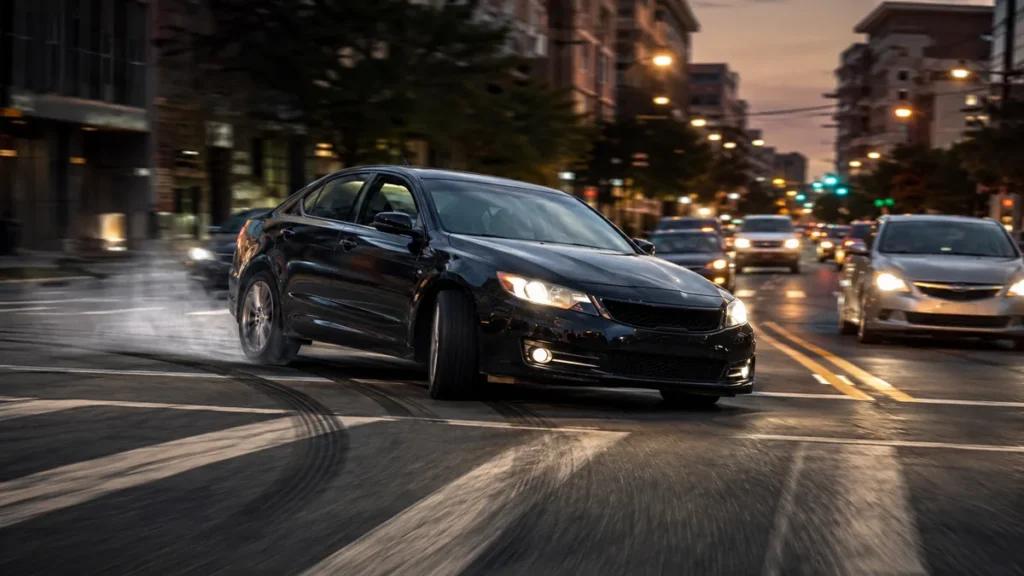
Most North Carolina drivers think a “reckless driving” charge is just a fancy traffic ticket. It isn’t. Under , reckless driving is a Class 2 misdemeanor — meaning a conviction goes on your permanent criminal record and can land you in jail for up to 60 days.
Key takeaways
| Point | Details |
|---|---|
| What it is | A Class 2 misdemeanor under . Not an infraction. It’s a criminal charge that creates a criminal record. |
| Two types | (a) “Carelessly and heedlessly in willful or wanton disregard” — § 20-140(a); (b) “Without due caution and circumspection… so as to endanger any person or property” — § 20-140(b). |
| Penalties | Up to 60 days in jail, fines up to $1,000+, 4 DMV license points, 4 SDIP insurance points (~80% premium increase). |
| Common triggers | Speeding 75+ mph in a 55 zone, racing, weaving aggressively through traffic, accidents with fault, driving while distracted to a dangerous degree. |
| Not just a traffic ticket | A reckless driving conviction shows up on standard background checks and can affect employment, CDL status, and immigration. |
What North Carolina law actually defines as reckless driving
Reckless driving in North Carolina is defined under , and the statute creates two distinct ways a driver can be charged:
(a) The “willful or wanton” version — § 20-140(a)
“Any person who drives any vehicle upon a highway or any public vehicular area carelessly and heedlessly in willful or wanton disregard of the rights or safety of others shall be guilty of reckless driving.”
This is the more serious version. The state must prove the driver knew their conduct created a high risk of harm and proceeded anyway. Common factual patterns:
- Street racing
- High-speed chases
- Drag racing in traffic
- Repeated aggressive cuts across lanes
- Driving the wrong way on a divided highway
(b) The “endangerment” version — § 20-140(b)
“Any person who drives any vehicle upon a highway or any public vehicular area without due caution and circumspection and at a speed or in a manner so as to endanger or be likely to endanger any person or property shall be guilty of reckless driving.”
This version doesn’t require willfulness — only that the manner of driving endangered (or was likely to endanger) others. Common factual patterns:
- Driving at very high speed in conditions that made it dangerous (rain, traffic, school zones)
- Causing an accident due to inattention
- Weaving through traffic at speed
- Driving with severely impaired sight (snow on windshield, etc.)
Both versions carry the same Class 2 misdemeanor penalty. The distinction matters at trial — § 20-140(b) is easier for the state to prove because it doesn’t require proof of willfulness.
Penalties — license, insurance, and criminal record consequences
A reckless driving conviction in North Carolina hits you in three separate ways simultaneously. Drivers often focus on only one and are blindsided by the others.
1. Criminal penalties
As a Class 2 misdemeanor, reckless driving carries:
| Sentence | Range |
|---|---|
| Jail time | Up to 60 days |
| Fine | Up to $1,000 (court’s discretion) |
| Court costs | Approximately $190–$250 |
| Probation | Possible, depending on prior record |
For a first-time offender with no criminal history, jail time is uncommon but legally available — and courts in Catawba, Burke, and Caldwell counties have imposed it in aggravated cases.
2. Driver’s license points
A reckless driving conviction adds 4 license points to your driving record under . Combined with any prior infractions, this can push a driver toward the 12-point threshold that triggers a 60-day license suspension.
3. Insurance (SDIP) points
This is where most drivers feel the worst pain. Reckless driving carries 4 SDIP points under the North Carolina Safe Driver Incentive Plan, which translates to roughly an 80% premium increase for three years. For a typical Hickory-area driver paying $1,500/year for auto insurance, that means:
| Year | Premium with SDIP surcharge |
|---|---|
| Year 1 (pre-conviction) | $1,500 |
| Year 1 (post-conviction) | ~$2,700 |
| Year 2 | ~$2,700 |
| Year 3 | ~$2,700 |
| Three-year total surcharge | ~$3,600 |
That $3,600 figure dwarfs the fine and court costs. For most drivers, the financial consequence of the insurance surcharge is the single biggest reason to fight a reckless driving charge.
4. Criminal record and background checks
Unlike a regular traffic infraction, a reckless driving conviction appears on:
- North Carolina court record searches
- Most employment background checks
- Federal background checks for jobs requiring security clearance
- CDL records (with serious consequences — see below)
- Immigration background checks (with potential consequences for non-citizens)
Pro Tip: If you’re a non-citizen, hold a CDL, work in a field with regulatory licensing (healthcare, finance, education), or have any pending applications that involve a background check, tell your attorney before you decide how to plead. A reckless driving conviction can have downstream consequences far beyond the courtroom that need to factor into your strategy.
When a traffic stop becomes a reckless driving charge
Officers in North Carolina have significant discretion in deciding whether to charge reckless driving alongside (or instead of) a speeding ticket. There’s no bright-line speed threshold that automatically triggers a reckless driving charge — but several patterns dramatically increase the odds:
Speed-related triggers
- Speeding 25+ mph over the posted limit — often charged as reckless driving instead of (or in addition to) speeding.
- Speeding 80+ mph regardless of the posted limit — common reckless trigger even in 65 or 70 zones.
- Speeding in school zones, work zones, or residential streets — context matters; 50 in a 25 will often draw reckless driving.
Behavior-related triggers
- Racing another vehicle (informally or via challenge)
- Repeatedly weaving across lanes at speed
- Following too closely combined with speed (tailgating)
- Passing on the right shoulder
- Passing illegally in a no-passing zone
- Aggressive lane changes that force other drivers to react
Accident-related triggers
- Causing an accident, especially with injury
- Single-vehicle accidents when the driver’s manner of driving caused the loss of control
- Hit-and-run scenarios that include reckless driving as an underlying charge
Court-area considerations
| Factor | Effect |
|---|---|
| First-time offender vs. prior record | Prior record significantly increases sentencing exposure |
| Accident with injuries | Reckless driving may be charged alongside more serious offenses |
| Defendant’s cooperation at the stop | Affects officer’s discretion |
| Local prosecutor’s office | Catawba, Burke, and Caldwell prosecutors differ on plea standards |
| Defense counsel involvement | Negotiated reductions are common with experienced defense |
Defending a reckless driving charge in NC
Reckless driving cases are defensible. Because the state has to prove either willful disregard (§ 20-140(a)) or endangering manner of driving (§ 20-140(b)), there’s often factual room to challenge the case. Common defenses include:
Challenging the underlying facts
- The officer’s speed measurement — radar calibration, training records, and methodology can all be challenged
- The “manner of driving” — the state has to prove the manner was reckless, not just the speed
- Witness testimony — passengers, dashcam, or other witness accounts may contradict the officer
Negotiating a charge reduction
Even without a trial, experienced defense counsel can often negotiate a reduction to a lesser charge — for example:
- Improper equipment (no points, no insurance points, but a conviction)
- A standard speeding ticket without the reckless driving element
- Careless and reckless driving (some prosecutors will plead this as a lesser charge)
Using a PJC (if available and strategic)
A Prayer for Judgment Continued is available for reckless driving (it’s a Class 2 misdemeanor, not a § 20-141 speeding charge over 25 mph, and not a DWI). If you haven’t used a PJC in the past three years on the same insurance policy, this can be a powerful tool — see our full guide on for details.
Strategic considerations
| If your facts include… | Then… |
|---|---|
| Accident with serious injury | Trial may be your best path; conviction has compound consequences |
| Speed alone (no other reckless conduct) | Often reducible to a regular speeding charge |
| CDL driver in commercial vehicle | Federal regulations limit options — fight the underlying charge, don’t accept a PJC |
| Prior reckless driving conviction within 5 years | Penalties escalate; aggressive defense becomes more important |
| No prior record, clean facts, no accident | Reduction or PJC often available |
Pro Tip: Don’t pay the citation and assume reckless driving will go away. Paying a citation in North Carolina is treated as an admission of guilt — for an infraction, that’s the end of it; for a Class 2 misdemeanor like reckless driving, paying triggers all of the consequences listed above. Always consult an attorney before paying any reckless driving citation.
Working with King & Rowe on reckless driving cases
Our office is at 2017 N Center Street in Hickory, ten minutes from the in Newton. King & Rowe handles reckless driving cases throughout Catawba, Burke, and Caldwell counties — and because reckless driving sits at the intersection of traffic law and criminal law, our and both apply.
When you bring us a reckless driving charge, we evaluate:
- The strength of the state’s case — radar evidence, officer testimony, witness statements, dashcam if available.
- Your driving record and criminal history — to determine what penalties you actually face and what plea options are realistic.
- Your insurance situation — particularly whether a PJC is available and worth using.
- Collateral consequences — CDL, employment, immigration, professional licensure.
- The local prosecutor’s typical posture — different prosecutors in different counties offer different plea standards.
Most reckless driving cases resolve through negotiation rather than trial, but the negotiation outcome depends heavily on early defense involvement. The earlier we get involved, the more we can shape the case.
Schedule a consultation
If you’ve been charged with reckless driving in Catawba, Burke, or Caldwell County, call King & Rowe at (828) 466-3858 to discuss your options. Don’t pay the citation. Don’t assume it’s “just a traffic ticket.” We represent drivers throughout the region — including in , , , and — and we appear at the on traffic and criminal calendars every week.
You can also reach us through our for a same-day response.
Frequently asked questions
What’s the difference between reckless driving and speeding in NC?
Speeding is an infraction (non-criminal). Reckless driving is a Class 2 misdemeanor — a criminal offense. A speeding ticket carries license points and insurance points; a reckless driving conviction adds those plus a criminal record, the possibility of jail, and a $1,000+ fine. Reckless driving can be charged alongside speeding, or instead of speeding, depending on the officer’s discretion.
How many points is a reckless driving conviction in NC?
A reckless driving conviction adds 4 DMV license points and 4 SDIP insurance points. The SDIP points typically translate to roughly an 80% increase in your auto insurance premium for three years.
Can a reckless driving charge be dismissed in NC?
It can — though dismissal is less common than a reduction to a lesser charge. Experienced defense counsel often negotiates reckless driving down to “improper equipment,” a regular speeding ticket, or “careless and reckless” depending on the prosecutor’s office and the facts. Outright dismissal usually requires a fundamental flaw in the state’s case (e.g., suppression of evidence or successful challenge to the officer’s basis for the stop).
Will a reckless driving conviction affect my CDL?
Yes — significantly. Under federal CDL regulations, reckless driving is one of the “serious traffic violations.” Two serious traffic violations in three years can result in a 60-day CDL disqualification; three in three years can result in a 120-day disqualification. CDL drivers cannot use a PJC to mask the conviction. If you hold a CDL and are charged with reckless driving, fighting the underlying charge or negotiating a non-reckless reduction is the only path that protects your commercial license.